
Content Silo Structure: Building Topical Authority for Medical SEO
A content silo structure organizes medical website content into thematic hubs, crucial for enhancing topical authority and patient acquisition in specialized healthcare. This strategic architecture helps search engines understand a site’s Expertise, Authoritativeness, and Trustworthiness (E-E-A-T), vital for Your Money Your Life (YMYL) medical information. Implementing a content silo structure improves user navigation and signals comprehensive coverage of specific medical specialties. It directly impacts visibility for targeted patient queries and reinforces clinic credibility by showcasing in-depth, accurate content.
Abdurrahman Şimşek, a Semantic SEO Strategist, specializes in building high-authority semantic content networks for medical clinics. His expertise focuses on optimizing website architecture and internal linking strategies to achieve superior topical relevance and E-E-A-T for healthcare providers.
To explore your options, contact us to schedule your consultation.
A content silo structure tailored for medical specialties enhances topical authority and patient acquisition in London’s private healthcare market. This site architecture helps search engines understand your Expertise, Authoritativeness, and Trustworthiness (E-E-A-T), which is critical for Your Money Your Life (YMYL) medical websites. Content organization directly impacts visibility and patient engagement.
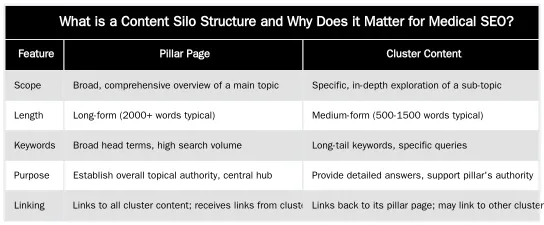
What is a Content Silo Structure and Why Does it Matter for Medical SEO?
A content silo structure organizes website content into distinct, thematically related categories, creating topical hubs. This arrangement signals a site’s topical depth to search engines, improving topical authority and user navigation. For medical websites, this organization establishes E-E-A-T and helps patients find relevant, trustworthy information efficiently.
Defining Physical vs. Virtual Silos for Clinic Websites
Content siloing can be physical or virtual. A physical silo uses URL structure to define categories (e.g., `yourclinic.com/plastic-surgery/facial-surgery/`), creating distinct directories. Virtual siloing uses internal linking to establish topical relationships with flat URLs (e.g., `yourclinic.com/facial-surgery-guide`). For medical clinics, a hybrid approach is often most effective, combining logical URL paths with strong internal linking to reinforce semantic connections.
The E-E-A-T and YMYL Advantage of Siloing
Demonstrating Expertise, Authoritativeness, and Trustworthiness (E-E-A-T) is critical for Your Money Your Life (YMYL) medical websites. A content silo structure contributes to E-E-A-T by showcasing comprehensive coverage of specific medical topics. Publishing in-depth, accurate content within a defined silo signals to search engines that the site is an authority on that subject. This structure builds patient trust, as visitors can navigate to detailed information, reinforcing the clinic’s credibility. For more on content organization, explore a content silo architecture guide.
How Do Content Silos Benefit Different Medical Specialties?
Content siloing benefits medical specialties by tailoring information to specific patient needs and procedural details. For a plastic surgery clinic, a silo might group all facial procedures, while a dermatology practice could organize content around skin conditions or aesthetic treatments. This specialization helps search engines recognize the clinic’s expertise, improving visibility for specific patient queries.
Tailoring Silos for Plastic Surgery, Dermatology, and Aesthetics
A plastic surgery clinic could use a silo structure with pillar pages for “Facial Surgery,” “Breast Augmentation,” and “Body Contouring” instead of a generic “Services” page. Under “Facial Surgery,” cluster content would detail procedures like “Rhinoplasty,” “Blepharoplasty,” and “Facelift,” each linking back to the “Facial Surgery” pillar. A dermatology clinic could have silos for “Acne Treatments,” “Anti-Aging Solutions,” or “Dermatological Conditions,” with supporting articles on specific therapies or diagnoses. This organization helps attract patients searching for precise treatments in London.
Enhancing User Navigation for Complex Medical Information
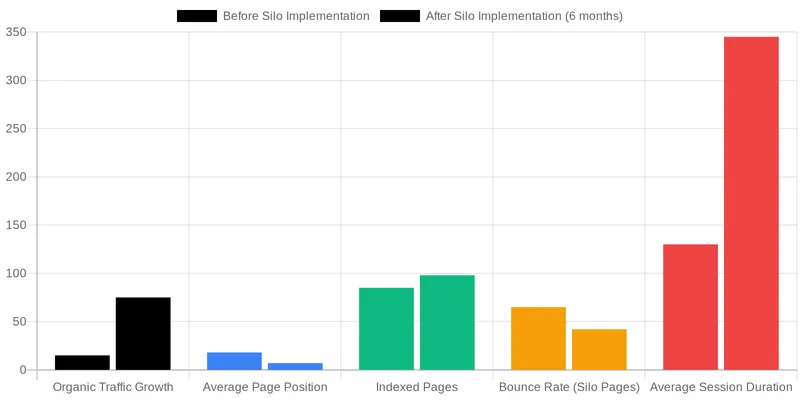
Patients often seek specific answers to intricate medical questions. A content silo simplifies the user journey with intuitive pathways. If a patient is researching “breast augmentation options,” they can navigate to the “Breast Augmentation” pillar page and explore related cluster content on “implant types,” “recovery timelines,” or “cost considerations.” This navigation reduces bounce rates and increases time on site, signaling a positive user experience to search engines. Patients find the information they need without navigating unrelated content, which fosters trust.
Building Your Medical Content Silo: A Step-by-Step Practical Guide
Building a content silo for a medical website requires planning and keyword categorization. The process involves identifying broad service categories for pillar pages and developing detailed supporting articles (cluster content). The goal is a clear hierarchy that guides search engines and patients. For a deeper understanding, explore building an E-E-A-T-driven internal linking architecture.
Identifying Core Services and Pillar Page Opportunities
First, use keyword research to identify high-volume, broad topics for your clinic’s core services. For a plastic surgeon, these might be “Rhinoplasty London,” “Breast Enlargement,” or “Liposuction.” These topics become your pillar pages, which are comprehensive guides to a procedure. They offer a high-level overview and link to detailed sub-topics. Developing these hubs is crucial for a pillar page SEO strategy.
Developing Cluster Content and Interlinking Strategies
After defining pillar pages, create cluster content articles that detail specific aspects of the pillar topic. For a “Rhinoplasty London” pillar, cluster content might include “Open vs. Closed Rhinoplasty,” “Rhinoplasty Recovery Timeline,” or “Cost of Nose Surgery in London.” Each cluster article should link back to its pillar page using semantically rich anchor text to reinforce the pillar’s authority. Learn more about building topic clusters.
Optimizing Internal Linking for E-E-A-T and Crawl Efficiency
Internal linking within a content silo is a cornerstone of semantic SEO for medical websites. It reinforces E-E-A-T signals, impacts Google’s understanding of entity relationships, and optimizes the Cost of Retrieval (CoR). Abdurrahman Şimşek’s semantic engineering work emphasizes that every link should guide users and search crawlers through the site’s topical network. This differentiates navigational links (for user experience) from contextual links (for semantic connections).
Strategic Internal Linking to Reinforce Topical Hubs
Internal links within a silo distribute link equity and establish semantic connections. Cluster pages should link to their pillar pages using descriptive, keyword-rich anchor text. For instance, an article on “Rhinoplasty recovery tips” should link to the “Rhinoplasty” pillar page with anchor text like “learn more about rhinoplasty procedures.” This strengthens the pillar page’s authority. Relevant cluster pages within the same silo can link to each other, creating a topical network. This linking is crucial for medical sites to demonstrate expertise.
Reducing Cost of Retrieval Through Efficient Site Architecture
Cost of Retrieval (CoR) is the resources Googlebot uses to crawl, process, and index a website. A content silo minimizes CoR with a clear site architecture. Hierarchical organization and efficient internal linking help Googlebot discover and understand page relationships. This reduces crawl effort, leading to more efficient indexing and potentially faster ranking. For a clinic with vast content, an optimized internal linking strategy, possibly using tools like Ruxi Data for internal linking automation, ensures important pages are crawled frequently without wasting crawl budget. Understanding crawl budget is key to technical SEO, as detailed by Google Search Central.
Auditing and Adapting Your Medical Content Silo Structure
A content silo requires regular auditing and refinement to maintain effectiveness and topical relevance. The medical field is dynamic, with new procedures, research, and patient queries emerging. Continuous improvement ensures your website remains an authority and adapts to search engine algorithms. This process involves identifying gaps, evaluating performance, and adjusting site architecture.
Identifying Topical Gaps and Opportunities for Expansion
Content audits identify where silos lack depth or where new medical advancements present expansion opportunities. Analyze search console data for queries your site almost ranks for, or research emerging trends in your medical specialty. If a plastic surgery clinic sees rising interest in “non-surgical facelift alternatives,” this could indicate a need for new cluster content or a new pillar page within an “Aesthetic Treatments” silo. This ensures your content remains comprehensive.
Pruning Ineffective Content and Consolidating Topics
Some content may become outdated, redundant, or underperforming. Addressing this “content rot” is crucial. Pruning involves updating and consolidating similar articles or removing content that no longer serves a purpose. For example, if multiple articles cover slightly different aspects of the same minor skin condition, consolidating them into one definitive guide strengthens topical focus. This process maintains content quality, prevents dilution of topical authority, and improves site health. Refer to Google’s advice on creating helpful, reliable content.
Conclusion
A planned content silo structure is essential for medical websites to achieve high organic visibility in 2026. Organizing content into topical hubs enhances E-E-A-T signals, improves user navigation, and optimizes crawl efficiency. This helps search engines understand your expertise and builds trust with patients. Regular auditing ensures the structure remains effective, solidifying your clinic’s authority. For guidance on developing a semantic content network for your London medical practice, visit abdurrahmansimsek.com.
Frequently Asked Questions
What is the first step to creating a content silo structure for a plastic surgery clinic?
The first step is to categorize your core services into broad specialties. For example, you might create top-level silos for ‘Facial Surgery,’ ‘Breast Surgery,’ and ‘Body Contouring.’ These categories will become the foundation of your pillar pages for your new content silo structure, guiding your content strategy.
How should pages be linked within a medical content silo structure?
All supporting ‘cluster’ pages should link up to their main ‘pillar’ page. The pillar page should also link down to its most important cluster pages, establishing clear topical relationships within the overall content silo structure. Cross-linking between different silos should be minimal and only when highly relevant to maintain structural integrity.
Should my URL structure reflect my content silos?
Yes, a physical silo where the URL structure reflects the hierarchy (e.g., domain.com/facial-surgery/rhinoplasty/) is highly recommended. This reinforces your site’s organization for search engines and users, making the topical relationships within your content architecture explicit.
How does a content silo structure improve the user experience?
A well-implemented content silo structure creates a logical and intuitive navigation path for patients. Users interested in a specific medical area can easily find all related content in one organized hub, from high-level guides to specific procedural details, which builds trust and keeps them engaged on your site longer.
Can a single blog post belong to more than one content silo?
It is best practice for a piece of content to live within one primary silo to maintain a clean architecture. If a topic is highly relevant to two silos, you can create a contextual internal link from the secondary silo to the article in its primary silo, rather than duplicating content or confusing the overall site structure.
How can medical clinics in London get started with implementing a content silo strategy?
Medical clinics, especially those in London’s Harley Street area, can begin by consulting with a specialist in semantic SEO. An expert can help audit existing content, identify core topical areas, and design a tailored content architecture to enhance E-E-A-T and attract more patients.
Ruxi Data brings together multi-model AI, automated website crawling, live indexation checks, topical authority mapping, E-E-A-T enrichment, schema generation, and full pipeline automation — from crawl to WordPress publish to social posting — all in one platform built for agencies and freelancers who run on results.