
Google Ads No Conversions: Optimizing Clinic Patient Acquisition
Many medical clinics experience google ads no conversions, where clicks fail to translate into booked patients. This article outlines critical reasons, including ad-to-landing page mismatches and weak E-E-A-T signals, which erode patient trust. It provides a conversion audit framework to optimize your patient booking funnel, enhance landing page effectiveness, and improve medical PPC performance. Understanding these factors is crucial for transforming ad spend into actual patient acquisition.
Abdurrahman Şimşek, a Semantic SEO Strategist, specializes in building high-converting websites and semantic content networks for medical clinics. His expertise helps healthcare providers optimize their digital presence to attract and convert high-value patients, ensuring advertising efforts yield tangible results.
To explore your options, contact us to schedule your consultation.
Many medical clinics find Google Ads generate clicks but fail to convert into patients, the problem of google ads no conversions. This article explains the reasons for this challenge and offers a conversion audit framework. It focuses on transforming clicks into booked appointments by addressing the unique challenges of the medical sector, ensuring your advertising budget yields patient acquisition.
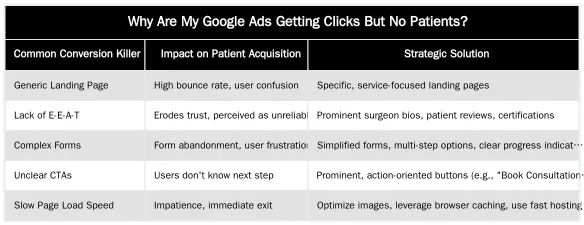
Why Are My Google Ads Getting Clicks But No Patients?
Google Ads clicks without conversions often stem from a disconnect between the ad promise and the user experience. Prospective patients click an ad expecting specific information or a clear path to booking; if the landing page fails to deliver, they disengage. This misalignment wastes ad spend and frustrates potential patients.
The Ad-to-Landing Page Mismatch Explained
A primary reason for high clicks and low conversions is a mismatch between the ad’s message and the landing page’s content. If an ad promises “London’s Best Lip Fillers” but the landing page is a generic homepage, users feel misled. For medical services, a contact form is rarely sufficient. Patients seek detailed information, reassurance, and clear next steps. The landing page must validate the ad’s claim and provide a clear path to booking an appointment.
Common Conversion Killers for Medical Clinics
Medical and aesthetic clinics face unique challenges that prevent Google Ads clicks from becoming patient bookings. These pitfalls relate to the sensitive nature of healthcare decisions and the trust required from prospective patients.
Weak E-E-A-T Signals & Trust Deficits
For Your Money or Your Life (YMYL) topics like health, Google emphasizes E-E-A-T: Expertise, Experience, Authoritativeness, and Trust. If a landing page lacks clear surgeon credentials, verifiable patient testimonials, or transparent medical information, patient confidence erodes. Prospective patients in competitive markets like London’s private healthcare need reassurance they are considering a qualified provider. A deficit in these signals leads to a high bounce rate and no conversions.
Ineffective Patient Booking Funnel Design
The patient booking funnel—the journey from Google Ads click to booked appointment—must be well-designed. Common issues include complex forms requiring too much personal information, unclear calls-to-action (CTAs), or a lack of immediate contact options. Patients often prefer to speak with someone directly for medical inquiries. If the funnel is a lengthy, impersonal process, they will likely abandon it. A clear patient journey with multiple contact points is necessary.
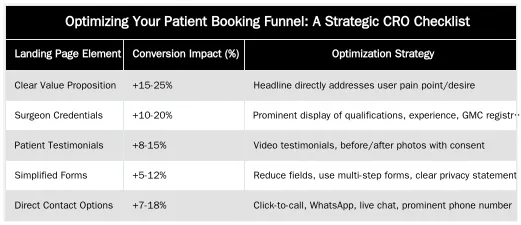
Optimizing Your Patient Booking Funnel: A Strategic CRO Checklist
Improving conversion rate optimization (CRO) for medical Google Ads requires focusing on key elements of your landing pages and ad campaigns to turn clicks into patient bookings.
High-Converting Medical Landing Page Elements
To optimize your landing page for conversions, include a clear value proposition that addresses the patient’s need. Prominently display surgeon bios, qualifications, and experience to build trust. Integrate patient testimonials and, where appropriate, before/after galleries. Provide clear pricing information (if applicable) and simple, concise forms. Offer direct contact options like phone numbers and live chat, as many patients prefer immediate communication for medical inquiries. Ensure mobile responsiveness, as much traffic comes from mobile devices.
Ad Copy & Quality Score Alignment for Patient Intent
Ad copy that matches patient search intent improves Quality Score and reduces cost per acquisition. Your ad text should mirror the language and services patients search for. For example, a search for “dermal fillers Harley Street” warrants ad copy that mentions “Dermal Fillers” and “Harley Street.” This alignment signals relevance to Google, boosting your Quality Score, which lowers bid costs and improves ad position. A higher Quality Score indicates a relevant ad-to-landing page experience, impacting your conversion rate.
Measuring Success: Tracking & Attributing Patient Leads
Accurate tracking and analytics are necessary to understand why Google Ads are not converting and to identify bottlenecks. Without measurement, optimizing campaigns is a guessing game. For medical practices, attributing patient leads to specific ad efforts is key to maximizing ROI.
Implementing Robust Call Tracking & Form Submissions
To track patient leads from Google Ads, implement call tracking. Use dynamic phone numbers on your website that change based on the ad source to see which campaigns, ad groups, and keywords generated calls. Ensure all form submissions are tracked as conversions in Google Analytics and Google Ads. This shows which ad interactions lead to inquiries. Google Tag Manager can help set up these conversion events, providing data on patient engagement.
Analyzing Cost Per Acquisition (CPA) for Medical Services
Optimizing your Cost Per Acquisition (CPA) is necessary for profitable patient acquisition. CPA is the total advertising cost divided by the number of new patients. For high-value medical procedures, a higher CPA may be acceptable if the patient’s lifetime value is high. Regularly review your CPA and conversion rates. A high CPA indicates inefficient ad spend, signaling a need to optimize ad targeting, landing page experience, or lead qualification. Refine campaigns to lower CPA while maintaining qualified leads. Resources like WordStream provide healthcare industry benchmarks to contextualize performance.
Transform Clicks into Patients: Your Next Steps
Fixing Google Ads that generate clicks but no conversions requires a data-driven approach for the medical sector. Generic PPC advice often fails to meet the trust and E-E-A-T requirements of healthcare. A conversion audit, optimized landing pages, refined ad copy, and accurate tracking can turn clicks into patient appointments. Partnering with an expert in medical digital marketing can improve conversion potential.
Frequently Asked Questions
How can a conversion audit help resolve google ads no conversions for my clinic?
A comprehensive conversion audit identifies the specific weak points in your ad campaigns and landing pages, from keyword targeting to user experience. By systematically addressing these issues, we transform clicks into actual patient bookings. This ensures your advertising budget delivers a strong return on investment.
My landing page has a contact form. Isn’t that enough to prevent google ads no conversions?
While a contact form is essential, a high-converting medical landing
Ruxi Data brings together multi-model AI, automated website crawling, live indexation checks, topical authority mapping, E-E-A-T enrichment, schema generation, and full pipeline automation — from crawl to WordPress publish to social posting — all in one platform built for agencies and freelancers who run on results.