
Website Migration SEO Checklist: Safeguarding Medical Clinic Visibility
A comprehensive website migration seo checklist is essential for medical clinics to prevent traffic loss and maintain E-E-A-T during significant site changes. This guide outlines critical technical SEO steps, from pre-launch planning and URL mapping to go-live execution and post-launch monitoring. It emphasizes managing 301 redirects, identifying crawl errors, and optimizing site architecture to ensure seamless transitions. Following a robust website migration seo checklist protects organic rankings and patient trust in the YMYL sector.
Abdurrahman Şimşek, a Semantic SEO Strategist specializing in London’s private healthcare, provides expert guidance on complex migrations. His 10+ years of experience ensure medical clinics maintain topical authority and robust online presence through meticulous technical SEO strategies.
To explore your options, contact us to schedule your consultation.
A website migration for a medical clinic requires a precise website migration SEO checklist to safeguard online visibility and patient trust. This guide provides London’s private healthcare providers a framework covering pre-launch preparations, go-live procedures, and post-launch monitoring. A successful transition prevents compromising organic rankings and maintains the E-E-A-T standards required in the YMYL (Your Money Your Life) sector.
What is a Website Migration and Why is SEO Crucial for Clinics?
A website migration involves significant changes to a site’s location, platform, structure, or content, impacting how search engines crawl and index it. For medical clinics, this process is critical due to the YMYL nature of their content, where accuracy and trustworthiness directly influence patient decisions and search engine rankings. Neglecting technical SEO during a migration can lead to traffic loss, diminished patient trust, and a decline in organic visibility.
Common migration types include changing domain names, moving to a new content management system (CMS), redesigning the site architecture, or consolidating multiple websites. Each type presents challenges that, if not addressed, can damage a clinic’s online presence. Search engines rely on consistent signals to understand a website’s authority and relevance. Disrupting these signals without planning can de-index pages, drop rankings, and reduce patient inquiries. For medical practices, maintaining E-E-A-T (Experience, Expertise, Authoritativeness, Trustworthiness) is critical, as a poor migration can undermine years of built credibility.
The Pre-Launch Website Migration SEO Checklist: Planning for Success
Before code changes or server moves, medical clinics must perform a pre-launch audit. This involves creating a content inventory, analyzing performance metrics, and establishing a strategy for the new site. Key steps include a full crawl of the existing site to identify all URLs, content assets, and internal linking structures. Documenting current organic rankings and traffic for critical pages provides a baseline for post-migration comparison.
A staging environment is essential for testing the new site before it goes live. This allows a pre-launch SEO review to ensure all technical elements are configured. This minimizes risks and identifies issues that could impact search performance. For clinics, this includes verifying that medical disclaimers, privacy policies, and appointment booking functionalities are operational and accessible to users and search engine crawlers.
Crafting Your URL Map and 301 Redirect Strategy
A critical component of any migration is URL mapping and 301 redirect implementation. A URL map is a spreadsheet listing every old URL and its corresponding new URL. This 1:1 mapping directs search engines and users from old content to its new location, preserving link equity and preventing broken links.
Implementing 301 redirects (permanent redirects) correctly is vital for maintaining SEO value. Incorrectly implemented redirects, or missing redirects for high-value pages, can lead to significant ranking drops. Tools can assist in generating these maps, but manual verification is often necessary for complex sites. For large-scale migrations, consider exploring automated redirect management solutions to ensure precision and scalability.
Staging Site SEO Audit: Catching Errors Before Go-Live
A staging site provides a safe environment to test the new website before it is publicly accessible. A technical SEO audit on the staging site should verify crawlability, indexability, `robots.txt` and `noindex` tag configurations (ensuring essential pages are not blocked), and canonical tags. Review the internal linking structure for logical flow and link equity distribution across the new site architecture.
For YMYL content, specific checks involve verifying the integrity of medical information, author profiles, and patient testimonials. Assess Core Web Vitals, mobile-friendliness, and accessibility. A technical SEO audit on the staging site identifies broken links, duplicate content, and other technical errors that could hinder post-launch search performance.
Go-Live Day: Executing Your Technical SEO Migration Plan
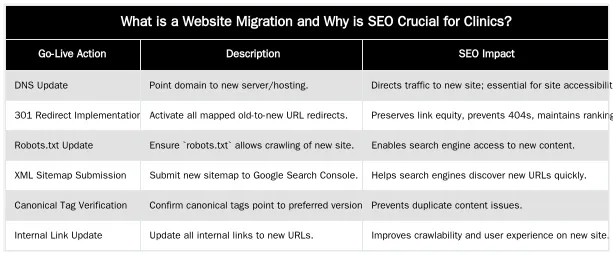
Go-live day requires precise execution of planned migration steps. Any misstep can have immediate consequences for search visibility. A timeline and dedicated team are essential. Primary actions include updating DNS records to point to the new server, implementing all 301 redirects, and updating internal links to the new URL structure.
After the new site is live, immediately verify server responses and site functionality. Check for 404 errors, ensure pages load correctly, and confirm forms and interactive elements are operational. For medical clinics, patient booking systems and emergency contact information must be verified instantly. The table below outlines key go-live actions and their importance:
Immediate Post-Launch Verifications and Checks
Immediately after going live, verify that the server responds with 200 OK status codes for live pages and that 301 redirects return a 301 status for old URLs. Check the `robots.txt` file to confirm it is not blocking crawlers. Submit the new XML sitemap to Google Search Console. Review canonical tags on key pages to ensure they point to the correct versions. Test site functionality, including navigation and forms, across browsers and devices. This speed is crucial for medical sites to minimize disruption to patient access.
Beyond the Launch: Post-Migration Monitoring and Recovery for Medical Sites
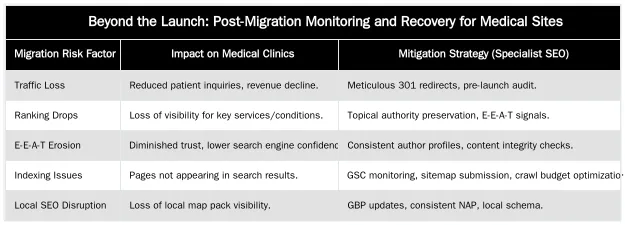
Post-launch monitoring is ongoing, especially for medical clinics where trust and visibility are critical. Monitoring helps identify and resolve issues quickly, minimizing negative impact on rankings and patient engagement. Track key performance indicators (KPIs) and respond to anomalies. For YMYL sites, any dip in performance can directly affect patient acquisition and clinic reputation.
Check for crawl errors, indexing issues, and changes in organic traffic. Analyzing traffic loss patterns can pinpoint areas requiring attention, such as specific content categories or geographic regions. Recovery tactics might involve refining redirect chains, optimizing new content, or addressing technical debt. Leverage the migration for long-term semantic growth.
Leveraging Google Search Console for Rapid Issue Detection
Google Search Console (GSC) is an indispensable tool for post-migration monitoring. The Coverage report helps identify indexing issues, such as pages excluded or encountering errors. The Performance report tracks organic traffic, impressions, and click-through rates, allowing for comparison against pre-migration data. The Crawl Stats report provides insights into Googlebot’s activity on the new site, indicating if it’s being crawled efficiently.
Immediately after go-live, submit your new XML sitemap through GSC to expedite indexing. Use the URL Inspection tool to request re-indexing for critical pages. Monitor the Core Web Vitals report to ensure the new site meets performance benchmarks. Any sudden drop in impressions or clicks, or an increase in crawl errors, signals an issue that requires immediate investigation and resolution.
Addressing Local SEO Impact and Google Business Profile
For medical clinics in competitive locations like Harley Street, local SEO drives patient appointments. A website migration can impact local rankings. Ensure your Google Business Profile (GBP) is updated with any new address, phone number, or website URL. Consistency across online directories (citations) is crucial. Verify the new website’s location pages are optimized with accurate schema markup for local businesses.
Monitor local search results for your clinic’s primary services and location-specific keywords. Discrepancies between your website and GBP listing can confuse search engines and reduce local visibility. Update all relevant local listings to reflect the new site, reinforcing your clinic’s presence in key London postcodes.
Why Specialist Medical SEO Expertise is Non-Negotiable for Migrations
General SEO advice is insufficient for medical clinics due to the YMYL sector’s regulatory, ethical, and E-E-A-T requirements. A specialist in medical SEO and semantic engineering understands these nuances, making a migration a strategic opportunity. With over 10 years of experience, Abdurrahman Şimşek specializes in building high-authority semantic content networks for medical clinics, plastic surgeons, and aesthetic practices in London.
This expertise extends beyond redirects, focusing on maintaining a clinic’s topical authority and entity recognition during the transition. Cost of Retrieval (CoR) optimization ensures search engines can efficiently process and rank the new site’s content, preserving its value. A specialist aligns the migration with long-term semantic growth strategies, not just loss prevention. For clinics in Harley Street and London, partnering with an SEO strategist specializing in semantic SEO and web design for plastic surgeons is essential for local search.
Safeguarding E-E-A-T and Topical Authority During Transition
A semantic SEO strategist ensures a migration preserves a clinic’s E-E-A-T signals. This involves structuring content, representing entities (e.g., medical conditions, treatments, practitioners), and using internal linking to reinforce topical clusters. A migration risks fragmenting topical authority if content is restructured without semantic foresight. A specialist ensures the new site architecture groups related content, maintaining signals of expertise and authoritativeness.
For YMYL content, this means verifying author bios are displayed and linked, medical claims are supported by reputable sources (e.g., NHS, WHO, peer-reviewed journals), and patient testimonials are ethically integrated. The goal is a stronger semantic content network, reinforcing the clinic’s authority. This approach to E-E-A-T and topical authority is crucial for success in the London private healthcare market.
Ready for a Seamless Migration? Partner with a Semantic SEO Expert
A website migration for a medical clinic is complex and carries risks if not managed by experts. This website migration SEO checklist is a roadmap, but specialized knowledge is essential. Don’t risk your rankings, patient trust, and online authority. Partner with Abdurrahman Şimşek, a London-based Semantic SEO Strategist with 10 years of experience, specializing in private healthcare. His expertise in semantic engineering and YMYL optimization makes your migration a catalyst for growth. Secure your clinic’s digital future and topical authority. Contact Abdurrahman Şimşek today for a strategic consultation.
Frequently Asked Questions
What is the single biggest risk during a website migration for a clinic, and how does a website migration SEO checklist mitigate it?
The biggest risk is a significant loss of organic rankings and patient traffic due to improper 301 redirect implementation. Failing to correctly map every old URL to its new equivalent signals to Google that pages are gone, effectively erasing accumulated SEO equity. A comprehensive website migration SEO checklist ensures meticulous planning and execution of these redirects, safeguarding your online visibility.
What is a URL map and why is it essential for a successful site transition?
A URL map is a crucial spreadsheet documenting every old URL and its corresponding new URL. This document serves as the blueprint for your 301 redirect strategy, ensuring search engines and users are seamlessly directed to the correct new pages. It is the most critical piece of a successful migration, preventing broken links and preserving link equity.
When should an SEO specialist be involved in a website redesign project for a medical clinic?
An SEO specialist should be involved from the project’s inception, ideally before any design or development work begins. Their early input is vital for defining site architecture, URL structures, and technical requirements that align with SEO best practices. This proactive approach, guided by a thorough website migration SEO checklist, ensures the new site is built for optimal search engine performance from day one.
What are the key things to check immediately after the new medical clinic site goes live?
Immediately post-launch, it’s crucial to verify several technical elements. Confirm that analytics tracking is active, all 301 redirects are functioning correctly, and the robots.txt file isn’t inadvertently blocking search engine crawlers. Additionally, ensure your XML sitemap has been submitted to Google Search Console and is free of errors.
Is a temporary drop in organic traffic normal after a website migration?
A minor, temporary fluctuation in traffic and rankings can be expected as search engines re-crawl and re-index the new site structure. However, a significant and sustained drop (e.g., more than 15-20% over several weeks) indicates a serious technical issue with the migration. Such declines require immediate diagnosis and remediation to prevent long-term damage to your online presence.
How can medical clinics ensure a seamless and SEO-friendly website migration?
To ensure a seamless and SEO-friendly website migration, medical clinics should partner with a specialist in medical SEO and semantic engineering. Experts like Abdurrahman Şimşek offer comprehensive strategic consulting, leveraging a robust website migration SEO checklist to manage every technical detail. This specialized guidance safeguards your online visibility and patient acquisition during critical transitions.
Ruxi Data brings together multi-model AI, automated website crawling, live indexation checks, topical authority mapping, E-E-A-T enrichment, schema generation, and full pipeline automation — from crawl to WordPress publish to social posting — all in one platform built for agencies and freelancers who run on results.