
Video Hosting Vs Embedding: Optimizing Video SEO for Medical Clinics
Understanding video hosting vs embedding is crucial for medical clinics aiming to enhance video SEO performance and patient engagement. This article details how each method impacts Core Web Vitals, page load speed, and overall search visibility. It explores the control gained through self-hosting or premium platforms like Wistia and Vimeo Pro, contrasting it with the convenience and limitations of YouTube embedding. Learn to strategically leverage video for topical authority and E-E-A-T signals, ensuring your patient education content effectively reaches its target audience while reinforcing your domain’s expertise.
Abdurrahman Şimşek, a Semantic SEO Strategist, provides expert recommendations for medical clinics and plastic surgeons. His 10+ years of experience in semantic engineering and medical SEO guide strategies for optimal video content configuration, enhancing topical authority and E-E-A-T within the YMYL search landscape.
To explore your options, contact us to schedule your consultation.
For London’s medical clinics and plastic surgeons, video content optimization impacts patient education and search visibility. This guide compares video hosting vs embedding to inform a strategy for video SEO performance, patient engagement, topical authority, and E-E-A-T signals.
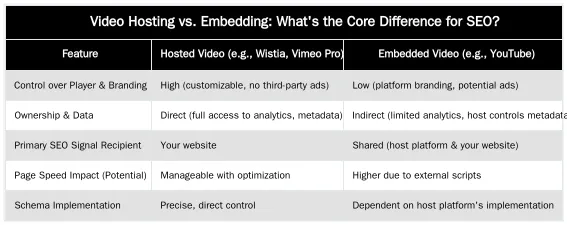
Video Hosting vs. Embedding: What’s the Core Difference for SEO?
The distinction between video hosting and embedding for SEO is control and origin. Video hosting is uploading files to a platform you manage or a dedicated service, granting control over metadata and delivery. Embedding displays a video hosted elsewhere (like YouTube) on your site, relying on the external platform’s infrastructure and SEO signals.
Understanding Hosted Video for Medical Content
Hosted video is content uploaded to a platform like Wistia, Vimeo Pro, or a self-hosted server. It provides direct ownership and control over the video file and its data. For medical clinics, this allows player customization, removal of third-party branding, and precise metadata management. This control maintains brand consistency and ensures all SEO signals point to your domain, reinforcing your site’s authority for surgical procedures and patient education.
The Mechanics of Embedded Video on Clinic Websites
Embedded video is a code snippet (typically an iframe) from an external platform placed on your website. The video appears on your site but streams from the host’s servers. This method is convenient but relinquishes control. The external platform dictates the player’s appearance, advertising, and how search engines interpret its relevance. For medical websites, this can dilute on-site SEO efforts, as some search signals may be attributed to the external host instead of your clinic’s domain.
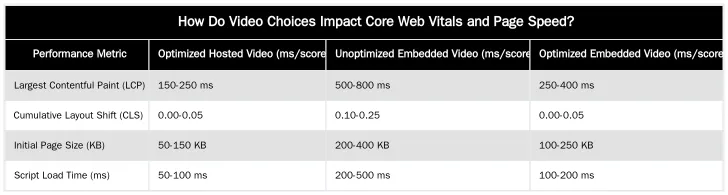
How Do Video Choices Impact Core Web Vitals and Page Speed?
Video delivery method influences a website’s Core Web Vitals, particularly Largest Contentful Paint (LCP) and Cumulative Layout Shift (CLS). Heavy video players, unoptimized scripts, and delayed loading can slow page speed, harming user experience and search rankings. For medical websites, where patient information must be accessible quickly, optimizing video performance is critical.
Minimizing Page Load Speed with Lazy Loading for Videos
Lazy loading mitigates the performance impact of hosted and embedded videos. It defers loading videos until they enter the user’s viewport, reducing initial page weight, improving LCP, and conserving bandwidth. Lazy loading all video content is foundational for optimizing Core Web Vitals. For more on optimizing imagery, refer to our guide on Lazy Loading vs. Eager Loading: Which is Better for Medical Imagery?
Analyzing the Impact of YouTube Embeds on LCP and CLS
YouTube embeds, while convenient, often introduce render-blocking JavaScript and CSS that can delay LCP. The dynamic nature of YouTube players can cause layout shifts (CLS) as the player loads or resizes, especially if dimensions are not explicitly defined. To optimize YouTube embeds, use a lightweight placeholder image that loads quickly, swapping it with the iframe on user interaction. This, combined with explicit width and height attributes, helps maintain layout stability and improve LCP scores. This is part of achieving optimal Core Web Vitals for Surgeons.
YouTube Embedding: When is it a Viable Strategy for Medical Clinics?
While direct video management offers superior SEO control, embedding YouTube videos is common due to its ease of use and audience reach. Medical clinics must know when this is viable and how to mitigate its SEO drawbacks. YouTube is a powerful distribution channel, but its website integration requires care to avoid undermining on-site SEO goals.
Balancing YouTube’s Reach with On-Site SEO Goals
YouTube’s user base offers brand awareness and a way to reach new patients. For supplementary content like health tips, testimonials, or less critical explainer videos, embedding from YouTube can be practical. The goal is to leverage YouTube’s search engine for discovery, driving traffic to your channel or website. However, for core surgical procedure videos or essential patient education, where direct SEO control and performance are critical, relying on YouTube embeds is not optimal.
Best Practices for Embedding YouTube Videos Without Hurting SEO
To minimize the negative SEO impact of YouTube embeds, implement lazy loading for iframes to prevent them from blocking initial page rendering. Use YouTube’s privacy-enhanced mode (youtube-nocookie.com) to reduce tracking scripts. Contextualize the video on your page with relevant text, headings, and surrounding content. This helps search engines understand the video’s relevance, even if SEO signals are shared with YouTube. Also, use a custom thumbnail that loads quickly, replacing it with the YouTube player on user interaction.
Expert Recommendations: Optimizing Video for Semantic SEO and E-E-A-T
Semantic SEO Strategist Abdurrahman Şimşek emphasizes that video content choices are integral to a broader semantic SEO and E-E-A-T strategy. The goal is building topical authority and establishing trust with search engines and patients. This requires an approach to video content that includes its technical setup and contextual integration within your website’s content network.
Aligning Video Strategy with Your Semantic Content Network
Video content, whether hosted or embedded, must be integrated into your clinic’s semantic content network. Each video should serve a purpose within a topic cluster, reinforcing the authority of core service pages. For instance, a rhinoplasty video should link to and be linked from the main rhinoplasty service page, related blog posts, and surgeon bio pages. This interconnectedness helps search engines understand your expertise and reduces the Cost of Retrieval for relevant information, boosting your site’s topical authority. The video delivery choice should support this network and prevent signal dilution.
Enhancing E-E-A-T Signals Through Surgical Video Optimization
Technically optimized surgical videos and patient education content are strong E-E-A-T (Experience, Expertise, Authoritativeness, Trustworthiness) signals for medical websites. A consultant surgeon presenting a procedure on video showcases their expertise and experience. Proper attribution, including the surgeon’s name, qualifications, and clinic details, is necessary. Implementing VideoObject schema with accurate details about the medical professional and procedure strengthens these signals. For example, stating the surgeon’s name in the video description and schema provides verifiable information to search engines, contributing to the content’s and clinic’s trustworthiness. Google’s Quality Rater Guidelines emphasize E-E-A-T for YMYL (Your Money Your Life) topics, so this optimization is critical for medical practices.
Choosing Your Video Strategy: A Decision Framework for Surgeons
Selecting a video content strategy for a medical clinic involves weighing factors against goals and resources. The ideal choice depends on priorities regarding control, performance, cost, and audience reach. This framework helps clinic owners and marketing managers decide on video content delivery.
Key Factors: Control, Performance, Cost, and Audience Reach
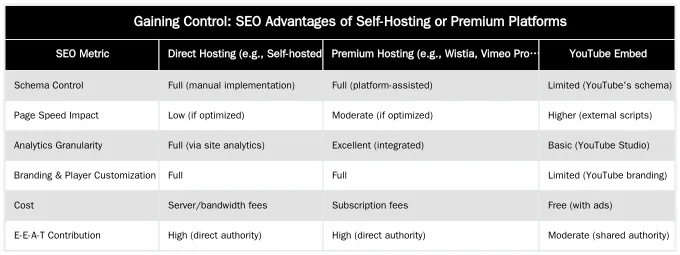
When deciding between direct video management and embedding, consider these factors. Control is the ability to customize the player, manage metadata, and prevent third-party advertising. Performance is how videos impact page load speed and Core Web Vitals. Cost includes subscription fees for premium platforms or server costs for self-hosting. Audience Reach is the potential for discovery on platforms like YouTube versus on-site engagement. For critical surgical videos and patient education, prioritizing control and performance yields better SEO outcomes. For brand awareness or supplementary content, leveraging YouTube’s reach may be more appropriate.
Comparative Analysis: Hosted vs. Embedded Video for Medical SEO
This table compares how different video delivery methods perform against key SEO metrics.
Future-Proof Your Clinic’s Video SEO with a Strategic Partner
Optimizing video for medical SEO requires technical expertise, knowledge of semantic principles, and E-E-A-T in healthcare. A video strategy can enhance patient engagement, search visibility, and topical authority. The complexities of hosting vs. embedding, schema, and performance optimization may require a specialist to ensure video content performs optimally in search.
Conclusion
The choice between video hosting and embedding is a strategic decision impacting your clinic’s SEO, patient education, and digital presence. While YouTube embedding offers convenience and reach, direct hosting or premium services provide superior control over SEO, page speed, and branding—critical for building E-E-A-T and topical authority. By considering your goals and implementing best practices like lazy loading and VideoObject schema, you can ensure your video content contributes to your clinic’s success. For guidance on optimizing your video strategy and building a semantic content network, explore how Abdurrahman Şimşek can assist your London practice at abdurrahmansimsek.com.
Frequently Asked Questions
What are the core differences in SEO impact when considering video hosting vs embedding for a medical clinic’s website?
The fundamental difference lies in control and attribution. Hosting a video on your own domain or a dedicated platform gives you direct control over metadata, schema, and analytics, allowing SEO equity to accrue to your site. Embedding, typically from platforms like YouTube, means the video’s primary SEO benefit often goes to the source platform, though it can still enhance user engagement on your page.
How does the choice between video hosting vs embedding impact Core Web Vitals for a medical procedure page?
The choice significantly affects Core Web Vitals. Unoptimized embedded videos, especially from third-party platforms, can negatively impact Largest Contentful Paint (LCP) and Cumulative Layout Shift (CLS) due to external scripts and large file sizes. Strategic video hosting vs embedding with lazy loading and optimized formats is crucial to maintain fast page speeds and a smooth user experience, which are vital for SEO.
For high-value YMYL content like surgical explainer videos, what is the recommended strategy regarding video hosting vs embedding?
For critical YMYL content such as surgical explainer videos, professional hosting is generally recommended over embedding. This approach provides superior control over branding, lead generation integrations, and ensures that the video’s SEO equity directly benefits your domain. It reinforces your E-E-A-T signals by keeping the valuable content directly associated with your clinic’s authority.
What are the main SEO advantages of using a professional video platform like Wistia compared to embedding from YouTube?
Professional platforms offer greater SEO control. They allow for direct implementation of VideoObject schema markup on your domain, detailed analytics, and customizable players that align with your brand. This helps Google attribute the video’s authority and relevance directly to your clinic’s website, enhancing your topical authority.
Can embedding a video still help my clinic achieve rich snippets in Google Search results?
Yes, it is possible to achieve video rich snippets even with embedded videos, but it requires careful implementation. You must manually add VideoObject schema markup to the page where the video is embedded. Professional hosting platforms often automate this process, increasing your chances of securing these valuable search enhancements.
How can Abdurrahman Şimşek help my London clinic optimize its video strategy for SEO and E-E-A-T?
Abdurrahman Şimşek, a London-based Semantic SEO Strategist, specializes in building high-authority Semantic Content Networks for medical clinics. He can assess your current video strategy, recommend optimal hosting or embedding solutions, and implement advanced schema markup to enhance your video SEO performance and E-E-A-T signals. Contact us to discuss a tailored strategy for your Harley Street clinic.
Ruxi Data brings together multi-model AI, automated website crawling, live indexation checks, topical authority mapping, E-E-A-T enrichment, schema generation, and full pipeline automation — from crawl to WordPress publish to social posting — all in one platform built for agencies and freelancers who run on results.