
Page Speed Audit Checklist: Optimizing Medical Site Performance
A page speed audit checklist provides a structured framework for medical websites to identify and resolve performance bottlenecks. This guide details essential steps for optimizing site loading times, crucial for patient trust and search engine visibility. It covers technical SEO audit elements like Core Web Vitals, reducing TTFB, and effective image compression. Implementing this page speed audit checklist enhances user experience, strengthens E-E-A-T signals, and supports high-value patient acquisition goals for medical clinics.
Abdurrahman Şimşek, a Semantic SEO Strategist, specializes in technical web development and holistic SEO for medical clinics. His expertise focuses on building high-authority semantic content networks and optimizing YMYL sites for superior performance and trust.
To explore your options, contact us to schedule your consultation.
For London’s private healthcare sector, a page speed audit checklist is essential for patient trust, search engine visibility, and practice growth. This guide provides a framework for medical websites to identify and resolve performance bottlenecks. Optimizing site loading times enhances user experience, strengthens E-E-A-T signals, and supports high-value patient acquisition goals.
What is a Page Speed Audit and Why it’s Critical for Medical Websites?
A page speed audit is a systematic evaluation of a website’s loading performance, identifying factors that slow page rendering and user interaction. For medical websites, slow loading times can erode patient trust, diminish perceived professionalism, and impact search engine rankings. Patients seeking urgent information or sensitive procedures require immediate access to content, making site speed a contributor to user experience and E-E-A-T signals.
Medical sites often feature high-resolution imagery, procedure explanations, and video testimonials that can impede performance if not optimized. A performance review ensures these elements load efficiently, maintaining a trustworthy experience for prospective patients. This supports building a semantic content network for medical clinics, where each page contributes to authority and user satisfaction.
The First Step: Establishing Your Performance Baseline
Establish a performance baseline before implementing changes by running key pages—homepage, primary procedure pages, and image galleries—through diagnostic tools. Focus on metrics like Core Web Vitals (Largest Contentful Paint, First Input Delay, Cumulative Layout Shift), Time to First Byte (TTFB), and Speed Index. Documenting these initial scores provides a benchmark to measure improvements. For a deeper understanding of these metrics, refer to our guide on Core Web Vitals for Surgeons.
Key Metrics & Tools: Understanding Your Medical Site’s Performance
Website performance metrics are crucial for medical sites aiming for high search rankings and patient engagement. SEO emphasizes user-centric metrics like Google’s Core Web Vitals. These signals reflect perceived speed, responsiveness, and visual stability, which is important for medical content.
Decoding Core Web Vitals for Patient-Centric Design
Core Web Vitals — Largest Contentful Paint (LCP), First Input Delay (FID), and Cumulative Layout Shift (CLS) — are vital for medical websites. LCP measures the loading of the largest content element, like a hero image on a procedure page, impacting a patient’s initial impression. A slow LCP can suggest a dated or unreliable practice. FID quantifies responsiveness for interactions with contact forms or navigation. CLS measures visual stability, preventing content shifts while a patient reads about a procedure or browses a gallery. High scores in these areas reinforce a clinic’s professionalism and trustworthiness. Explore specific strategies for LCP optimization in our article on achieving a sub-2.0s LCP on procedure pages.
Essential Tools for Comprehensive Speed Analysis
Several tools offer insights into medical site performance. Google PageSpeed Insights provides lab and field data with actionable recommendations. Lighthouse, in Chrome DevTools, audits performance, accessibility, SEO, and best practices. GTmetrix provides a waterfall chart to visualize loading sequences and identify bottlenecks. WebPageTest allows testing from various locations and devices to simulate patient experiences. Using these tools collectively provides a complete view of your site’s speed profile.
The Technical Page Speed Audit Checklist for Medical Sites
Optimizing a medical website’s speed requires addressing key technical areas. This performance review focuses on common causes of slow loading times and provides actionable steps. This checklist helps clinics improve their online presence and patient experience.
Optimizing High-Resolution Medical Imagery and Videos
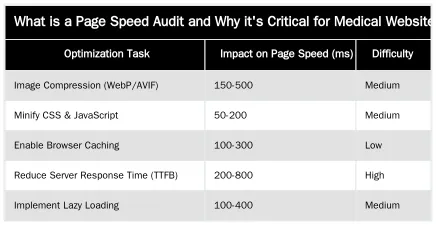
Medical websites for plastic surgeons and aesthetic clinics rely on ‘before and after’ galleries and video testimonials. These assets educate patients and build trust but can harm performance. Compress images by converting them to modern formats like WebP or AVIF to reduce file sizes without losing quality. Implementing lazy loading ensures images and videos only load when they enter the viewport, reducing initial page load times. Serving responsive images tailored to the user’s device prevents unnecessary bandwidth consumption.
Streamlining Code: Minify CSS, JavaScript, and Eliminate Render-Blocking Resources
Excessive or unoptimized code can delay a page’s rendering. Minify CSS and JavaScript files by removing unnecessary characters, comments, and whitespace without altering functionality. Eliminate render-blocking resources, which are scripts or stylesheets that prevent the browser from rendering content until they are processed. Techniques include deferring JavaScript execution until after critical content has loaded or asynchronously loading non-essential scripts. Prioritizing the critical rendering path ensures important visual elements appear quickly, improving perceived performance.
| Optimization Method | Benefit | Best Use Case |
|---|---|---|
| Image Compression | Reduced file sizes, faster downloads | High-resolution ‘before & after’ galleries |
| Code Minification | Smaller file sizes for CSS/JS, faster parsing | Complex websites with many scripts/styles |
| Browser Caching | Faster repeat visits for users | Sites with frequent returning patients |
| Content Delivery Network (CDN) | Faster content delivery globally | Clinics serving a wide geographical patient base |
| Lazy Loading | Prioritizes visible content, reduces initial load | Pages with extensive image/video content below the fold |
Server Response & Infrastructure: Reducing TTFB and Leveraging CDNs
A fast medical website requires a fast server infrastructure, as a slow server can negate front-end optimizations. Server-side optimizations are crucial for a rapid initial response, impacting user perception and search engine crawl efficiency.
Diagnosing and Reducing Time to First Byte (TTFB)
Time to First Byte (TTFB) measures the time for a browser to receive the first byte of a response from the server. A high TTFB indicates server-side issues like slow database queries, inefficient code (e.g., unoptimized PHP or Python), or inadequate hosting. To reduce TTFB, upgrade hosting, optimize database queries, implement server-side caching, and ensure efficient application code. For London-based clinics, a server geographically close to the target audience can improve TTFB.
Implementing Browser Caching and Content Delivery Networks (CDNs)
Browser caching instructs a user’s browser to store static assets (images, CSS, JavaScript) locally. On subsequent visits, the browser loads these resources from the local cache instead of the server, resulting in faster repeat page loads. Enabling browser caching is an effective optimization. For clinics serving a geographically diverse patient base, a Content Delivery Network (CDN) is essential. A CDN stores copies of your site’s static content on servers distributed globally. The CDN delivers content from the server closest to the user, reducing latency and improving loading speeds. Providers like Cloudflare offer CDN services that can benefit medical sites.
Beyond the Checklist: Advanced Page Speed Strategies for Elite Medical Practices
Medical practices in competitive markets like London require advanced strategies. Performance optimization should be integrated into a technical SEO framework, considering how speed impacts user experience, search engine crawlability, and digital asset efficiency.
Integrating Page Speed with a Holistic Technical SEO Framework
Page speed is a component of technical SEO. A fast website improves crawl budget efficiency, allowing search engines to index more content. It also signals site health and quality, important for YMYL (Your Money Your Life) websites. Integrating speed optimization with site architecture, schema markup, and internal linking creates a foundation for a semantic content network. This ensures every technical aspect contributes to authority and visibility.
The ‘Cost of Retrieval’ and Its Impact on Medical Site Performance
‘Cost of Retrieval’ (CoR) is the resources (time, bandwidth, processing power) search engines use to crawl, render, and understand a website. For complex medical websites, CoR can be high. Optimizing page speed reduces this cost. A faster site allows Googlebot to process more pages with the same resources, improving indexing and rankings. This is relevant for clinics in competitive markets like London. Minimizing CoR makes a site more appealing to search engines, enhancing its ability to rank for medical queries. Dive deeper into this concept with our articles on reducing Cost of Retrieval for SEO and conducting a Cost of Retrieval audit.
Measuring Success: What to Expect After Optimizing Your Medical Site’s Speed
Speed optimization yields benefits beyond technical scores. After optimization, Core Web Vitals should improve to ‘Good’ ratings. This correlates with better search engine visibility, as Google prioritizes fast sites. A faster site reduces bounce rates and improves user experience, fostering trust and engagement.
Translating Speed Improvements into Patient Acquisition
The goal of medical website optimization is to attract and convert patients. A faster website improves organic search rankings, increases click-through rates, and simplifies the path to booking a consultation. A fast, responsive site reflects positively on the clinic. This can lead to higher conversion rates, more phone calls, and more patient acquisitions for your London practice. Speed is a differentiator in private healthcare.
Accelerate Your Practice: Partner with a Specialist in Medical Site Performance
Optimizing a medical website requires knowledge of technical SEO and healthcare. For London clinics seeking to improve local search, patient trust, and conversion rates, expert assistance can help. Abdurrahman Şimşek provides Semantic Content Networks and technical SEO for medical clinics, skin clinics, and plastic surgeons. Partner with a strategist who understands the London private healthcare market to improve your website’s performance. Learn how a dedicated approach to website performance can elevate your practice at abdurrahmansimsek.com.
Conclusion
A website performance review is essential for medical practices. Addressing image optimization, code minification, server response times, and CDN implementation enhances a clinic’s online presence. Benefits include improved patient experience, stronger E-E-A-T signals, and increased patient acquisition. Prioritizing site speed supports a semantic content network and ensures a medical website remains competitive and trustworthy in the London market. For tailored strategies, consider partnering with a specialist in medical SEO and web development.
Frequently Asked Questions
What is the first step in a page speed audit checklist for a medical site?
The initial step involves establishing a performance baseline. You should run key pages, such as the homepage, procedure pages, and gallery, through tools like Google PageSpeed Insights, GTmetrix, and WebPageTest. This provides crucial initial scores for Core Web Vitals, Time to First Byte (TTFB), and other essential metrics before any optimizations are made.
Why is auditing image optimization so critical for surgeon websites?
Surgeon websites frequently feature high-resolution ‘before and after’ images, which are often the primary cause of slow load times if not optimized. A comprehensive page speed audit checklist is essential to ensure these images are properly compressed, correctly dimensioned, and utilize modern formats like WebP. This optimization significantly improves loading speed without compromising visual quality.
What does ‘eliminating render-blocking resources’ mean in a technical performance review?
This refers to identifying and addressing CSS and JavaScript files that prevent the browser from rendering the visible content of a webpage until they are fully downloaded and processed. A thorough page speed audit checklist should include checks to defer non-critical CSS and JavaScript or load them asynchronously. This strategy allows the browser to display content faster, improving perceived performance.
How do I check for effective caching during a website performance assessment?
To verify effective caching, you can use your browser’s Developer Tools, specifically the Network tab, or a dedicated speed testing tool. Look for specific response headers like `cache-control` or `expires` for your site’s static assets. These headers instruct the browser to store files locally, which significantly reduces load times for repeat visitors.
Beyond Core Web Vitals, what is another key metric in a site speed evaluation?
Time to First Byte (TTFB) is a crucial metric on any page speed audit checklist, measuring the duration until the browser receives the first byte of data from your server. A high TTFB, typically over 600ms, often signals a server-side problem, such as slow hosting or inefficient database queries. Addressing TTFB issues at the source is vital for overall site performance.
How can Abdurrahman Şimşek help medical practices with their site performance after a page speed audit checklist?
Abdurrahman Şimşek specializes in holistic SEO strategies for medical clinics, encompassing critical technical optimizations like page speed. Following a comprehensive page speed audit checklist, he provides actionable implementation plans tailored to your practice. This ensures your London private healthcare site achieves optimal loading times, enhancing patient engagement and strengthening E-E-A-T signals for improved organic growth.
Ruxi Data brings together multi-model AI, automated website crawling, live indexation checks, topical authority mapping, E-E-A-T enrichment, schema generation, and full pipeline automation — from crawl to WordPress publish to social posting — all in one platform built for agencies and freelancers who run on results.