URL Structure Site Architecture: Optimizing for SEO & User Experience
A well-designed url structure site architecture is fundamental for digital presence, directly impacting search engine visibility and user navigation. This article details how a logical URL hierarchy enhances crawlability, improves information architecture, and supports semantic SEO efforts. Strategic URL design, including semantic URLs and SEO-friendly patterns, is crucial for building topical authority and delivering a superior user experience. It guides both search engine bots and human visitors efficiently through your content, ensuring discoverability and comprehension of your site’s offerings.
Abdurrahman Şimşek, a Semantic SEO Strategist with over 10 years of experience, specializes in leveraging precise information architecture to build high-authority content networks. His expertise focuses on optimizing complex site structures for medical clinics and plastic surgeons, ensuring robust digital foundations.
To explore your options, contact us to schedule your consultation. You can also reach us via: Book a Semantic SEO Audit, Direct WhatsApp Strategy Line: +90 506 206 86 86
A url structure site architecture is foundational to site architecture, search engine optimization (SEO), and user navigation. Strategic URL design impacts crawlability, user experience, and site performance. A logical structure guides visitors and search engine bots, ensuring content is discoverable and understood.
What is URL Structure and Why is it Critical for Site Architecture?
URL structure is the organization of a site’s web addresses into a logical hierarchy that reflects its content. This structure dictates how easily users and search engine crawlers can navigate and comprehend the site. A well-organized URL path provides context about a page’s topic and its relationship to other content, making it a fundamental component of site architecture.
Defining URL Structure and Site Architecture
URL structure is the design of a site’s Uniform Resource Locators, including elements like domain, subdomains, subdirectories, and file names. Site architecture is the blueprint of a website, detailing how its pages are organized, linked, and presented. The two are linked; a logical URL structure supports a clear site architecture, making content discoverable. For medical websites, a clear structure supports patient trust and information accessibility. For more detailed best practices, review URL Structure Best Practices for Medical Websites.
How Does URL Structure Influence SEO, Crawlability, and User Experience?
URL construction impacts a site’s search visibility and user interaction. A logical, descriptive URL structure helps search engines discover and index pages and provides a clear navigation path for visitors, improving search rankings and user satisfaction.
Enhancing Search Engine Crawlability and Indexing
Clear, hierarchical URLs guide search engine crawlers like Googlebot through a site’s content efficiently. Logically organized URLs help crawlers understand page relationships and the site’s topical relevance. This improves content discovery and indexing and prevents duplicate content issues. Concise URLs with relevant keywords signal the page’s subject matter to search engines, aiding categorization and ranking.
Improving User Navigation and Engagement
Descriptive URLs give users context, indicating page content before they click. This builds trust and reduces uncertainty. On complex sites like medical websites, a clear URL path aids breadcrumb navigation, helping users understand their location in the site hierarchy. This reduces bounce rates and encourages engagement by making information easier to find.
Crafting SEO-Friendly URLs: Best Practices for Semantic Clarity
Effective URLs prioritize search engine readability and user comprehension. Semantic URLs communicate content, integrate keywords, and maintain site-wide consistency, making them meaningful content indicators, not just addresses.
Key Principles for Semantic and User-Friendly URLs
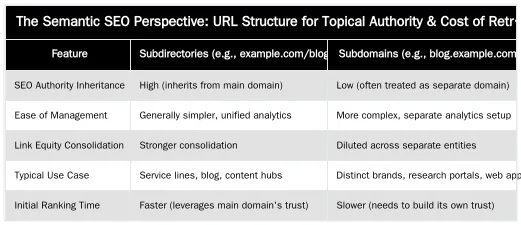
Semantic URLs are concise, descriptive, and use hyphens to separate words for human and search engine readability. They should include relevant keywords reflecting page content, avoiding generic terms or number strings. Using lowercase letters and omitting stop words (e.g., “a,” “the,” “and”) creates cleaner URLs. A URL should hint at the page’s topic, even out of context.
Handling URL Parameters and Canonicalization
Dynamic URLs from filters or sorting options can include parameters (e.g., `?color=blue&size=large`). These can cause duplicate content issues if unmanaged. Canonical tags specify the preferred page version to search engines, consolidating link equity and preventing indexing problems. This is important for e-commerce or large content hubs. Efficient management contributes to Reducing Cost of Retrieval for search engines and improves crawl budget efficiency.
Subdirectories vs. Subdomains: Strategic Choices for Site Architecture
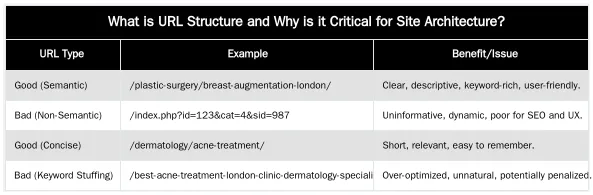
Choosing between subdirectories (e.g., `example.com/blog/`) and subdomains (e.g., `blog.example.com/`) is a critical site architecture decision. This choice has SEO implications for how search engines attribute authority and relevance. Understanding these differences is vital for structuring a site, especially for medical clinics.
Understanding the SEO Impact of Each Structure
Search engines generally treat subdirectories as part of the main domain, letting them inherit its authority and link equity. This helps consolidate SEO efforts. Subdomains are often treated as separate websites. They must build their own authority, which can dilute the main domain’s SEO power. The choice impacts link equity flow and perceived topical relevance across site sections.
Making the Right Choice for Medical Websites
Medical clinics usually prefer subdirectories for service lines or content hubs (e.g., `/plastic-surgery/`, `/dermatology/`, `/blog/`). This consolidates authority under the main domain, strengthening its topical authority for medical queries. Subdomains can be used for distinct brands, research portals, or applications needing separate branding and SEO (e.g., `research.clinicname.com`). For most London aesthetic clinics, a subdirectory approach within a semantic content network is more effective.
Implementing and Auditing Your URL Structure for Long-Term Success
An optimal URL structure requires planning, implementation, and monitoring. A structured approach ensures changes enhance SEO value. Auditing and migration strategies are key to site health and performance.
Tools and Techniques for URL Audits
Regular URL audits identify issues like broken links, redirect chains, and non-SEO-friendly URLs. Tools like Google Search Console provide insights into indexing status and crawl errors. Site crawlers like Screaming Frog or Ahrefs analyze URL patterns, identify duplicate content, and map the site hierarchy. This analysis ensures consistency with best practices for technical SEO.
Managing URL Migrations and Redirects Effectively
Migrating a site or restructuring URLs requires a plan to avoid losing SEO value. The critical step is implementing 301 redirects from old to new URLs. This signals to search engines that the content has permanently moved, preserving link equity. Updating all internal links to the new URLs is also vital. Post-migration, monitor crawl errors, indexation, and organic traffic in Google Search Console to address issues and ensure sustained performance.
Ready to Optimize Your Site’s Foundation? Partner with a Semantic SEO Expert
A URL structure and site architecture are fundamental to a successful online presence. For London medical clinics, plastic surgeons, and aesthetic practices, an optimized url structure site architecture enhances visibility, patient acquisition, and digital authority. Semantic SEO principles ensure your website communicates clearly with search engines and prospective patients.
Elevate Your Online Presence with Strategic Site Architecture
A clear, semantic URL structure improves SEO performance, user experience, and patient bookings. As a London-based Semantic SEO Strategist with 10 years of experience, I build high-authority Semantic Content Networks for medical professionals. My expertise makes your site architecture an asset for growth in competitive markets like Harley Street.
Book a Semantic SEO Audit to assess your site architecture. For immediate strategic discussion, reach out via Direct WhatsApp Strategy Line: +90 506 206 86 86.
Frequently Asked Questions
What is the primary role of url structure site architecture?
The primary role of a well-defined url structure site architecture is to establish a logical, hierarchical path for both users and search engine crawlers. This organization makes content discoverable and understandable, significantly impacting crawl efficiency, user experience, and overall site performance.
How does an effective URL organization improve user navigation?
An effective URL organization acts as a clear digital signpost, guiding users through the website and indicating their current location within the site’s hierarchy. Intuitive URLs, like `/procedures/face/rhinoplasty/`, enhance user experience by making it easier to find relevant information and understand the site’s content structure.
How can a suboptimal url structure site architecture negatively affect SEO, especially for medical websites?
A suboptimal url structure site architecture can severely hinder SEO by creating crawlability issues, diluting link equity, and leading to duplicate content problems. For critical YMYL (Your Money Your Life) medical sites, a confusing structure erodes trust and makes it harder for search engines to accurately assess content authority.
Is it beneficial to include keywords in my URLs for optimizing url structure site architecture?
Yes, incorporating relevant keywords into your URL slugs is a recommended practice for optimizing your url structure site architecture. It provides immediate context to both search engines and users about the page’s content, contributing to better click-through rates and a clearer understanding of the page’s topic.
What is the distinction between subdirectories and subdomains in web organization?
A subdirectory (e.g., `yoursite.com/blog`) is a folder within your primary domain, which consolidates SEO authority and link equity under one root. Conversely, a subdomain (e.g., `blog.yoursite.com`) is often treated by search engines as a distinct entity, potentially fragmenting your site’s overall authority and requiring separate SEO efforts.
How can I get expert help to optimize my site’s URL structure and architecture?
To ensure your website’s foundation is robust and SEO-friendly, consider partnering with a semantic SEO expert. You can book a Semantic SEO Audit directly at abdurrahmansimsek.com/contact/ or reach out via WhatsApp for strategic guidance.
Ruxi Data brings together multi-model AI, automated website crawling, live indexation checks, topical authority mapping, E-E-A-T enrichment, schema generation, and full pipeline automation — from crawl to WordPress publish to social posting — all in one platform built for agencies and freelancers who run on results.