
Schema for Medical Procedures: Enhancing E-e-a-t & Visibility
Implementing schema for medical procedures is crucial for enhancing visibility and establishing E-E-A-T in search results. This article details how to leverage structured data, specifically the MedicalProcedure schema, to explicitly mark up ‘candidate suitability’ using `indication` and `contraindication` properties, and ‘expected results’ through `outcome` and `description`. By defining these critical entity attributes, medical practices provide clear, machine-readable information to search engines, improving rich snippet presence and preparing content for generative AI overviews. This precise application of schema for medical procedures strengthens credibility for YMYL content.
Abdurrahman Şimşek, a Semantic SEO Strategist, specializes in building high-authority semantic content networks for medical clinics. His expertise in Medical SEO and Entity-Attribute-Value (EAV) modeling ensures precise structured data implementation, critical for YMYL content and establishing E-E-A-T signals.
To explore your options, contact us to schedule your consultation. You can also reach us via: Book a Semantic SEO Audit, Direct WhatsApp Strategy Line: +90 506 206 86 86
Implementing schema for medical procedures enhances visibility and establishes authority in search results. This guide explains how to use structured data to mark up ‘candidate suitability’ and ‘expected results,’ strengthening E-E-A-T signals. Defining these entity attributes improves a medical practice’s presence in rich snippets and prepares for generative AI search. These principles provide clear, machine-readable information to search engines.
What is MedicalProcedure Schema and Why is it Critical for YMYL?
MedicalProcedure schema is structured data markup describing medical and surgical procedures to search engines. It provides explicit, machine-readable details about treatments, including their indications, outcomes, and potential risks. It is critical for Your Money Your Life (YMYL) content. This schema helps Google understand medical services, supporting the assessment of Expertise, Experience, Authoritativeness, and Trustworthiness (E-E-A-T).
For YMYL content, structured data confirms on-page information. Stating that a procedure is performed by a board-certified surgeon, detailing its steps, and outlining recovery times provides verifiable signals. This clarity reduces ambiguity for search algorithms evaluating medical source credibility. Accurate markup helps search engines present content as a reliable medical source.
The Role of Structured Data in Establishing E-E-A-T for Medical Content
`MedicalProcedure` schema enhances E-E-A-T signals with machine-readable facts about procedures and the expertise behind them. Marking up details like the performing physician, medical specialty, and scientific references provides evidence of authority and trustworthiness. This data helps search engines connect the procedure to qualified entities, such as GMC-registered consultant surgeons, reinforcing credibility. For more on implementing advanced medical schema, see advanced medical schema for entity recognition.
Marking Up ‘Candidate Suitability’ with MedicalProcedure Schema
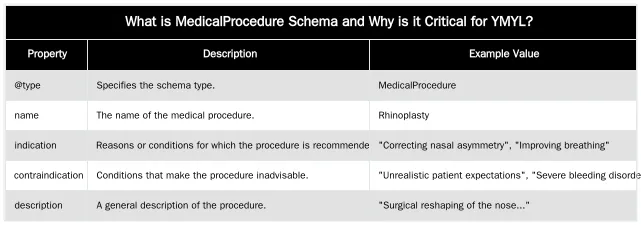
`MedicalProcedure` schema uses `indication` and `contraindication` properties to define candidate suitability. `indication` specifies the conditions or reasons a procedure is recommended, outlining who benefits. `contraindication` identifies factors that make a procedure inadvisable, safeguarding patient health and managing expectations. The `description` property can add details on patient profiles or lifestyle factors.
For rhinoplasty, `indication` could include “correcting nasal asymmetry” or “improving breathing difficulties.” `contraindication` could list “unrealistic patient expectations” or “underlying health conditions.” Structuring this information provides transparent guidance to search engines and patients about eligibility criteria. This attracts qualified leads and reduces inquiries from unsuitable candidates.
Leveraging ‘Indication’ and ‘Contraindication’ Properties
`MedicalProcedure` schema’s `indication` and `contraindication` properties state who is suitable for a procedure. These properties help search engines categorize and present medical treatment information. A search for “who is suitable for a facelift” could pull from `indication` markup for a concise answer in search results. This benefits patients with immediate information and strengthens Google’s semantic understanding of the content. It helps the right patients find the right procedures, aligning with ethical medical marketing.
Defining ‘Expected Results’ and ‘Outcomes’ for Medical Procedures
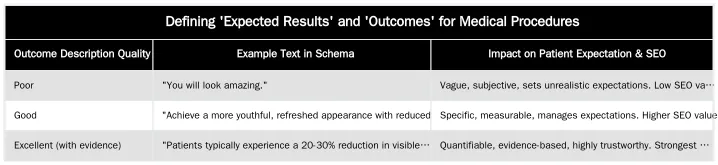
`MedicalProcedure` schema’s `outcome` property describes anticipated treatment results. It communicates realistic post-procedure expectations. Outcome data should be clear, evidence-based, and compliant with medical advertising guidelines. Specify measurable improvements, not vague promises. This transparency builds trust and helps patients make informed decisions.
For complex procedures, the `outcome` property can link to pages with detailed explanations, including galleries, recovery timelines, and result variations. The schema provides a summary for search engines, while users can access comprehensive information. Accurate outcome descriptions contribute to rich snippet eligibility, like patient reviews or procedure details, enhancing search visibility.
Structuring Outcome Data for Clarity and Rich Snippets
Structure the `outcome` property with descriptive text highlighting benefits and typical results. For a breast augmentation, the outcome could describe “increased breast volume and improved contour” instead of “larger breasts.” For more detail, link to a page or use a nested `WebPageElement` or `CreativeWork`. This helps search engines and patients understand the procedure’s advantages. Comprehensive guidance on how to structure all medical procedure pages, including outcome sections, is available.
Beyond Basics: Advanced Schema for Entity-Attribute-Value (EAV) Modeling
Entity-Attribute-Value (EAV) modeling is a framework for representing complex medical information. It treats information as an attribute of an entity, allowing for granular data structures. For medical procedures, EAV defines attributes without direct schema.org properties, like ‘anesthesia type,’ ‘recovery time,’ ‘associated risks,’ or ‘pre-operative instructions.’ Abdurrahman Şimşek’s semantic engineering approach uses EAV to create a representation of medical entities for Google’s Knowledge Graph.
This is crucial for clinics in competitive markets like London. Defining every procedure attribute, from implant materials to surgical techniques, provides search engines with more detail. This structured data improves Google’s understanding of medical entities, increasing the likelihood of accurate retrieval and prominent display in search results. Integrating EAV with platforms like Ruxi Data automates and scales this process.
Integrating EAV with MedicalProcedure Schema for Granular Detail
Integrating EAV with `MedicalProcedure` schema defines specific procedure attributes, enriching the data model. For example, EAV can specify `outcome: expectedDuration`, `outcome: typicalImprovementPercentage`, or `outcome: potentialComplications`. This detail makes the schema more comprehensive for Google’s Knowledge Graph, enabling search engines to answer specific patient questions from your site’s data. This semantic understanding is a cornerstone of the EAV model for surgical procedures, making every facet of a procedure machine-readable.
A `MedicalProcedure` for “Liposuction” could have these EAV attributes:
- `anesthesiaType`: “Local with sedation”
- `recoveryTime`: “1-2 weeks for initial swelling, 3-6 months for full results”
- `associatedRisks`: “Bruising, swelling, temporary numbness”
- `postProcedureCare`: “Compression garment for 4-6 weeks”
This detail provides a complete picture of the procedure.
How Precise Schema Impacts Rich Snippets and Generative AI Overviews
Detailed `MedicalProcedure` schema impacts search visibility through rich snippets and Generative AI Overviews. Rich snippets (e.g., FAQs, how-to guides, review stars) are enhanced search results that can increase click-through rates. Explicit structured data increases eligibility for these displays. For example, `Review` schema for patient testimonials can show star ratings in the SERP.
As search engines adopt Generative Engine Optimization (GEO) and AI Overviews, structured data becomes more critical. AI summaries rely on understanding entities and their attributes. Precise `MedicalProcedure` schema and semantic HTML feed Google’s AI models factual information, making it more likely your content will be sourced for AI-generated answers. This positions your practice as an authority, influencing patient acquisition.
Optimizing for AI Overviews with Semantic HTML and Structured Data
Semantic HTML combined with JSON-LD schema makes content digestible for AI models, increasing the likelihood of being featured in AI Overviews. Semantic HTML tags (“, `
Future-Proof Your Medical SEO: Partner with a Semantic Strategist
Implementing advanced structured data and semantic engineering for medical websites is a specialized task requiring deep expertise. Abdurrahman Şimşek, a London-based Semantic SEO Strategist with over 10 years of experience, specializes in building Semantic Content Networks for medical clinics, skin clinics, and plastic surgeons. His approach, using Ruxi Data, creates websites resilient to algorithm updates and optimized for generative AI search. A specialist can help your clinic improve local organic search across Harley Street and premium London postcodes, attracting high-value patients through a data-driven strategy. Book a Semantic SEO Audit to transform your digital presence. Direct WhatsApp Strategy Line: +90 506 206 86 86.
Conclusion
Schema for medical procedures is a requirement for medical practices seeking visibility and authority. Marking up information like ‘candidate suitability’ and ‘expected results’ enhances E-E-A-T signals, improves rich snippet eligibility, and optimizes for AI Overviews. This semantic precision ensures search engines understand, trust, and prioritize medical content for relevant patient queries. For London-based plastic surgeons and aesthetic clinic owners, a strategic approach to structured data is necessary to improve local organic search. Reach out to Abdurrahman Şimşek. Book a Semantic SEO Audit, or connect via Direct WhatsApp Strategy Line: +90 506 206 86 86.
Frequently Asked Questions
What is the recommended schema for medical procedures to mark up ‘candidate suitability’?
The `MedicalProcedure` schema type is ideal for marking up ‘candidate suitability’. You can effectively use properties like `description` or `indication` to detail who is an appropriate candidate for a specific treatment. This explicit definition is a key aspect of schema for medical procedures, enhancing clarity for both users and search engines.
How can I use schema for medical procedures to specify ‘expected results’ for a treatment?
Within your `MedicalProcedure` structured data, the `outcome` property is specifically designed for specifying ‘expected results’. It allows you to clearly describe the typical outcomes patients can anticipate from a procedure. This transparency, facilitated by schema for medical procedures, builds trust and provides valuable, machine-readable information about the treatment’s efficacy.
Does implementing schema for medical procedures guarantee rich snippets in search results?
While implementing schema for medical procedures doesn’t guarantee rich snippets, it is a crucial prerequisite. Proper and comprehensive structured data significantly increases the likelihood of Google displaying these enhanced search results. This improved visibility can attract more qualified traffic to your medical practice.
Which structured data format is best for marking up medical procedures?
Google strongly recommends using JSON-LD for structured data, including medical procedure markup. It is generally easier to implement and maintain compared to Microdata, as it can be placed separately in the “ or “ of your HTML. This separation simplifies managing complex information without altering the visible content.
How does detailed structured data benefit visibility in AI Overviews for medical content?
Detailed structured data, by explicitly defining key attributes like procedure suitability and expected results, makes your content highly machine-readable. This allows Google’s Generative Experience to confidently extract and present this critical information directly in AI Overviews. It positions your practice as an authoritative source, enhancing your presence in emerging search interfaces.
How can medical clinics get expert help with implementing advanced structured data?
Medical clinics seeking to implement advanced structured data and semantic SEO strategies can partner with an expert. Abdurrahman Şimşek offers specialized consulting for medical practices, focusing on building high-authority semantic content networks. You can book a Semantic SEO Audit to get started.
Ruxi Data brings together multi-model AI, automated website crawling, live indexation checks, topical authority mapping, E-E-A-T enrichment, schema generation, and full pipeline automation — from crawl to WordPress publish to social posting — all in one platform built for agencies and freelancers who run on results.