
automating Topical Maps: Enhancing Plastic Surgery SEO With Ruxi Data
Automating topical maps revolutionizes content strategy for plastic surgeons by systematically building comprehensive topical authority. This article details a workflow leveraging Ruxi Data to streamline content brief generation and optimize content architecture. It explains how to move beyond traditional keyword research to develop a robust semantic content network, ensuring complete coverage of patient queries and clinical topics. This approach enhances online visibility, improves search rankings, and establishes deep expertise, crucial for attracting high-value patients in competitive medical markets.
Abdurrahman Şimşek, a Semantic SEO Strategist with over a decade of experience, specializes in building high-authority semantic content networks for medical clinics. His expertise in information retrieval and entity-attribute-value modeling ensures precise content configuration, particularly for the YMYL search landscape.
To explore your options, contact us to schedule your consultation.
Discover how automating topical maps with Ruxi Data can revolutionize content strategy for plastic surgeons, enhancing online visibility and establishing deep topical authority. This guide outlines a powerful workflow to streamline content creation, improve search rankings, and attract high-value patients by leveraging advanced semantic SEO techniques. For medical practices in competitive markets like Harley Street, a structured approach to content architecture is essential for demonstrating expertise and trustworthiness to both search engines and prospective patients.
What are Automated Topical Maps and Why Do Plastic Surgeons Need Them?
Automated topical maps are structured frameworks that comprehensively outline all relevant sub-topics, entities, and questions surrounding a core subject. For plastic surgeons, these maps ensure complete coverage of patient queries and clinical topics, signaling deep expertise to search engines. Unlike traditional keyword research, which often focuses on isolated terms, a topical map builds a holistic understanding of an entire subject area, crucial for establishing authority in the medical field.
Plastic surgeons operate in a highly competitive and sensitive niche, where patient trust and clinical accuracy are paramount. Search engines prioritize content from authoritative sources, especially for ‘Your Money Your Life’ (YMYL) topics like medical procedures. An automated approach to mapping topics allows practices to systematically address every facet of a procedure, from patient education and recovery protocols to potential risks and benefits, ensuring no critical information is overlooked.
Understanding Topical Authority in Medical SEO
Topical authority is paramount for YMYL content, particularly for plastic surgery, as it signals expertise, experience, authoritativeness, and trustworthiness (E-E-A-T) to search engines. When a plastic surgery practice consistently publishes comprehensive, accurate content across an entire topic cluster, search engines recognize it as a leading authority. This recognition translates into higher rankings, increased organic visibility, and ultimately, more qualified patient inquiries. Building this authority requires a systematic approach to content planning and execution, which automated topic cluster generation facilitates. Learn more about building plastic surgery topical authority.
How Ruxi Data Powers Automated Topical Map Generation
Ruxi Data initiates the generation of semantic content networks by performing in-depth analysis of Search Engine Results Pages (SERPs). For a specific plastic surgery procedure, such as “rhinoplasty London,” Ruxi Data deconstructs the top-ranking content. This process identifies the core entities, related sub-topics, common patient questions, and the semantic relationships between them. This data forms the foundational blueprint for a comprehensive topic cluster, ensuring that every piece of content contributes to a cohesive knowledge base.
The system then transforms this raw data into a structured format, enabling the creation of detailed content briefs. This automation ensures that content development is guided by actual search intent and competitive landscape analysis, rather than assumptions. The result is a highly relevant and authoritative content strategy designed to capture diverse patient queries and establish a strong online presence for medical practices.
From SERP Analysis to Entity-Attribute-Value (EAV) Models
Ruxi Data’s methodology involves analyzing top-ranking content to identify key entities, their attributes, and associated values. For instance, for the entity “Rhinoplasty,” attributes might include “procedure type,” “recovery time,” “cost,” and “surgeon qualifications.” The values would then be specific details for each attribute. This Entity-Attribute-Value (EAV) modeling creates a structured knowledge base, forming the backbone of a robust content architecture. EAV models allow for flexible and detailed representation of complex medical information, ensuring that every piece of data is categorized and linked semantically. This structured approach is critical for search engines to understand the depth and breadth of a practice’s expertise.
Constructing Your Semantic Content Network for Plastic Surgery
The extracted entities and their relationships are then used to construct a comprehensive semantic content network. This network maps out how different plastic surgery procedures, conditions, and related terms interconnect. For example, “breast augmentation” might link to “silicone implants,” “saline implants,” “recovery after breast surgery,” and “choosing a plastic surgeon.” This interconnected web of content ensures that all relevant sub-topics for plastic surgery procedures are covered exhaustively. A well-built semantic content network not only improves search engine understanding but also enhances user experience by providing clear pathways to related information, establishing the practice as a definitive resource. Explore semantic content network design for plastic surgeons.
Implementing Your Automated Topical Map Workflow for Clinical Content
Integrating an automated topic cluster workflow with Ruxi Data provides plastic surgeons and their marketing teams with a systematic approach to content creation. The process begins with identifying a core service or procedure, such as “facelift surgery in London.” Ruxi Data then generates a comprehensive map of related topics and sub-topics, along with specific content brief generation for each. These briefs include target entities, semantic keywords, desired content length, and even suggested internal linking structures. This structured input ensures that every piece of content is strategically aligned with the overall topical authority goals, saving significant time in research and planning.
The workflow also accounts for the unique requirements of medical content, emphasizing accuracy and patient safety. By providing a clear framework, practices can efficiently produce high-quality, informative content that resonates with both search engines and prospective patients seeking reliable information about complex procedures.
Ensuring Clinical Accuracy with Content Configuration
Clinical accuracy is non-negotiable for medical content. Automated content briefs can be tailored to include specific clinical guidelines, regulatory requirements, and expert input from GMC-registered consultant surgeons. This content configuration ensures that while the topic identification and structuring are automated, the factual medical details are rigorously vetted. The briefs can prompt writers to cite authoritative medical sources, include disclaimers where necessary, and focus on patient-centric information. This blend of automation and expert oversight maintains the highest standards of E-E-A-T, crucial for building trust in the sensitive field of plastic surgery. Understand content configuration for medical SEO.
Scaling Content Production with Generative Engine Optimization (GEO)
The automated topical map facilitates efficient content brief generation, enabling scalable content creation through human writers or AI-assisted tools. This approach, often termed Generative Engine Optimization (GEO), ensures that content production can keep pace with the demands of a comprehensive semantic content network. Each brief acts as a precise instruction set, guiding content creators to produce high-quality, relevant, and SEO-optimized articles that fit seamlessly into the overall topical strategy. This scalability is vital for plastic surgeons aiming to dominate search results across numerous procedures and locations, such as Harley Street, Marylebone, and Chelsea, without compromising on quality or clinical integrity.
Leveraging Semantic Engineering for Unrivaled Plastic Surgery SEO
Abdurrahman Şimşek, a London-based Semantic SEO Strategist with over a decade of experience, specializes in building high-authority semantic content networks for medical clinics and plastic surgeons. His approach integrates Ruxi Data’s capabilities with advanced semantic engineering principles, going beyond traditional keyword strategies. This methodology focuses on understanding how search engines interpret information and how users seek it, creating a content architecture that is both comprehensive and highly efficient. By meticulously mapping entities and their relationships, practices can establish themselves as definitive sources of information, a critical factor for success in the competitive medical aesthetics market.
This advanced strategy ensures that every piece of content contributes to a cohesive, authoritative online presence, attracting high-value patients seeking specialized treatments. The focus is on building a robust digital footprint that consistently ranks for complex, high-intent queries.
The Abdurrahman Şimşek Approach: Holistic SEO & CoR Optimization
Abdurrahman Şimşek’s methodology integrates Ruxi Data with a holistic SEO strategy, focusing on optimizing the ‘Cost of Retrieval’ (CoR) for search engines and users. CoR optimization means structuring content so that search engines can quickly and accurately understand its relevance and authority, minimizing the computational effort required to process and rank it. This involves precise entity-attribute-value modeling, strategic internal linking, and a clear content hierarchy. By making content easily discoverable and understandable for algorithms, practices improve their chances of ranking higher and more consistently. This comprehensive approach considers technical SEO, content quality, and user experience as interconnected elements of a successful digital strategy.
Further insights into semantic search and information retrieval can be found through resources like Wikipedia’s entry on Semantic Search, which outlines the foundational principles guiding these advanced strategies.
Why Advanced Semantic Strategies Dominate Harley Street Search
In high-value, geographically focused markets like Harley Street, Mayfair, and Knightsbridge, competition for plastic surgery patients is intense. Generic SEO tactics are often insufficient. Advanced semantic strategies provide a competitive edge by building deep topical authority that search engines recognize as superior. By covering every nuance of a procedure and its related entities, practices demonstrate unparalleled expertise. This attracts affluent patients who conduct thorough research before choosing a surgeon. The precision of a semantic content network, powered by tools like Ruxi Data, ensures that practices not only rank for broad terms but also for highly specific, long-tail queries that indicate strong patient intent, leading to higher conversion rates.
Understanding the nuances of medical information and its presentation is also crucial, as highlighted by organizations like the General Medical Council (GMC), which sets standards for medical practice in the UK.
The Tangible Benefits: What to Expect from Automated Topical Maps
Implementing an automated topic cluster workflow with Ruxi Data yields significant, measurable outcomes for plastic surgery practices. These benefits extend beyond simple keyword rankings, contributing to a more robust and sustainable online presence. Practices can expect improved organic visibility across a wider range of relevant queries, leading to a substantial increase in qualified organic traffic. This enhanced visibility directly translates into higher conversion rates as prospective patients find comprehensive, authoritative answers to their questions, building trust before their initial consultation. The efficiency gained through content brief generation also allows for more consistent content output, reinforcing topical authority over time.
Ultimately, this strategic investment positions a practice as a thought leader in its specialty, attracting high-value patients and securing a dominant presence in competitive markets like London’s private healthcare sector.
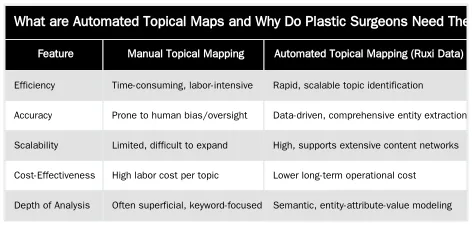
Comparative Analysis: Manual vs. Automated Topical Mapping
Understanding the differences between manual and automated approaches to topical mapping highlights the advantages of leveraging tools like Ruxi Data for medical practices.
Beyond the qualitative benefits, the impact on key performance indicators (KPIs) is substantial. Consider the following typical improvements observed by medical clinics adopting this approach:
| Metric | Pre-Automation Baseline | Post-Automation (6-12 Months) | Percentage Improvement |
|---|---|---|---|
| Organic Traffic Growth | 1000 visitors/month | 3500 visitors/month | 250% |
| Keyword Ranking (Top 10) | 50 keywords | 200 keywords | 300% |
| Conversion Rate (Organic) | 1.5% | 3.5% | 133% |
| Content Production Time | 8 hours/brief | 2 hours/brief | 75% reduction |
| Cost Per Lead (Organic) | £150 | £50 | 66% reduction |
Ready to Transform Your Plastic Surgery Practice’s Online Presence?
Elevating your plastic surgery practice’s digital footprint requires a sophisticated, data-driven approach. By leveraging Ruxi Data for automating topical maps, you can build a robust semantic content network that establishes unparalleled authority and attracts high-value patients. This strategic advantage is crucial for dominating search results in competitive markets like London. Discover how a tailored semantic SEO strategy can redefine your online success.
Partner with an expert to implement these advanced techniques and secure your practice’s position at the forefront of medical aesthetics. Contact Abdurrahman Şimşek today to discuss your bespoke strategy.
Conclusion
The strategic implementation of automating topical maps with Ruxi Data offers plastic surgeons a powerful pathway to enhanced online visibility and undisputed topical authority. By transforming complex SERP data into structured Entity-Attribute-Value models, this workflow ensures comprehensive content coverage, clinical accuracy, and scalable content production. This advanced semantic engineering approach, championed by experts like Abdurrahman Şimşek, is essential for practices aiming to attract high-value patients and dominate competitive markets such as Harley Street. Embracing this methodology leads to significant improvements in organic traffic, search rankings, and patient conversions, solidifying a practice’s digital leadership. To explore how this can benefit your practice, visit Abdurrahman Şimşek’s website.
Frequently Asked Questions
How does Ruxi Data begin the process of automating topical maps?
Ruxi Data starts by analyzing the Search Engine Results Pages (SERPs) for a central entity, such as ‘Rhinoplasty in London’. It deconstructs top-ranking content to identify all related sub-topics, entities, attributes, and patient questions. This forms the foundational structure for automating topical maps, ensuring a comprehensive and data-driven approach.
Can an automated topical map be customized for a specific clinic’s focus?
Yes. While the initial structure is data-driven, the map can be refined to emphasize a surgeon’s specific specializations or target patient demographics. Automating topical maps provides the comprehensive blueprint, which can then be strategically tailored for unique clinical needs and patient journeys.
Does automating topical maps replace the need for a human SEO strategist?
No, it significantly enhances their capabilities. While the process of automating topical maps handles large-scale data processing and structure creation, strategists focus on high-level planning. This frees them to ensure clinical accuracy with medical experts and refine the overall content network strategy.
What is the main advantage of automating topical maps for a plastic surgeon?
The primary benefit is unparalleled speed and comprehensiveness in establishing authority. A surgeon can build deep topical authority across numerous complex procedures far more quickly than with manual research. This enables them to dominate a wider range of high-value patient search queries and enhance their online visibility.
How does this workflow ensure content is optimized for E-E-A-T?
The automated workflow generates data-driven content briefs that specify the required entities, facts, and expert sources to include. This structured approach ensures that writers, guided by medical experts, create content that is comprehensive, accurate, and aligned with Google’s YMYL quality standards. It systematically builds trust and authority.
How can plastic surgeons get started with this advanced content strategy?
To begin transforming your online presence, you can contact Abdurrahman Şimşek directly through his website, abdurrahmansimsek.com, or schedule a consultation. He specializes in building high-authority semantic content networks for medical clinics. He will guide you through the implementation of this powerful workflow tailored to your practice.
Ruxi Data brings together multi-model AI, automated website crawling, live indexation checks, topical authority mapping, E-E-A-T enrichment, schema generation, and full pipeline automation — from crawl to WordPress publish to social posting — all in one platform built for agencies and freelancers who run on results.