
Content Configuration: Enhancing Medical SEO Accuracy
Content configuration in medical SEO systematically structures verified clinical expertise into machine-readable formats. This workflow ensures clinical accuracy and optimizes information for search engine algorithms, moving beyond traditional content writing. Readers will learn how to transform authoritative medical knowledge into semantically rich, E-E-A-T compliant content. This approach builds patient trust and algorithmic favor for YMYL content, leveraging expert collaboration and information design. It details a precise method for achieving digital authority through structured data and content quality control.
Abdurrahman Şimşek, a Semantic SEO Strategist, specializes in building high-authority semantic content networks for medical clinics. His expertise in medical content configuration and E-E-A-T frameworks ensures clinical accuracy and robust online presence for private healthcare providers.
To explore your options, contact us to schedule your consultation.
In the highly sensitive realm of medical SEO, content configuration is paramount for clinical accuracy and search engine visibility. This article explores a robust workflow designed to transform expert medical knowledge into semantically structured, E-E-A-T compliant content, ensuring both patient trust and algorithmic favor. It details how medical practices can leverage structured data and expert collaboration to build a strong online presence, moving beyond traditional content creation to a more precise and effective approach for digital authority.
What is Content Configuration in Medical SEO?
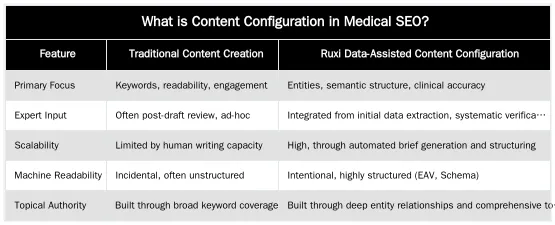
Content configuration in medical SEO involves systematically structuring verified clinical expertise into a machine-readable format. This process ensures clinical accuracy and optimizes information for search engine algorithms, rather than simply writing new text. Its core purpose is to transform existing, authoritative medical knowledge into semantically rich content that search engines can easily understand, index, and rank, thereby building trust and authority for medical practices.
Content Writing vs. Content Configuration: A Paradigm Shift
Traditional content writing often focuses on creating engaging narratives around keywords, with less emphasis on the underlying data structure. In contrast, content configuration prioritizes the semantic structure of information, treating medical knowledge as data points to be organized. This involves identifying core entities (e.g., a specific surgical procedure), defining their attributes (e.g., recovery time, benefits, risks), and establishing relationships between them. This shift moves beyond mere keyword optimization to a deeper, entity-based understanding, ensuring that every piece of information contributes to a cohesive and accurate knowledge graph.
Why Clinical Accuracy is Non-Negotiable for YMYL Content
For Your Money Your Life (YMYL) content, such as medical information, clinical accuracy is paramount. Google’s algorithms place immense scrutiny on YMYL topics due to their potential impact on a user’s health, safety, or financial well-being. Inaccurate or misleading medical content can lead to severe penalties, including de-ranking and loss of trust. Therefore, a robust content quality control process is essential to verify all medical claims and ensure they align with established clinical guidelines and expert consensus.
Navigating Google’s E-E-A-T Requirements for Medical Content
Google’s E-E-A-T guidelines—Expertise, Experience, Authoritativeness, and Trustworthiness—are critical for medical content. Expertise refers to the knowledge of the content creator, while Experience highlights practical, first-hand understanding. Authoritativeness is about the reputation of the creator and the website as a source of information. Trustworthiness encompasses accuracy, transparency, and safety. Effective content configuration directly supports these pillars by integrating verified information from GMC-registered professionals, clearly attributing sources, and presenting data in a structured, verifiable manner. This comprehensive approach to medical content strategy helps clinics establish themselves as reliable sources of health information. For a deeper dive into establishing these signals, explore a detailed E-E-A-T content workflow.
The Workflow: From Clinical Expertise to Semantic Structure
A structured medical content workflow is crucial for transforming complex clinical expertise into semantically rich, search-engine-friendly information. This process involves close collaboration between medical Subject Matter Experts (SMEs) and semantic SEO strategists. The goal is to extract, verify, and organize medical facts into a format that is both human-readable and machine-understandable, leveraging advanced information design principles and tools like Ruxi Data and Entity-Attribute-Value (EAV) modeling.
Integrating Subject Matter Experts (SMEs) for Verified Information
The foundation of accurate medical content lies in direct engagement with qualified medical professionals. This involves structured interviews, data extraction from clinical notes, and review sessions to verify every piece of information. SMEs provide the raw, authoritative data, which is then translated into structured data points. For instance, a plastic surgeon’s knowledge about a specific procedure like rhinoplasty can be broken down into entities (e.g., “rhinoplasty”), attributes (e.g., “recovery time,” “anesthesia type,” “ideal candidate”), and their corresponding values. This systematic approach ensures that the content reflects genuine clinical expertise. Understanding the EAV model for surgical procedures is key to this integration.
Leveraging Ruxi Data for Algorithmic Authorship & Semantic Structuring
Ruxi Data plays a pivotal role in scaling this process. It analyzes Search Engine Results Pages (SERPs) to identify relevant entities, their relationships, and topical gaps within a medical niche. This data-driven insight allows for the automated generation of highly detailed content briefs, guiding the semantic structuring of medical content. By identifying the precise information required by search engines and users, Ruxi Data facilitates a move towards ‘algorithmic authorship,’ where content is assembled and optimized based on a deep understanding of semantic relationships, rather than solely human intuition. This enhances efficiency and maintains clinical accuracy at scale. For more on automating E-E-A-T content, refer to this guide.
| Metric | Traditional Method (Hours/Content Piece) | Configured Method (Hours/Content Piece) | Efficiency Gain (%) |
|---|---|---|---|
| SME Interview & Data Extraction | 5 | 2 | 60% |
| Content Brief Generation | 3 | 0.5 | 83% |
| Drafting & Initial Structuring | 8 | 4 | 50% |
| Clinical Review & Verification | 4 | 2 | 50% |
| SEO Optimization & Schema Implementation | 2 | 1 | 50% |
| Total Time per Content Piece | 22 | 9.5 | 57% |
Optimizing for Generative AI: The Future of Medical Content
The rise of Generative AI models and their integration into search engines necessitates a new approach to content. Content configuration, especially through Entity-Attribute-Value (EAV) models and robust structured data, is crucial for Generative Engine Optimization (GEO). By presenting medical information in a clear, factual, and highly organized manner, clinics ensure their content is readily consumed, understood, and cited by AI models. This proactive strategy positions medical websites as authoritative sources in the evolving search landscape, where AI overviews and conversational interfaces are becoming more prevalent.
How Semantic Engineering Future-Proofs Your Medical Website
Semantic engineering involves designing content and website architecture to communicate meaning directly to search engines and AI. This approach builds algorithm-proof topical authority by creating a dense network of interconnected, semantically rich information. Abdurrahman Şimşek, with over a decade of experience in semantic engineering and specializing in medical SEO for London clinics, focuses on creating content that not only ranks today but remains relevant and authoritative as search algorithms evolve. This involves meticulous information design, leveraging structured data, and understanding the nuances of how AI processes medical queries. Implementing a robust semantic SEO for surgeons strategy ensures long-term digital resilience. For further reading on the future of search, consider resources from organizations like Search Engine Journal, which frequently covers AI’s impact on SEO.
Partner with a Specialist in Medical Content Configuration
For plastic surgeons, aesthetic clinics, and private healthcare providers in London, mastering content configuration is essential for digital dominance. Partnering with a specialist who understands the unique demands of medical SEO, semantic engineering, and Ruxi Data integration ensures your content is clinically accurate and algorithmically optimized. Abdurrahman Şimşek offers strategic consulting to build high-authority semantic content networks, driving patient acquisition and establishing your practice as a trusted leader in the competitive London market. Elevate your online presence and secure your position at the forefront of medical search. Visit abdurrahmansimsek.com to learn more.
Conclusion
Effective content configuration is the cornerstone of a successful medical SEO strategy in 2026 and beyond. By prioritizing clinical accuracy, integrating subject matter expertise, and leveraging advanced semantic structuring techniques, medical practices can build a resilient online presence. This approach not only satisfies stringent E-E-A-T requirements but also positions content favorably for generative AI, ensuring long-term visibility and patient trust. For London-based clinics seeking to dominate local organic search and attract high-value patients, a specialized partner in semantic SEO is indispensable. Explore how a tailored strategy can transform your digital footprint at abdurrahmansimsek.com.
Frequently Asked Questions
What is the difference between ‘content writing’ and ‘content configuration’?
Content writing typically involves creating text from scratch, often based on research. In contrast, content configuration begins with verified clinical expertise provided by a medical professional. This expertise is then systematically structured using a semantic framework, transforming it into a machine-readable and SEO-optimized format. This process ensures accuracy and leverages existing knowledge rather than generating new content.
How does this workflow ensure E-E-A-T compliance?
This specialized workflow is fundamentally designed for E-E-A-T compliance. Expertise is directly sourced from the medical professional, ensuring clinical accuracy and credibility. Authoritativeness is established by structuring this knowledge within a comprehensive topical authority model, while trust is built through verifiable accuracy and clear attribution to the expert. This holistic approach satisfies search engine requirements for high-quality medical information.
What does the process of content configuration look like for a busy surgeon?
We streamline the content configuration process to be highly efficient for busy medical professionals. Ruxi Data generates a structured brief outlining specific questions and data points required from the surgeon. This information can be conveniently provided through voice notes, brief interviews, or bullet points, minimizing time commitment. Our expert team then handles the semantic structuring and optimization, transforming raw expertise into SEO-ready content.
Does Ruxi Data write the medical information itself, or is it involved in content configuration?
Ruxi Data does not write the medical information itself; its role is in the semantic structuring and modeling aspects of this content approach. Its LLMs are utilized to create robust semantic structures, identify relevant entities, and map out query networks. The foundational clinical facts, expert opinions, and authentic experiences are always provided by the human medical expert, ensuring absolute accuracy and trustworthiness.
How does configuring content improve SEO performance for medical practices?
Structuring medical content significantly enhances SEO performance by aligning perfectly with user and search engine expectations. This approach produces authoritative, accurate information in a highly organized and digestible format. The result is improved search rankings, increased user engagement, and a higher likelihood of inclusion in prominent search features like AI Overviews.
How can medical clinics get started with this specialized content approach?
Medical clinics interested in leveraging this advanced content structuring method can begin by contacting Abdurrahman Şimşek for a strategic consultation. We will assess your current digital presence and clinical expertise to develop a tailored plan. This initial step helps outline how to transform your valuable medical knowledge into a powerful asset for online authority and patient trust.
Ruxi Data brings together multi-model AI, automated website crawling, live indexation checks, topical authority mapping, E-E-A-T enrichment, schema generation, and full pipeline automation — from crawl to WordPress publish to social posting — all in one platform built for agencies and freelancers who run on results.