
Logical Internal Linking: Connecting Treatment Hubs for Enhanced SEO & UX
Logical internal linking is crucial for optimizing complex medical websites, especially for plastic surgery clinics. This strategy logically connects non-surgical and surgical treatment hubs, mirroring the patient’s journey from initial inquiry to advanced procedures. Implementing effective logical internal linking enhances information architecture, distributes page authority, and strengthens topical relevance across your site. This approach improves user experience, guides patients through relevant services, and ultimately boosts organic visibility and conversions for medical practices.
Abdurrahman Şimşek, a Semantic SEO Strategist, specializes in developing high-authority Semantic Content Networks for medical clinics. His expertise focuses on crafting robust internal linking strategies that optimize information architecture and drive organic growth for healthcare providers.
To explore your options, contact us to schedule your consultation. You can also reach us via: Book a Semantic SEO Audit, Direct WhatsApp Strategy Line: +90 506 206 86 86
Optimizing website architecture for complex medical sites like plastic surgery clinics requires effective logical internal linking. Connecting non-surgical and surgical treatment hubs enhances user experience, distributes page authority, and builds topical authority. This strategy helps your site rank higher and attract more high-value patients by guiding their journeys through your information architecture.
What is Logical Internal Linking for Medical Websites?
Logical internal linking connects pages on the same website based on semantic relevance and user intent. For medical websites like plastic surgery clinics, this means linking non-surgical and surgical treatment hubs to mirror a patient’s inquiry progression. This approach moves beyond keyword matching to build an information architecture that guides users and search engines through related topics and services.
Reflecting the Patient Journey: Non-Surgical to Surgical
Patients often research less invasive, non-surgical options like “Botox” or “dermal fillers” before their interest evolves to surgical procedures like a “brow lift” or “facelift.” An effective internal linking strategy anticipates this journey. Providing clear, contextual links from non-surgical procedure pages to related surgical options guides users, improves their experience, and facilitates conversions. This approach creates a cohesive narrative that reinforces the clinic’s expertise.
Why Connecting Treatment Hubs Boosts SEO & User Experience
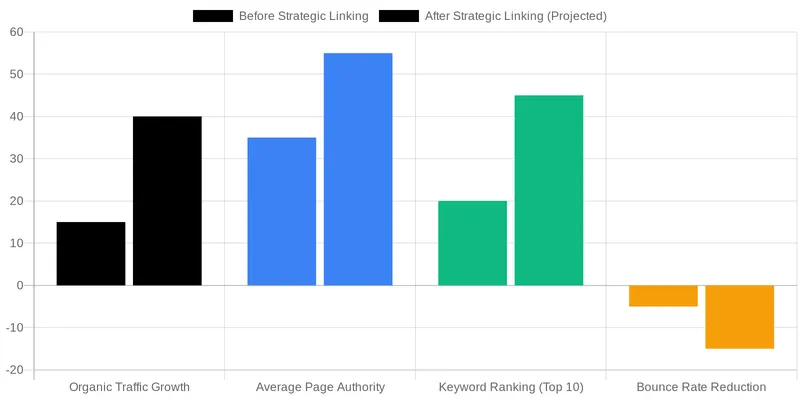
A structured internal linking strategy enhances search engine optimization (SEO) and user experience (UX). Connecting non-surgical and surgical treatment hubs signals a medical website’s authority to search engines and provides intuitive navigation for patients. This improves crawlability, distributes link equity, and solidifies topical relevance, contributing to higher organic visibility.
Distributing Page Authority and Link Equity Effectively
Internal links pass page authority (“link juice”) from established pages to newer or semantically related content. For instance, a high-performing page on “Facelift Surgery” can link to supporting pages like “Mini Facelift,” “Neck Lift,” and “Non-Surgical Facelift Options.” This distribution of link equity strengthens the site and helps individual procedure pages rank higher. Authority is shared across the content network rather than concentrated on a few pages.
Enhancing Topical Authority and Semantic Relevance
Search engines like Google use entity-based understanding to interpret website content. An internal linking structure helps them comprehend the relationships between medical topics on your site. When pages about “Breast Augmentation,” “Breast Lift,” and “Breast Reduction” are interconnected, it reinforces your clinic’s expertise in “Breast Surgery.” This semantic relevance signals topical authority, positioning your site as a resource in its medical specialty. This aligns with Google’s algorithms, which prioritize sites demonstrating deep knowledge.
Crafting an E-E-A-T-Driven Internal Linking Architecture
An internal linking architecture supporting E-E-A-T (Experience, Expertise, Authoritativeness, Trustworthiness) is critical for medical websites. Abdurrahman Simsek, a London-based Semantic SEO Strategist, emphasizes that links should strategically highlight expert content, link procedures to surgeon bios, and reinforce trust signals. This helps search engines recognize the clinic’s knowledge and credibility, which is critical in the YMYL (Your Money or Your Life) medical sector.
Structuring Content Silos for Medical Specialties
Content silos organize related pages into thematic clusters, signaling expertise in medical specialties to search engines. A plastic surgery clinic might have a “Breast Surgery” silo with pages for procedures (augmentation, lift, reduction), recovery guides, and testimonials. Within this silo, pages are heavily interconnected. Strategic cross-linking occurs between relevant silos, for example, from a “Facial Rejuvenation” page to a “Non-Surgical Treatments” hub. This structure prevents orphaned pages and ensures a clear hierarchy. A content silo architecture guide provides more detail.
Contextual vs. Navigational Links: A Strategic Balance
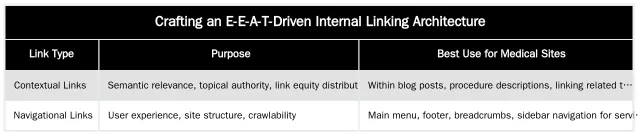
A balanced internal linking strategy requires understanding contextual and navigational links. Contextual links are embedded within body text, using semantically relevant anchor text to connect to related content; search engines value them for topical signals. Navigational links in menus, footers, and breadcrumbs provide structural guidance for users and search engines. Medical sites should balance contextual links reinforcing procedure relationships (e.g., linking “liposuction” from a “tummy tuck” page) with clear navigational links for broader categories. Consult Google’s guidelines on internal links for best practices.
Implementing Advanced Internal Linking Strategies for Clinics
Effective internal linking is a strategic, ongoing process. Medical clinics should regularly audit links, optimize anchor text, and use structural elements like breadcrumbs and semantic HTML. These practices create a user-friendly and discoverable information architecture.
Auditing and Optimizing Existing Internal Links
Regular internal link audits are crucial. The process involves identifying broken links and optimizing anchor text to be descriptive and semantically rich. Tools like Screaming Frog or Google Search Console can identify broken links and provide insights into linking patterns. Audits reveal opportunities to add new links from high-authority pages to supporting content, strengthening topical clusters. An audit ensures every link serves a purpose. For a comprehensive guide, see Ahrefs’ internal link audit guide.
Leveraging Breadcrumbs and Semantic HTML for Navigation
Breadcrumbs are navigational aids showing a user’s location within a site’s hierarchy. On complex medical sites, breadcrumbs improve user experience by allowing navigation back to parent categories. For SEO, breadcrumbs provide pathways for crawlers and can appear in search results as rich snippets, enhancing visibility. Using semantic HTML elements (like `
Ruxi Data brings together multi-model AI, automated website crawling, live indexation checks, topical authority mapping, E-E-A-T enrichment, schema generation, and full pipeline automation — from crawl to WordPress publish to social posting — all in one platform built for agencies and freelancers who run on results.