
Mapping Patient Questions: Optimizing Content for Patient Journeys
This guide explains how to map patient questions to a Semantic Content Network (SCN), ensuring content directly addresses user intent across the patient journey. By categorizing patient queries into awareness, consideration, and decision stages, medical clinics can create targeted content that builds trust and drives conversions. This strategic approach optimizes content for both patient needs and search engine algorithms, crucial for YMYL niches like aesthetic marketing and plastic surgery. Understanding how to map patient questions enables clinics to attract high-value patients effectively.
Abdurrahman Şimşek, a Semantic SEO Strategist, specializes in building high-authority Semantic Content Networks for medical clinics. His approach leverages deep understanding of information retrieval and entity architecture to optimize content for the complex YMYL search landscape, ensuring precise patient acquisition.
To explore your options, contact us to schedule your consultation. You can also reach us via: Book a Semantic SEO Audit, Direct WhatsApp Strategy Line: +90 506 206 86 86
Mapping patient questions to your Semantic Content Network (SCN) attracts high-value patients in the aesthetic and plastic surgery market. This guide explains how to align content strategy with the patient journey. Addressing specific patient queries at each stage builds trust, drives conversions, and optimizes content for patient needs and search engine algorithms in 2026.
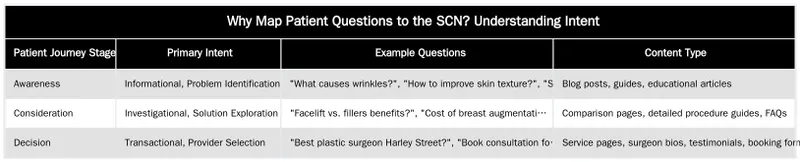
Why Map Patient Questions to the SCN? Understanding Intent
Mapping patient questions to your Semantic Content Network (SCN) ensures content directly addresses user intent. This alignment is fundamental to medical SEO in YMYL (Your Money Your Life) niches like plastic surgery and aesthetics. It allows clinics to provide relevant, authoritative information at every touchpoint, fostering trust and improving conversion rates.
Understanding the patient journey is central. Each stage represents a distinct mindset and set of information needs. Categorizing questions by these stages allows content creators to develop targeted resources that meet patients from initial curiosity to booking a consultation.
The Patient Journey: Awareness, Consideration, Decision
The patient journey in aesthetic medicine has three stages, each with evolving user intent. The awareness stage is when patients recognize a problem and search for general information. In the consideration stage, they research solutions, comparing procedures, costs, and recovery times. The decision stage is when patients seek a provider, evaluating surgeons, reading testimonials, and looking for booking information.
Identifying Patient Questions Across the Aesthetic Journey
Identifying the questions patients ask at each stage of their journey is foundational to a patient-centric content strategy. This process focuses on the underlying intent and conversational nature of search queries, not just keyword volume.
Tools and Techniques for Question Keyword Research
To identify patient questions, use Google’s “People Also Ask” (PAA) boxes and related searches to understand common queries. Keyword research platforms can filter by question-based question keywords to find long-tail phrases. Patient forums, social media, and direct feedback provide insights into patient concerns. Analyzing competitor content also reveals topics and potential content gaps.
Categorizing Questions by Intent and Stage
Categorize identified questions to align with the patient journey. Questions like “What is Botox?” or “How does laser skin resurfacing work?” are in the awareness stage. Queries like “Botox vs. fillers for forehead lines” or “Average cost of liposuction in London” indicate consideration stage intent. Questions like “Book a consultation for dermal fillers” or “Reviews for Dr. [Surgeon Name] in Marylebone” are in the decision stage. This categorization is critical for content mapping, ensuring each content piece serves a specific purpose.
Understanding patient queries, from broad informational to specific transactional questions, is foundational to an effective medical SEO strategy. This allows for the creation of content that resonates.
Structuring Content for Each Stage of the Patient Funnel
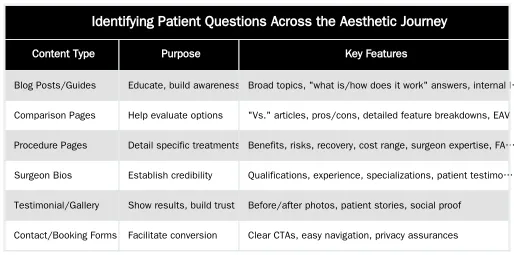
Effective content structure delivers information when a patient needs it, guiding them through the marketing funnel. Each stage requires specific content types, formats, and calls-to-action (CTAs) to address mapped patient questions and move them toward conversion.
Awareness Stage: Educate and Inform
Content for the awareness stage focuses on education. This includes blog posts and guides that answer “what is,” “how does it work,” or “symptom” questions, like “Understanding the Signs of Facial Aging” or “What is Non-Surgical Rhinoplasty?” The goal is to build knowledge and establish the clinic as an authority. Content should be digestible, feature infographics, avoid sales pitches, and use internal links to guide patients to related informational content.
Consideration Stage: Compare and Evaluate
At the consideration stage, patients evaluate options. Content should compare options and detail procedures, including comparison pages (“Facelift vs. Thread Lift”) and guides addressing “pros and cons,” “cost,” or “recovery time” questions. Examples include “The Cost of Breast Augmentation in London” or “Rhinoplasty Recovery Timeline.” Entity-Attribute-Value (EAV) modeling is powerful here. Structuring content around entities (e.g., ‘Breast Augmentation’) and their attributes (e.g., ‘Cost’, ‘Recovery Time’, ‘Anesthesia Type’) provides organized, comprehensive answers, signaling expertise to patients and search engines.
Decision Stage: Convert and Book
Content for the decision stage is for conversion. This includes optimized service pages, surgeon biographies, patient testimonials, and FAQs about booking and logistics. It addresses questions like “where can I get it,” “who is the best,” and “how to book.” Use clear calls-to-action like “Book a Consultation” or “Contact Us.” These pages must provide all information for a patient to take the next step, including location details, contact forms, and booking options. For instance, a service page on “Liposuction in Harley Street” would include surgeon credentials, patient results, and a direct booking link.
Integrating Question Mapping into Your Semantic Content Network
Integrating patient question mapping into a Semantic Content Network (SCN) creates a cohesive, authoritative knowledge base. This approach builds topical authority beyond keyword matching, signaling expertise to search engines and reducing Google’s Cost of Retrieval. It is a durable strategy against algorithm updates, especially for YMYL content.
From Questions to Entities: Building Topical Authority
Treat each patient question and its answer as an entity or attribute in your SCN. For example, in “What is the recovery time for a facelift?”, ‘Facelift’ is the entity and ‘Recovery Time’ is an attribute. Providing comprehensive, interlinked content addressing all facets of these entities builds topical authority. This signals to search engines that your website is a definitive source for a topic, enhancing visibility and trustworthiness. This structure helps search engines understand content relationships, simplifying information retrieval for complex queries.
Optimizing for Generative AI and E-E-A-T
Well-mapped, entity-rich content is optimized for Generative Engine Optimization (GEO) and strengthens E-E-A-T (Experience, Expertise, Authoritativeness, Trustworthiness) signals. Generative AI models in search rely on structured, factual, and contextually rich information to formulate answers. Answering patient questions within a semantic framework provides the clear, authoritative data these models require. This positions your content as a preferred source, enhancing visibility in AI Overviews and other generative search features. Abdurrahman Şimşek’s expertise in semantic engineering configures content for algorithmic understanding, reinforcing E-E-A-T for medical topics. Google’s Core Web Vitals documentation emphasizes user experience and content quality.
The Abdurrahman Şimşek Approach: Data-Driven Patient Acquisition
Abdurrahman Şimşek’s methodology uses semantic engineering to automate and scale patient question mapping for a competitive advantage. This data-driven approach aligns content with patient intent and search engine expectations in the London private healthcare market.
Leveraging Ruxi Data for Scalable Question Mapping
This approach uses Ruxi Data, a semantic infrastructure analyzing SERP data and patient queries. Ruxi Data identifies common questions and question gaps competitors miss. This analysis automates content brief creation, ensuring new content addresses specific patient needs at each journey stage. This scalable process allows clinics to expand their topical authority without compromising content quality or semantic precision. It offers a systematic way to cover entire topic landscapes for aesthetic procedures, moving beyond manual keyword research.
Case Study Snippet: Impact on Patient Leads and Conversions
Clinics implementing this data-driven methodology see significant improvements in organic visibility and patient acquisition. For instance, a London plastic surgery clinic increased qualified patient leads within 12 months, attributable to aligning content with patient questions and a strengthened Semantic Content Network. The content architecture resulted in higher rankings for high-value transactional queries and more consultation bookings. This demonstrates the impact of a semantic, patient-centric SEO strategy on a clinic’s revenue. For context on semantic search trends, see Search Engine Land’s articles on semantic search.
Ready to Transform Your Patient Acquisition Strategy?
Mapping patient questions to your Semantic Content Network is a strategic imperative for medical clinics seeking sustained organic growth. Aligning content with the patient journey builds trust, establishes authority, and converts inquiries into consultations. Abdurrahman Şimşek creates these precise, data-driven semantic strategies for London’s medical practices.
Elevate your online presence and attract high-value patients. Book a Semantic SEO Audit to learn how a tailored strategy can transform your patient acquisition. For immediate assistance, contact the Direct WhatsApp Strategy Line: +90 506 206 86 86.
Frequently Asked Questions
Why is it important to map patient questions to the SCN?
Mapping patient questions ensures content directly addresses user intent at each stage of their journey. This strategic alignment builds trust, provides immense value, and effectively guides potential patients through the conversion funnel, optimizing for patient needs and search engine algorithms.
What types of inquiries are relevant for the Awareness stage?
At the Awareness stage, patients ask broad, informational questions like “What causes jowls?” or “How to get rid of frown lines?”. Content here should be educational, introducing potential solutions without any direct sales pitch to attract a wide audience.
How do you map patient questions for the Consideration stage?
To map patient questions for the Consideration stage, focus on comparative and detailed procedural queries. Patients at this point are evaluating options, asking “Facelift vs. thread lift” or “What are the best non-surgical facelift alternatives?”. Your content should provide thorough comparisons and in-depth information to help them make informed choices.
What kind of patient inquiries are crucial for the Decision stage?
For the Decision stage, patient inquiries are transactional or logistical, such as “How much does rhinoplasty cost in London?” or “Consultation with a Harley Street plastic surgeon”. This content should feature service pages, clear pricing, and accessible booking forms to facilitate direct conversion.
How does the process to map patient questions enhance topical authority?
When you map patient questions comprehensively across the entire patient journey, you demonstrate profound expertise in your niche. This systematic approach proves to search engines that your domain is a definitive and authoritative resource, significantly boosting your topical authority and overall search visibility.
How can I get started with mapping patient inquiries for my clinic?
To begin optimizing your content strategy, you can book a Semantic SEO Audit with Abdurrahman Şimşek. This will help identify key patient inquiries and develop a tailored plan to integrate them into your Semantic Content Network for enhanced patient acquisition and improved online presence. Book a Semantic SEO Audit today.
Ruxi Data brings together multi-model AI, automated website crawling, live indexation checks, topical authority mapping, E-E-A-T enrichment, schema generation, and full pipeline automation — from crawl to WordPress publish to social posting — all in one platform built for agencies and freelancers who run on results.