
Medical Schema for Surgeons: Enhancing Online Visibility & E-e-a-t
Implementing medical schema for surgeons is crucial for digital visibility and E-E-A-T in 2026. This guide details how structured data, including Physician and MedicalProcedure schema, enhances a practice’s presence in the Google Knowledge Graph. Surgeons gain a competitive edge by explicitly defining their expertise and services, improving search engine understanding and trust. Proper schema implementation is essential for attracting high-value patients and dominating local search, particularly in competitive medical markets like Harley Street. It directly signals authority and trustworthiness to search algorithms.
Abdurrahman Şimşek, a Semantic SEO Strategist with 10+ years of experience, specializes in building high-authority semantic content networks for medical clinics. His expertise in Medical SEO and structured data ensures precise entity definition and enhanced digital performance for healthcare providers.
To explore your options, contact us to schedule your consultation.
In the highly competitive digital landscape of 2026, understanding and implementing medical schema for surgeons is no longer optional—it’s a strategic imperative. This technical guide will demystify Physician and MedicalProcedure markup, explaining how structured data enhances your online visibility, strengthens E-E-A-T signals, and positions your practice for dominance in the Google Knowledge Graph, especially within premium markets like Harley Street. Surgeons seeking to optimize their online presence and attract high-value patients will find this information essential for navigating modern search engine algorithms.
What is Medical Schema for Surgeons and Why is it Critical in 2026?
Medical schema, also known as structured data, is a standardized format for providing information about a webpage and its content to search engines. For surgeons, this involves using specific vocabulary from Schema.org, typically implemented in JSON-LD, to explicitly define entities like physicians, medical practices, and surgical procedures. This explicit markup helps search engines like Google understand the context and attributes of your medical content, leading to enhanced visibility in search results and better recognition within the Google Knowledge Graph.
In 2026, the importance of structured data healthcare has intensified, particularly for Your Money Your Life (YMYL) topics. Search engines prioritize accuracy and authority for medical queries, making precise entity definition through schema a fundamental SEO strategy. For competitive markets such as Harley Street SEO, robust schema implementation can differentiate a practice, contributing to rich snippets and improved local search rankings.
The E-E-A-T Imperative for Medical Practitioners
Structured data directly feeds into Google’s E-E-A-T (Experience, Expertise, Authoritativeness, Trustworthiness) assessment, which is crucial for medical content. By marking up a surgeon’s credentials, specialties, affiliations, and the details of medical procedures, you provide clear signals to search engines about the legitimacy and depth of expertise. This explicit information helps build trust and authority, which are paramount for any medical professional’s online presence. Proper YMYL schema implementation ensures that search engines can confidently present your practice as a reliable source of medical information and services.
Implementing Physician Schema: A Step-by-Step Guide for Doctors
Implementing physician schema involves using JSON-LD to describe individual doctors and their associated medical practices. This markup typically combines `Person`, `Physician`, and `MedicalBusiness` types to create a comprehensive entity profile. The goal is to provide search engines with a clear, unambiguous understanding of who the doctor is, their qualifications, and where they practice. This is a foundational step for any surgeon aiming for strong online visibility.
A basic JSON-LD structure for a doctor might look like this, embedded within the “ section of your webpage:
<script type="application/ld+json">
{
  "@context": "https://schema.org",
  "@type": ["Physician", "Person"],
  "name": "Dr. Jane Doe",
  "url": "https://example.com/dr-jane-doe",
  "image": "https://example.com/dr-jane-doe.jpg",
  "medicalSpecialty": "https://schema.org/PlasticSurgery",
  "hasCredential": "MD",
  "alumniOf": {
    "@type": "EducationalOrganization",
    "name": "University College London"
  },
  "address": {
    "@type": "PostalAddress",
    "streetAddress": "123 Harley Street",
    "addressLocality": "London",
    "postalCode": "W1G 9PJ",
    "addressCountry": "UK"
  },
  "telephone": "+442071234567",
  "sameAs": [
    "https://www.linkedin.com/in/drjanedoe",
    "https://www.gmc-uk.org/doctors/1234567"
  ]
}
</script>
This `json-ld for doctors` provides explicit signals about the surgeon’s identity, qualifications, and location, which is vital for local search and establishing authority.
Key Properties for Robust Physician Markup
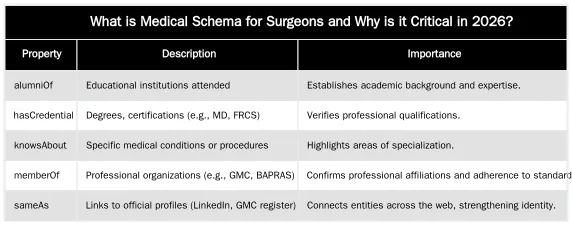
Beyond the basic properties, a robust physician schema leverages additional attributes to paint a complete picture for search engines. These properties help solidify the doctor’s expertise and affiliations. For more detailed guidance on structuring your medical practice’s online presence, refer to our comprehensive guide on medical schema for surgeons.
Mastering MedicalProcedure Schema for Surgical Practices
For surgical practices, marking up individual procedures with `MedicalProcedure` schema is essential for attracting patients searching for specific treatments. This structured data type allows you to detail the specifics of each surgery, from its purpose to recovery expectations. By providing this explicit information, you help search engines understand the nuances of your services, making your content more discoverable for relevant queries.
Consider a plastic surgery clinic offering rhinoplasty. The `MedicalProcedure` markup would include details such as:
<script type="application/ld+json">
{
  "@context": "https://schema.org",
  "@type": "MedicalProcedure",
  "name": "Rhinoplasty (Nose Reshaping)",
  "procedureType": "https://schema.org/SurgicalProcedure",
  "medicalSpecialty": "https://schema.org/PlasticSurgery",
  "bodyLocation": "Nose",
  "description": "Surgical procedure to reshape the nose, improving proportion and aesthetic harmony.",
  "howPerformed": "Performed under general anesthesia, involving reshaping bone and cartilage.",
  "typicalRecoveryTime": "2-4 weeks for initial swelling, up to 1 year for final results.",
  "preparation": "Consultation, medical evaluation, avoiding certain medications.",
  "risks": "Swelling, bruising, infection, asymmetry, breathing difficulties.",
  "benefits": "Improved nasal aesthetics, enhanced facial balance, corrected breathing issues.",
  "estimatedCost": {
    "@type": "MonetaryAmount",
    "currency": "GBP",
    "value": "6000"
  },
  "performer": {
    "@type": "Physician",
    "name": "Dr. Jane Doe",
    "url": "https://example.com/dr-jane-doe"
  }
}
</script>
This detailed `medicalprocedure schema` ensures that search engines can accurately categorize and display information about your surgical offerings.
Enhancing SERP Features with Procedure-Specific Data
The primary benefit of implementing `MedicalProcedure` schema is providing search engines with explicit, structured details about surgical procedures, such as cost, recovery time, and anesthesia type. This detailed information can unlock rich SERP features, including carousels, detailed snippets, and FAQ sections directly in search results. These visually appealing elements improve click-through rates by offering users immediate, relevant information. For example, a search for “rhinoplasty cost London” could display your clinic’s estimated cost directly in the search results, making your practice stand out.
Beyond Basic Markup: Advanced Semantic Strategies for Surgeons
While basic schema implementation is crucial, advanced semantic strategies offer a competitive edge, especially in the sophisticated London medical market. This involves moving beyond simple property-value pairs to build a comprehensive understanding of medical entities and their relationships. Entity-Attribute-Value (EAV) modeling, for instance, allows for a more flexible and granular representation of complex medical data, enabling clinics to define specific attributes for each procedure or physician that might not fit standard schema properties.
By structuring data with an EAV approach, a clinic can create a rich internal knowledge graph. This graph connects surgeons to their specific sub-specialties, the unique techniques they employ, the types of patients they serve, and the outcomes of particular procedures. This depth of structured information allows search engines to understand the true scope of a surgeon’s expertise and the specific value proposition of a clinic, contributing significantly to topical authority and the development of robust semantic content networks.
Leveraging Ruxi Data for Unrivaled Entity Recognition
Integrating advanced semantic infrastructure, such as Ruxi Data, enhances Google’s understanding of complex medical entities and their relationships. Ruxi Data acts as a powerful layer that processes and organizes vast amounts of unstructured and semi-structured medical information, converting it into a machine-readable format. This process allows for the identification of nuanced connections between medical conditions, treatments, specialists, and research, far beyond what standard schema markup alone can achieve.
For surgeons in London, leveraging Ruxi Data means that their specific expertise in niche procedures, their contributions to medical research, or their unique patient care philosophies can be explicitly recognized and understood by search engines. This provides a significant competitive advantage, enabling a practice to rank for highly specific, long-tail queries and to establish itself as a definitive authority in its chosen fields. This deep entity recognition is fundamental to building a semantic content network for surgeons that truly dominates the digital landscape, especially when combined with a strong plastic surgery topical authority strategy.
Common Schema Errors and Best Practices for Medical SEO
Drawing on over a decade of experience in medical SEO, common errors in structured data implementation often undermine its potential. These include using incorrect schema types, omitting required properties, or invalid nesting of elements. For instance, incorrectly using `LocalBusiness` instead of `MedicalBusiness` for a clinic, or failing to include a surgeon’s `medicalSpecialty`, can lead to missed opportunities for rich results and accurate entity recognition. Another frequent mistake is providing inconsistent data across different schema types or external profiles, which can confuse search engines.
Best practices involve rigorous validation using tools like Google’s Rich Results Test and Schema Markup Validator. Regular auditing ensures schema remains accurate and aligned with evolving search engine guidelines. Integrating schema implementation with an overall SEO strategy, rather than treating it as an isolated task, ensures maximum impact. For YMYL content, accuracy and up-to-date information are paramount. Google explicitly states that structured data should reflect the visible content on the page, avoiding hidden or misleading markup. Google’s structured data guidelines provide comprehensive details on proper implementation.
Ensuring Schema Accuracy and Compliance in Healthcare
The critical need for accuracy in medical schema stems from its direct impact on patient trust and YMYL implications. Misleading or incorrect information, even in structured data, can erode credibility and potentially harm patients seeking medical advice or services. Therefore, every piece of structured data must be meticulously verified against official credentials, clinic information, and medical facts. This includes ensuring that all `hasCredential`, `memberOf`, and `medicalSpecialty` properties are precise and verifiable. Adherence to web accessibility standards also plays a role in ensuring that structured data is correctly interpreted and presented to all users.
The ROI of Semantic Schema: What Surgeons Can Expect in 2026
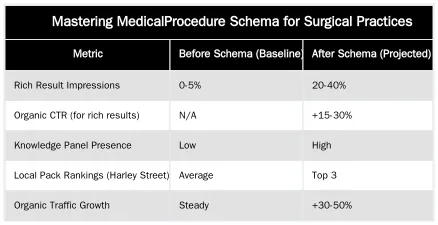
Investing in robust semantic schema implementation yields measurable returns for surgical practices. The tangible benefits include significantly improved organic visibility, higher click-through rates (CTRs) due to rich results, and an enhanced E-E-A-T profile. For practices in competitive locations like Harley Street and across London, a strong local search presence is a direct outcome of well-implemented structured data, leading to more qualified patient inquiries. This foundational work creates a resilient digital presence that is less susceptible to algorithmic shifts.
By providing search engines with explicit signals about your expertise and services, your practice becomes a more prominent and trusted entity in the digital health landscape. This strategic advantage translates into sustained organic growth and a stronger brand reputation, positioning your clinic for long-term success in 2026 and beyond.
Measuring Success: Key Metrics for Schema Performance
Tracking the effectiveness of your structured data involves monitoring specific key performance indicators (KPIs). These metrics provide insights into how schema is impacting your online presence and patient acquisition efforts.
Elevate Your Practice: Partner with a Medical SEO Expert
Implementing advanced medical schema for surgeons requires specialized expertise in semantic SEO and web development. Abdurrahman Şimşek is a London-based Semantic SEO Strategist with over a decade of experience, specializing in building high-authority semantic content networks for medical clinics, skin clinics, and plastic surgeons. If your practice aims to dominate local organic search across Harley Street and premium London postcodes, attract high-value patients, and establish an unshakeable digital foundation, strategic partnership is key. Unlock the full potential of your online presence.
Contact Abdurrahman Şimşek today for a consultation to implement advanced schema strategies and build a high-converting online presence tailored to the unique demands of the private healthcare market. Visit abdurrahmansimsek.com to learn more.
Conclusion
In 2026, the strategic implementation of medical schema is indispensable for surgeons seeking to thrive in the digital landscape. By meticulously marking up physician and procedure details, practices can significantly enhance their online visibility, bolster E-E-A-T signals, and secure prominent positions in the Google Knowledge Graph. Moving beyond basic markup to embrace advanced semantic strategies, including EAV modeling and Ruxi Data integration, provides a distinct competitive advantage, particularly within the discerning London medical market. Prioritizing accurate, comprehensive structured data is not merely a technical task; it is a fundamental investment in the long-term success and authority of your surgical practice. Partnering with a specialist in medical semantic SEO ensures your practice is equipped to meet these evolving demands and achieve sustained growth.
Frequently Asked Questions
What is the primary benefit of implementing MedicalProcedure schema for surgeons?
Implementing MedicalProcedure schema provides search engines with explicit, structured details about surgical procedures, such as cost, recovery time, and anesthesia type. This detailed medical schema for surgeons can lead to enhanced SERP features and better entity recognition by Google, significantly improving your practice’s visibility.
How does medical schema for surgeons contribute to YMYL SEO and E-E-A-T?
For Your Money or Your Life (YMYL) topics, structured data provides verifiable information that helps Google confirm the expertise and authority of the source. It’s a foundational element for demonstrating trustworthiness and strengthening E-E-A-T signals in the competitive medical field, crucial for patient confidence.
Can I automate the generation of medical schema for surgeons for my London clinic?
Yes, automation is possible using specialized platforms like Ruxi Data or custom scripts. These tools can pull from a database of procedures and surgeon profiles to generate accurate JSON-LD, ensuring your medical schema for surgeons is scalable and error-free. This approach saves valuable time and maintains data consistency across your online presence.
Is Physician schema necessary if I already have MedicalBusiness schema?
Yes, it is highly recommended to implement both. MedicalBusiness schema describes the clinic or practice as an entity, while Physician schema details the individual surgeon’s credentials, specializations, and affiliations. Both are crucial for building comprehensive E-E-A-T signals and a robust online presence that accurately reflects your expertise.
What specific physician data should be included in the medical schema for surgeons?
Essential data includes the surgeon’s full name, medical specialty (e.g., Plastic Surgery), affiliations with hospitals or medical organizations, and educational background. Additionally, a link to their official registration (e.g., GMC number in the UK) should be included. This comprehensive data within the medical schema for surgeons helps establish authority and trust with search engines and potential patients.
How can I get expert assistance with implementing advanced structured data for my medical practice?
Abdurrahman Şimşek, a London-based Semantic SEO Strategist, specializes in building high-authority Semantic Content Networks for medical clinics. You can contact him through his website, abdurrahmansimsek.com, to discuss tailored strategies for your practice. Leveraging his expertise ensures accurate and effective schema implementation for optimal online visibility.
Ruxi Data brings together multi-model AI, automated website crawling, live indexation checks, topical authority mapping, E-E-A-T enrichment, schema generation, and full pipeline automation — from crawl to WordPress publish to social posting — all in one platform built for agencies and freelancers who run on results.