
Medical SEO ROI: Measuring True Clinic Growth & Patient Value
Measuring medical seo roi requires focusing on tangible business outcomes beyond traffic and rankings. This article details critical SEO KPIs for healthcare, such as Cost Per Qualified Lead (CPQL) and patient acquisition cost, which directly reflect patient acquisition and revenue. Readers will learn to implement advanced conversion tracking in Google Analytics 4 and apply effective lead attribution models. The content emphasizes demonstrating real clinic growth metrics and aligning SEO reporting with strategic business intelligence to optimize marketing performance and understand true consultation value from organic search.
Abdurrahman Şimşek, a Semantic SEO Strategist, provides expert guidance on these advanced measurement techniques. His insights help medical clinics transition from vanity metrics to data-driven strategies, proving the financial impact of SEO and ensuring marketing investments drive measurable clinic growth.
To explore your options, contact us to schedule your consultation. You can also reach us via: Book a Semantic SEO Audit, Direct WhatsApp Strategy Line: +90 506 206 86 86
Measuring medical seo roi extends beyond simple traffic and rankings, focusing instead on tangible business outcomes like patient acquisition and revenue. This article will explore the critical Key Performance Indicators (KPIs) that truly reflect the value of organic search for medical clinics, providing a framework for accurate measurement and reporting in 2026. Understanding these metrics is essential for any clinic aiming to optimize its digital marketing investment and achieve sustainable growth. It provides a strategic blueprint for evaluating SEO success in healthcare.
Why Traditional SEO Metrics Fall Short for Medical Clinics
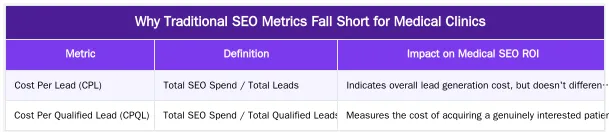
The single most important KPI for medical SEO is ‘Cost Per Qualified Lead’ (CPQL). This metric precisely measures the expense incurred through SEO to generate a genuine patient inquiry, allowing for direct comparison with other marketing channels and providing a clear indication of marketing efficiency. Focusing solely on website traffic or search engine rankings provides an incomplete picture of organic search effectiveness for healthcare providers.
Beyond Vanity Metrics: The True Goal of Medical SEO
High website traffic does not automatically translate into high-value patients or increased revenue for a medical practice. A clinic might rank highly for broad terms, attracting many visitors who are not ready to book a consultation or are not within the target demographic. Similarly, top rankings for non-commercial keywords offer little direct business impact. The true goal of SEO for medical clinics is to attract qualified prospective patients who are likely to convert into appointments and long-term clients, directly contributing to the clinic’s financial health. This requires a shift from vanity metrics to those that reflect actual business outcomes.
Key Performance Indicators (KPIs) for True Medical SEO ROI
To accurately assess the return on investment for healthcare SEO, clinics must track specific metrics that align with their business objectives. These seo kpis for healthcare move beyond surface-level data to reveal the actual impact on patient acquisition and revenue generation. Understanding these deeper metrics is fundamental for strategic decision-making and optimizing marketing spend.
Calculating Cost Per Qualified Lead (CPQL) for Patient Acquisition
Cost Per Qualified Lead (CPQL) is a crucial metric for medical practices. Unlike a general Cost Per Lead (CPL), CPQL filters out unqualified inquiries, focusing only on leads that meet specific criteria for a potential patient (e.g., specific procedure interest, geographic location, insurance status). This allows for a more accurate assessment of marketing efficiency. To calculate CPQL, divide the total SEO investment (including agency fees, content creation, tools) by the number of qualified leads generated through organic search over a defined period. This metric provides a direct comparison of organic search profitability against other marketing channels.
Measuring Consultation Value and Patient Lifetime Value (PLV)
Beyond the initial lead, understanding the consultation value and patient lifetime value (PLV) is vital. Consultation value can be assigned by tracking the conversion rate from consultation to booked procedure and the average revenue per procedure. Patient acquisition cost (PAC) is then derived by dividing the total SEO investment by the number of new patients acquired. PLV estimates the total revenue a patient is expected to generate over their relationship with the clinic. By integrating these values, clinics can understand the long-term financial impact of their organic search efforts, making a stronger case for continued investment in SEO.
Implementing Advanced Conversion Tracking in Google Analytics 4
Effective measurement of organic search performance hinges on robust conversion tracking. Google Analytics 4 for doctors offers a flexible event-based data model, making it ideal for capturing diverse patient interactions. Setting up GA4 correctly ensures that every meaningful action a prospective patient takes on your website is recorded, providing the data necessary to calculate accurate return on investment.
Tracking Phone Calls, Form Submissions, and Online Bookings
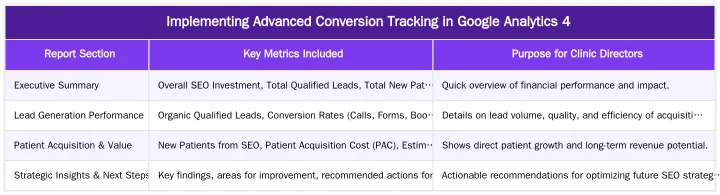
For medical clinics, key conversions often include phone calls, form submissions, and online appointment bookings. In GA4, these are configured as custom events. For phone calls, event tracking can be set up for clicks on “tel:” links. Form submissions typically trigger an event upon successful completion, often managed via Google Tag Manager. Integrating online booking systems requires careful coordination to ensure booking confirmations or successful appointment submissions are sent as events to GA4. Accurate data collection for these interactions is paramount for effective lead attribution and understanding which organic channels drive the most valuable patient engagement. For a deeper dive into setting realistic SEO goals and KPIs, explore further resources.
Attribution Modeling & Reporting SEO Performance to Clinic Directors
Understanding how different marketing touchpoints contribute to a patient’s decision-making process is crucial for accurate marketing performance evaluation. Lead attribution in healthcare is complex due to the typically longer patient journey. Clear, actionable SEO reporting is essential for communicating the value of organic search to clinic stakeholders.
Understanding Multi-Touch Attribution in the Patient Journey
Patients often interact with a clinic’s online presence multiple times before booking an appointment. They might discover the clinic through an organic search, return via a direct visit, and then convert after seeing a social media ad. Multi-touch attribution models distribute credit across all touchpoints in the patient journey, offering a more holistic view than last-click attribution. Models like linear (equal credit to all touchpoints), time decay (more credit to recent interactions), or position-based (more credit to first and last interactions) can provide different insights into the role of organic search. Google Analytics 4 offers various attribution models to help clinics understand the full impact of their SEO efforts.
Crafting an Impactful Medical SEO ROI Report Template
An effective SEO report for clinic directors focuses on business impact, not just technical metrics. It should clearly articulate the return on investment for medical SEO. Key components include: CPQL, total qualified leads from organic search, patient acquisition cost, estimated consultation value, and the overall revenue attributed to SEO. Visualizations and concise summaries help clinic directors quickly grasp the value. This approach ensures that SEO is viewed as a revenue-generating investment rather than an overhead cost.
The Semantic SEO Advantage in Driving Measurable ROI
Semantic SEO and a focus on entity architecture are fundamental to attracting higher quality leads and improving the return on investment for medical practices. As a Semantic SEO Strategist, Abdurrahman Şimşek specializes in building high-authority Semantic Content Networks for medical clinics. This approach moves beyond keywords to understand the underlying intent and context of patient queries, leading to more precise targeting and better conversions.
How E-E-A-T and Topical Authority Influence Lead Quality
In the YMYL (Your Money Your Life) space of healthcare, Google prioritizes content from sources demonstrating high Expertise, Experience, Authoritativeness, and Trustworthiness (E-E-A-T). A robust semantic SEO strategy builds this E-E-A-T by establishing comprehensive topical authority around a clinic’s specialties. This means creating a deep, interconnected body of content that thoroughly covers every aspect of a medical topic. Websites with strong E-E-A-T signals and topical authority attract more qualified patients who trust the information provided, reducing CPQL and increasing consultation value. Google’s Quality Rater Guidelines emphasize the importance of these factors for medical content.
Ruxi Data & Semantic Engineering for Optimized Patient Acquisition
Advanced semantic infrastructure, such as that provided by Ruxi Data, plays a critical role in optimizing for search engine ‘Cost of Retrieval’ (CoR). By structuring content around entities and their attributes, Ruxi Data helps search engines understand the precise meaning and relationships within medical information. This enhances the visibility of high-value medical content, ensuring it reaches the most relevant prospective patients. This data-driven approach, central to semantic SEO for surgeons, leads to better organic search performance and a significantly improved medical seo roi. Furthermore, understanding the EAV model for surgical procedures is key to this precise content structuring. Analyzing topic cluster ROI, conducting a topic cluster ROI analysis, and implementing a topic cluster ROI framework are all integral to this data-driven strategy.
Future-Proofing Your Clinic’s Growth with Data-Driven SEO
Adopting a robust ROI measurement framework transforms SEO from a perceived expense into a quantifiable investment. By consistently tracking metrics like CPQL, patient acquisition cost, and patient lifetime value, medical clinics gain clear business intelligence. This data empowers them to make informed decisions, allocate resources effectively, and continuously refine their organic search strategies. A data-centric approach ensures that every SEO effort is aligned with the clinic’s financial objectives, driving tangible results.
Achieving Sustainable Patient Growth and Competitive Advantage
Consistent ROI measurement allows for strategic adjustments, ensuring long-term success in the competitive medical market. Clinics that understand their organic search profitability can adapt to algorithm changes, optimize their content for higher-value patients, and identify new growth opportunities. This proactive, data-driven strategy leads to sustainable patient growth, builds a strong online presence, and establishes a significant competitive advantage. It moves beyond guesswork, providing a clear roadmap for achieving and maintaining market leadership.
Unlock Your Clinic’s Full Organic Growth Potential
Accurately measuring the return on investment for your medical clinic’s organic search efforts is no longer optional; it is a strategic imperative. By focusing on the right KPIs and leveraging advanced tracking and semantic strategies, you can transform your online presence into a powerful patient acquisition engine. Partner with a specialist who understands the unique demands of the London private healthcare market and can implement a data-driven SEO framework tailored to your clinic’s growth. Contact us today to discuss how a semantic SEO strategy can drive measurable results for your practice. Book a Semantic SEO Audit, Direct WhatsApp Strategy Line: +90 506 206 86 86
Conclusion
Measuring medical SEO ROI effectively requires moving beyond superficial metrics to focus on tangible business outcomes like Cost Per Qualified Lead, patient acquisition cost, and patient lifetime value. Implementing advanced conversion tracking in Google Analytics 4 and adopting sophisticated attribution models are crucial steps. By embracing semantic SEO principles and data-driven strategies, medical clinics can attract higher-quality leads, optimize their marketing spend, and achieve sustainable growth. This comprehensive approach ensures that SEO investments directly contribute to the clinic’s financial success and long-term competitive advantage. To explore how these strategies can be tailored for your practice, contact us. Book a Semantic SEO Audit, Direct WhatsApp Strategy Line: +90 506 206 86 86
Frequently Asked Questions
What is the single most important KPI for measuring medical SEO ROI?
The single most important KPI for measuring medical SEO ROI is ‘Cost Per Qualified Lead’. This metric moves beyond traffic to measure how much you are spending in SEO to generate a genuine patient inquiry, which can then be directly compared to the cost from other marketing channels. It provides a clear financial perspective on your SEO investment.
How do you track a patient who finds the clinic online but calls to book?
We implement dynamic call tracking to accurately attribute phone calls. This technology displays a unique phone number on the website to visitors from organic search, allowing us to directly link phone call consultations back to our SEO efforts in our analytics. This ensures a comprehensive understanding of patient acquisition channels.
Why are rankings not the best measure of success for a clinic’s medical SEO ROI?
Rankings can often be a misleading ‘vanity metric’ for evaluating the true value of SEO. Ranking #1 for a term that doesn’t drive qualified patients or consultation bookings is ultimately unproductive. We prioritize tracking rankings for high-intent keywords that directly lead to actual patient conversions, which is a much more meaningful measure of success than just position.
How does topical authority contribute to a better medical SEO ROI?
Building topical authority allows a clinic to rank for hundreds of relevant long-tail informational queries, not just a few competitive ‘head’ terms. This strategy attracts a much larger volume of highly-qualified traffic at all stages of the patient journey, leading to a more consistent flow of leads and a higher overall return on investment. It establishes the clinic as a comprehensive resource in its specialty.
What kind of report can a clinic director expect to receive regarding their medical SEO ROI?
Clinic directors receive clear, business-outcome-focused reports, free from technical jargon. These reports feature a dashboard showing month-over-month growth in qualified leads, consultation bookings from organic search, the calculated cost per acquisition, and the projected revenue generated from SEO. This provides a transparent view of the strategic impact on the clinic’s bottom line and its overall medical SEO ROI.
How can Abdurrahman Şimşek help my clinic improve its medical SEO ROI?
Abdurrahman Şimşek, a Semantic SEO Strategist with 10+ years of experience, specializes in driving measurable results for medical clinics. He applies a unique Semantic SEO Framework to build topical authority and optimize for patient acquisition. To explore how your clinic can achieve significant organic growth, you can Book a Semantic SEO Audit or contact him directly via WhatsApp at +90 506 206 86 86.
Ruxi Data brings together multi-model AI, automated website crawling, live indexation checks, topical authority mapping, E-E-A-T enrichment, schema generation, and full pipeline automation — from crawl to WordPress publish to social posting — all in one platform built for agencies and freelancers who run on results.