Holistic SEO Vs Traditional SEO: Future-proofing Medical Authority
Understanding holistic seo vs traditional seo is crucial for private healthcare in 2026. This article explains why traditional, keyword-centric approaches are insufficient for medical clinics, contrasting them with a comprehensive, entity-based strategy. Readers will learn how holistic SEO prioritizes user intent, builds deep topical authority, and leverages semantic engineering to establish verifiable expertise. This modern approach drives sustainable long-term growth by aligning with advanced search algorithms that value context and E-E-A-T, moving beyond isolated ranking factors.
Abdurrahman Şimşek, a Semantic SEO Strategist, specializes in building high-authority Semantic Content Networks for medical clinics. His expertise in semantic engineering, E-E-A-T, and information retrieval ensures private healthcare providers achieve dominant organic search presence and attract high-value patients.
To explore your options, contact us to schedule your consultation.
In the rapidly evolving digital landscape of 2026, understanding the distinction between holistic SEO vs traditional SEO is critical, especially for private healthcare providers. This article will dissect why a narrow, keyword-centric approach no longer suffices for medical clinics and how a comprehensive, entity-based strategy drives sustainable growth and authority. For plastic surgeons and aesthetic clinics in competitive markets like London, a modern approach to search engine optimization is essential for attracting high-value patients and establishing verifiable expertise.
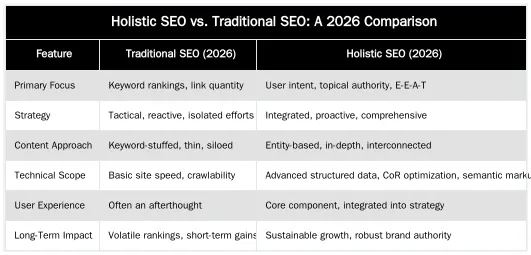
Holistic SEO vs. Traditional SEO: A 2026 Comparison
The fundamental difference between these two approaches lies in their scope and underlying philosophy. Traditional methods focus on isolated ranking factors, while a comprehensive strategy integrates all aspects of online presence to serve user intent and build authority.
What is Traditional SEO?
Traditional search engine optimization primarily focuses on ranking for specific keywords. Its tactics often involve keyword research, basic on-page optimization (meta tags, heading tags), acquiring backlinks, and some technical fixes. This approach is often reactive and aims for quick wins, treating search engine algorithms as a set of rules to be gamed rather than a system designed to understand and serve users.
What is Holistic SEO?
Holistic search engine optimization is an integrated strategy that encompasses technical foundations, comprehensive content, superior user experience (UX), and advanced semantic understanding. It prioritizes user intent, builds deep topical authority, and aims to establish a brand as the most relevant and trustworthy source of information for a given set of entities. This approach aligns with modern search engine algorithms that increasingly prioritize understanding context and user satisfaction.
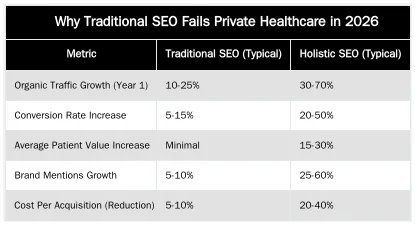
Why Traditional SEO Fails Private Healthcare in 2026
For private healthcare providers, especially plastic surgeons and aesthetic clinics, traditional search optimization methods are increasingly insufficient. The inherent limitations of a keyword-centric approach fail to address the complex requirements of modern search engines and the critical nature of medical information.
The Fundamental Flaw for Plastic Surgeons
Traditional SEO’s narrow focus on ranking for a list of keywords ignores several non-negotiable elements for success in the YMYL (Your Money or Your Life) healthcare sector. It often overlooks the technical foundations required for efficient crawling and indexing, the intricate user journey from awareness to conversion, and the paramount need to build deep, verifiable topical authority. For a plastic surgeon, simply ranking for “rhinoplasty London” is not enough if the website lacks the comprehensive information, trust signals, and user experience that patients and search engines demand.
Navigating YMYL: Beyond Keywords
Medical content falls under Google’s stringent YMYL guidelines, necessitating exceptional levels of Expertise, Experience, Authoritativeness, and Trust (E-E-A-T). Traditional methods, which often prioritize keyword density over genuine expertise, fall short here. They cannot adequately demonstrate a clinic’s credentials, the surgeon’s experience, or the trustworthiness of the information provided. Search engines in 2026 are sophisticated enough to discern superficial content from truly authoritative sources, making a comprehensive, trust-building strategy essential.
The Pillars of a Holistic SEO Strategy for Medical Clinics
A comprehensive search engine optimization strategy for private healthcare is built upon several interconnected pillars. These components work in synergy to create a robust online presence that satisfies both search engine algorithms and prospective patients.
Semantic Content Architecture & Topical Authority
Building a strong online presence for medical clinics requires moving beyond individual keywords to construct comprehensive content networks around core entities. This involves mapping out all relevant topics and sub-topics related to a medical specialty, such as plastic surgery, and creating interconnected content that thoroughly addresses every facet. This approach establishes deep topical authority, signaling to search engines that the clinic is a definitive source of information. It ensures that every patient query, from initial research to specific treatment details, is met with expert, authoritative content.
Technical SEO & User Experience (UX)
The technical foundation of a website is critical for both search engines and users. This includes optimizing site speed, ensuring mobile-friendliness, implementing structured data (Schema markup) to help search engines understand content, and providing intuitive navigation. A seamless user experience contributes directly to E-E-A-T by demonstrating professionalism and making valuable information easily accessible. A technically sound website ensures that search engines can efficiently crawl and index content, while a positive UX keeps potential patients engaged and builds trust.
Leveraging E-E-A-T and Semantic Engineering in 2026
For private healthcare providers, particularly in London’s competitive aesthetic medicine market, advanced strategies are necessary to stand out. This involves a deep understanding of E-E-A-T and the application of semantic engineering principles.
E-E-A-T: The Cornerstone of Medical SEO
Expertise, Experience, Authoritativeness, and Trust (E-E-A-T) are paramount for YMYL content. For medical clinics, this means clearly signaling the qualifications of practitioners, showcasing their experience through case studies and testimonials, establishing the clinic’s authority within its specialty, and building overall trust through transparent, accurate information. A holistic approach integrates these signals across the entire digital footprint, from website content to online reviews and professional affiliations. Understanding and implementing E-E-A-T for YMYL in 2026 is not merely a ranking factor; it is a prerequisite for patient safety and ethical practice.
Semantic Engineering & Cost of Retrieval (CoR)
Semantic engineering involves structuring content and data in a way that search engines can easily understand the relationships between entities. This includes advanced semantic modeling, such as Entity-Attribute-Value (EAV) structures, which precisely define medical procedures, conditions, and practitioners. By leveraging platforms like Ruxi Data, London clinics can optimize information retrieval, reducing the “Cost of Retrieval” (CoR) for search engines. Lower CoR means search engines expend less effort to understand and rank content, leading to improved visibility. This sophisticated approach enhances entity understanding, making a website a more valuable and easily digestible resource for search algorithms. For more on the foundational principles, see Information Retrieval on Wikipedia.
Long-Term Growth & ROI: The Holistic Advantage
While traditional SEO often delivers fleeting results, a holistic approach to search engine optimization provides sustainable benefits and a measurable return on investment for private healthcare providers. It shifts focus from temporary ranking boosts to enduring online authority and patient trust.
Sustainable Patient Acquisition & Brand Authority
By building deep topical authority and consistently demonstrating E-E-A-T, medical clinics achieve consistent organic visibility. This leads to a steady stream of higher-quality leads, as prospective patients are more likely to trust and convert with a recognized expert. A strong online presence, cultivated through a comprehensive strategy, translates into a robust brand reputation in competitive markets like London, attracting high-value patients seeking specialized care. This long-term investment yields compounding returns, establishing the clinic as a leader in its field.
Measuring Success Beyond Rankings
The success of a comprehensive SEO strategy extends beyond simple keyword rankings. Key Performance Indicators (KPIs) include conversion rates (e.g., appointment bookings, inquiry forms), patient inquiries, time on site, bounce rate, and overall organic traffic quality. These metrics provide a more accurate picture of patient engagement and business growth. Focusing on these deeper indicators ensures that SEO efforts are directly contributing to the clinic’s bottom line and long-term objectives. For foundational guidance on SEO, refer to the Google SEO Starter Guide.
Ready to Transform Your Clinic’s Online Presence?
The digital landscape of 2026 demands more than superficial SEO tactics. For private healthcare providers, particularly plastic surgeons and aesthetic clinics in London, a sophisticated, integrated approach is essential for sustainable growth and authority.
Partner with a Semantic SEO Expert
Elevate your clinic’s digital strategy with a specialist who understands the nuances of medical SEO, semantic engineering, and the London private healthcare market. Discover how a tailored Semantic SEO for Plastic Surgeons in London can build a robust online presence, attract high-value patients, and establish your practice as a leading authority. Partner with Abdurrahman Şimşek to implement a comprehensive strategy designed for long-term success.
Conclusion
The distinction between holistic SEO vs traditional SEO is clear: one offers fleeting results, while the other builds enduring digital authority. For private healthcare in 2026, a comprehensive, entity-based strategy is not merely an advantage but a necessity. By prioritizing E-E-A-T, semantic engineering, and an exceptional user experience, medical clinics can secure sustainable organic growth and establish themselves as trusted leaders. Embrace a forward-thinking approach to ensure your clinic thrives in the competitive online environment. To discuss a tailored strategy for your practice, visit AbdurrahmanSimsek.com.
Frequently Asked Questions
What is the core difference between holistic SEO vs traditional SEO for private healthcare?
Traditional SEO often focuses narrowly on individual keywords and quick ranking wins. In contrast, a holistic approach integrates technical excellence, semantic content, and E-E-A-T to build a comprehensive, resilient online presence that serves user intent across the entire patient journey. This fundamental distinction highlights why the holistic SEO vs traditional SEO debate is crucial for long-term success.
How does a comprehensive SEO strategy offer a more sustainable growth model for medical clinics?
A comprehensive strategy, unlike traditional methods, builds a resilient digital asset by focusing on technical excellence, creating a semantic content network, and establishing verifiable E-E-A-T. This makes a website less vulnerable to algorithm updates and creates a long-term competitive moat, providing sustained organic growth beyond what a keyword-centric approach can achieve.
In the holistic SEO vs traditional SEO debate, how does content creation differ?
In traditional SEO, content is often created primarily to target specific keywords. However, in a holistic approach, content is engineered to build a comprehensive knowledge base that serves the user at every stage of their journey, becoming a core part of the website’s semantic architecture, not just a collection of articles. This ensures deeper engagement and authority.
Does adopting a holistic approach mean completely disregarding keywords?
Not at all. A holistic approach views keywords as vital representations of user intent within a broader topic, helping us understand our audience. The distinction in holistic SEO vs traditional SEO is that the goal shifts from merely ranking for a few phrases to building deep topical authority around an entire subject matter, using keywords as a guide.
Why is Abdurrahman Şimşek’s methodology considered a leading example in the holistic SEO vs traditional SEO discussion?
Our methodology is considered holistic because it seamlessly integrates advanced technical SEO, semantic content engineering, and robust E-E-A-T infrastructure into a unified strategy. We treat these as interconnected components essential for building a dominant online presence for medical clients, moving beyond the limitations of traditional, siloed approaches.
How can private healthcare providers begin implementing a comprehensive SEO strategy?
To start transforming your clinic’s online presence, we recommend scheduling an initial consultation with Abdurrahman Şimşek. This allows us to assess your current digital footprint and discuss how a tailored semantic SEO strategy can achieve your long-term growth objectives in the competitive healthcare market.
Ruxi Data brings together multi-model AI, automated website crawling, live indexation checks, topical authority mapping, E-E-A-T enrichment, schema generation, and full pipeline automation — from crawl to WordPress publish to social posting — all in one platform built for agencies and freelancers who run on results.