Surgical Procedure Attributes: Enhancing Patient Decisions and SEO
Understanding surgical procedure attributes like procedure time, recovery duration, anesthesia type, and cost is fundamental for patient decision-making and effective SEO. This article explains how structuring these critical data points, using methods like Entity-Attribute-Value (EAV) modeling and custom post types, significantly improves user experience and search visibility for medical clinics. Clear presentation of these attributes builds patient trust, satisfies specific search intent, and strengthens topical authority within the competitive YMYL medical sector, especially for London’s private healthcare market.
Abdurrahman Şimşek, a Semantic SEO Strategist with over 10 years of experience, specializes in building high-authority semantic content networks for medical and plastic surgery clinics. His expertise in information retrieval and EAV modeling optimizes medical data for superior online performance.
To explore your options, contact us to schedule your consultation. You can also reach us via: Book a Semantic SEO Audit, Direct WhatsApp Strategy Line: +90 506 206 86 86
Understanding surgical procedure attributes like time, recovery, anesthesia type, and cost is critical for patients and SEO. This article explains why these data points are crucial for the patient journey, how to structure them for user experience and search visibility, and strategies to leverage them for topical authority and conversion optimization in the London medical market. A clear presentation of these details builds trust and streamlines patient research.
Why Are Surgical Procedure Attributes Critical for Patient Decisions and SEO?
Attributes like procedure time, recovery duration, anesthesia type, and cost are fundamental for patients evaluating medical treatments. Providing this information upfront addresses core concerns, builds trust, and helps patients determine suitability. For SEO, these structured data points align with user search intent, improve eligibility for rich results, and strengthen a website’s E-E-A-T (Experience, Expertise, Authoritativeness, Trustworthiness) signals in the YMYL (Your Money Your Life) medical sector.
Patients research these practical aspects first. A website providing clear answers for each surgical procedure attribute becomes a reliable source. This transparency reduces patient anxiety and improves user experience. For search engines, well-defined data points improve content understanding, leading to better rankings for relevant queries. This is vital in competitive markets like London, where clinics differentiate through information delivery.
Identifying & Structuring Key Surgical Procedure Attributes for Clarity
Collect essential attributes for medical procedures as structured data points, not descriptive text. This supports efficient data management and scalability. Tools like custom post types and Advanced Custom Fields (ACF) in a CMS let clinics define, store, and manage data fields for each procedure consistently. This approach ensures every procedure page presents comprehensive, comparable information for patients and search engines.
Essential Data Points for Every Procedure Page
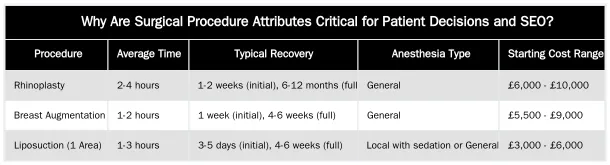
Every procedure page needs these data points: average procedure time (e.g., “1-3 hours”), a recovery timeline detailing initial downtime and when normal activities can resume, and common anesthesia types (local, sedation, general) with brief explanations. Transparent cost ranges or starting prices are essential for patient self-qualification and trust. Providing these details upfront helps patients make informed decisions and reduces unqualified inquiries.
Beyond the Basics: Advanced Attributes for Competitive Advantage
Advanced attributes provide a competitive edge. These include typical pain level (on a scale), expected results with timelines, and the number of required sessions for multi-stage treatments. Detailed pre-procedure preparation and post-procedure care guidelines enhance patient understanding. This granular detail improves the patient experience and signals expertise to search engines, strengthening topical authority.
Implementing Surgical Procedure Attributes for Enhanced UX & SEO
Present procedure attributes for both user experience and technical SEO. Use clear formatting like bullet points, dedicated sections, or comparison tables for readability. Ensure mobile responsiveness so information is digestible on any device. Use schema markup to define attributes for search engines, improving eligibility for rich results and entity recognition.
Crafting Clear & Concise On-Page Attribute Displays
Display attributes clearly. Bullet points are good for summaries, while dedicated sections allow for detailed explanations. Comparison tables are effective for procedures with similar goals but differing attributes, helping patients weigh options. The goal is to make complex medical information accessible and easy to understand.
Leveraging Schema Markup for Surgical Procedure Data
Schema markup communicates procedure details to search engines. By implementing advanced medical schema, specifically `MedicalProcedure`, `Physician`, and other properties, clinics can define attributes like `procedureType`, `recoveryTime`, `anesthesia`, and `estimatedCost`. This structured data helps Google understand each offering, increasing the likelihood of appearing in rich results like carousels or enhanced snippets. Accurate schema implementation is a cornerstone of medical SEO, ensuring search algorithms recognize and use your site’s detailed information.
How Entity-Attribute-Value (EAV) Modeling Transforms Medical Content
Entity-Attribute-Value (EAV) modeling provides a framework for organizing complex medical data like surgical procedure attributes. As a Semantic SEO Strategist with over 10 years of experience, Abdurrahman Şimşek uses EAV to build authoritative semantic content networks. This approach moves beyond keyword matching, enabling Google to understand the relationships between medical entities (e.g., “Rhinoplasty”), their attributes (e.g., “recovery time”), and their values (e.g., “2 weeks”). This structured understanding gives London’s clinics an advantage, allowing them to improve search results by providing clarity and depth of information.
From Disparate Data to a Cohesive Semantic Network
EAV modeling transforms fragmented information into a cohesive semantic network. Each attribute is linked to its parent entity (the procedure) and connected to broader medical concepts. For instance, “recovery time” for “Rhinoplasty” can link to “post-operative care” and “patient expectations.” This interconnectedness creates an authoritative content structure favored by Google’s algorithms. Explore our guide on the EAV model for surgical procedures and understand how Entity-Attribute-Value (EAV) SEO can be applied.
Future-Proofing Your Content with Ruxi Data & Semantic Engineering
Implementing EAV, combined with tools like Ruxi Data, enables scalable content generation and automated updates. This methodology addresses Google’s evolving algorithms, including those for Generative Engine Optimization (GEO) and AI Overviews. Structuring information precisely optimizes for “Cost of Retrieval” (CoR), making it faster for search engines to process content. This efficiency improves crawlability, indexing, and visibility, aligning with Google’s understanding of search.
Optimizing Procedure Attributes for Higher Conversions & Patient Trust
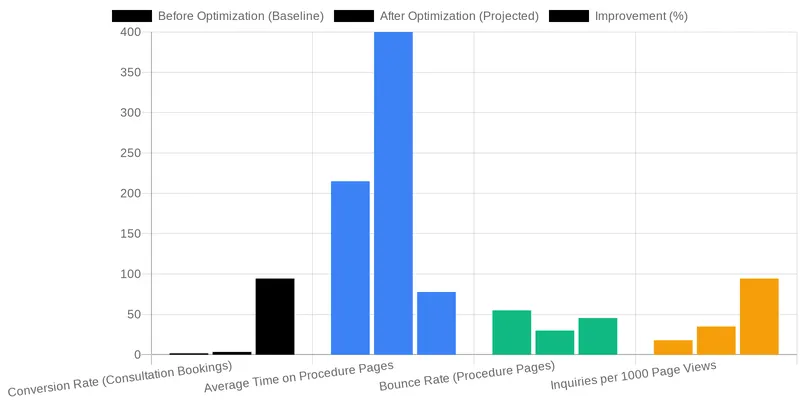
Optimizing procedure attributes directly impacts business outcomes. Clear, transparent information fosters patient trust. Patients who find details on procedure time, recovery, anesthesia, and cost are more likely to engage, spend more time on the page, and book a consultation. This approach aligns with YMYL principles by providing accurate information that empowers patient decision-making, leading to higher conversion rates.
Addressing Patient Concerns Proactively with Data
Providing attribute data upfront addresses common patient questions and alleviates anxieties. This helps patients self-qualify, so contacts are well-informed with a higher intent to book. This efficiency in the patient acquisition funnel benefits busy London clinics. Research shows transparent information impacts patient satisfaction and trust, as detailed in studies on patient information needs.
Measuring the Impact: KPIs for Attribute Optimization
Monitor key performance indicators (KPIs) to assess attribute optimization. These include conversion rate (form submissions, calls), time on page, bounce rate, and engagement with elements like comparison tables or FAQ sections. Tracking these metrics shows how improved data presentation translates into better user engagement and more patient inquiries.
Partner with a Semantic SEO Strategist for Data-Driven Growth
Leveraging surgical procedure attributes requires expertise in semantic SEO and web development. Abdurrahman Şimşek, a London-based Semantic SEO Strategist, offers solutions for plastic surgeons and aesthetic clinic owners. With 10 years of experience, he specializes in building Semantic Content Networks, using EAV modeling and Ruxi Data to optimize for Google’s algorithms. For clinics seeking to attract high-value patients and improve local organic search across Harley Street and premium London postcodes, discover how specialist medical SEO services can improve your online presence.
Conclusion
Structured presentation of surgical procedure attributes is fundamental for patient empowerment and SEO performance. Detailing procedure time, recovery, anesthesia, and cost builds trust and enhances user experience. Strategies like Entity-Attribute-Value (EAV) modeling and schema markup help search engines comprehend and prioritize this information, driving topical authority and conversions. For London’s medical market, this data-driven approach is a necessity for growth. Book a Semantic SEO Audit or reach out directly via WhatsApp: +90 506 206 86 86.
Frequently Asked Questions
Why are key surgical procedure attributes like time, recovery, and cost crucial for patients and SEO?
These attributes are fundamental data points patients use to evaluate and compare treatments. Clearly presenting these details addresses core concerns, builds trust, and helps potential clients understand if a procedure aligns with their needs. For SEO, clearly presenting these surgical procedure attributes provides valuable content that search engines can understand and rank.
What is the best way to structure information about a procedure’s characteristics on a webpage?
A consistent, easy-to-scan format, such as an ‘At-a-Glance’ info box at the top of the page, works best. Using clear headings and icons for each characteristic enhances readability for users and provides a clear structure for search engine crawlers. This improves both user experience and search visibility.
How does transparency regarding the cost of medical procedures impact patient conversions?
Providing transparent price ranges significantly helps conversions by managing expectations and pre-qualifying leads. Patients, especially in high-value markets like London, expect this openness. Hiding costs can lead to distrust and unqualified inquiries, which wastes valuable administrative time.
How can structured data enhance the visibility of surgical procedure attributes?
Structured data, such as Schema.org markup, helps search engines understand the context and details of your medical content. By mapping specific procedure characteristics to relevant properties, you provide rich, E-E-A-T-driven data that can improve how your services appear in search results. This makes your surgical procedure attributes more discoverable.
What additional surgical procedure attributes should clinics consider including on their websites?
Beyond time, recovery, anesthesia, and cost, consider adding ‘Ideal Candidate,’ ‘Results Duration,’ ‘Technology Used,’ and ‘Pain Level.’ The more relevant and structured surgical procedure attributes you provide, the more comprehensive your resource becomes, strengthening your topical authority and ability to answer patient questions.
How can I get expert help optimizing my clinic’s surgical procedure attributes for SEO?
Abdurrahman Şimşek, a London-based Semantic SEO Strategist, specializes in building high-authority content networks for medical clinics. You can book a Semantic SEO Audit via his website or directly contact him on WhatsApp at +90 506 206 86 86 for data-driven growth strategies tailored to your surgical procedure attributes.
Ruxi Data brings together multi-model AI, automated website crawling, live indexation checks, topical authority mapping, E-E-A-T enrichment, schema generation, and full pipeline automation — from crawl to WordPress publish to social posting — all in one platform built for agencies and freelancers who run on results.