Google Ads Clicks but No Patients: Optimizing for Patient Acquisition
If your google ads clicks but no patients, it signals a critical disconnect in your patient acquisition strategy. This article presents a conversion audit framework to diagnose why high click-through rates fail to generate actual patient inquiries for medical and aesthetic clinics. It details how to align ad copy with specific user intent, optimize medical landing pages for conversion, and improve lead quality. Understanding this framework helps transform wasted ad spend into effective patient growth, reducing patient acquisition cost and securing valuable cosmetic surgery leads.
Abdurrahman Şimşek, a Semantic SEO Strategist with over 10 years of experience, specializes in building high-authority semantic content networks for medical clinics and plastic surgeons. His expertise ensures digital strategies drive tangible patient conversions, focusing on YMYL and E-E-A-T optimization.
To explore your options, contact us to schedule your consultation.
Are your google ads clicks but no patients? This common issue indicates a disconnect between ad campaigns and patient acquisition for your medical or aesthetic clinic. High click-through rates often fail to generate patient inquiries. This article provides a conversion audit framework to diagnose the problem and offers strategies to convert ad spend into patient growth, focusing on the private healthcare sector.
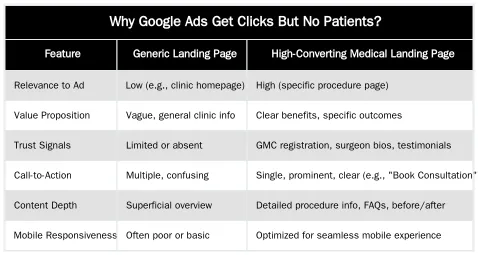
Why Google Ads Get Clicks But No Patients?
The most common reason for high Google Ads clicks without patient conversions is a mismatch between the ad’s promise and the landing page experience. Users click an ad expecting specific information or a clear action path but find generic content or confusing navigation. This disconnect breaks the patient journey, causing high bounce rates and wasted ad spend.
The Ad-to-Landing Page Disconnect Explained
A patient searching for “lip fillers London” or “rhinoplasty Harley Street” has clear intent. If your ad promises a solution but the landing page is a general homepage, the user’s expectation is not met, creating friction. A user needs a dedicated page for that service with relevant details, doctor expertise, and clear next steps. Without this alignment, even targeted ads will not convert. This is foundational to effective medical SEO for plastic surgeons and aesthetic clinics.
The Conversion Audit Framework: Diagnosing PPC Issues
A conversion audit identifies bottlenecks in your Google Ads campaigns. The framework analyzes every stage of the patient’s journey, from search query to conversion. It moves beyond superficial metrics to uncover the root causes of underperformance, ensuring every click has the potential to become a patient.
Auditing Your Ad Copy & Keyword Strategy
Audit your ad copy for clarity, compelling calls-to-action, and alignment with user intent. Ad copy must articulate the specific service and its benefits, with explicit calls-to-action. Analyze your keyword strategy to identify broad or irrelevant terms attracting low-quality traffic. A negative keyword list is crucial for filtering out searches that will not lead to patient acquisition. For instance, for cosmetic surgery leads, negative keywords should exclude “free” or “DIY.” This ensures ads reach interested individuals.
Evaluating Landing Page Performance & UX
Evaluate landing page performance by examining critical elements. A high-converting medical landing page features a clear value proposition addressing the patient’s need. Trust signals like GMC registration, doctor biographies, and patient testimonials are paramount. The page must be mobile-responsive. The user experience (UX) must be intuitive, with easy-to-find forms, contact information, and booking options. Optimizing these elements is central to conversion rate optimization (CRO for healthcare).
Optimizing for High-Value Patients: Key Strategies
Attracting high-value patients to plastic surgery and aesthetic clinics requires more than generic PPC tactics. It demands an approach that considers the sensitive nature of medical decisions and patient investment. These strategies focus on enhancing lead quality and optimizing the patient acquisition cost for specialized procedures.
Crafting Irresistible Ad Copy for Surgeons
Ad copy for medical procedures must build trust and convey expertise. Focus on the surgeon’s qualifications, experience, and specializations. Highlight desired patient outcomes and the clinic’s commitment to patient safety and satisfaction. For example, an ad for breast augmentation might emphasize “Board-Certified Plastic Surgeon, 15+ Years Experience” and “Natural-Looking Results.” A/B test ad variations to identify which messages resonate with your target audience. Address patient concerns and aspirations directly in the ad text.
Building High-Converting Medical Landing Pages
An effective landing page for a specific medical procedure is a comprehensive resource for that procedure, such as “breast augmentation London.” Key elements include detailed descriptions, before-and-after galleries, patient testimonials, and clear doctor bios. Provide transparent pricing or consultation fees where appropriate. Prominently display booking options like an online form, a call-tracked phone number, or live chat. The goal is to provide all necessary information and a clear path to conversion.
What to Expect: Measuring Your PPC Success
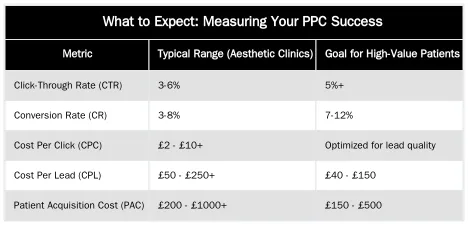
Measuring Google Ads success for medical clinics extends beyond clicks. Success is defined by patient acquisition and return on investment. Clinics must track key performance indicators (KPIs) to understand campaign effectiveness and make data-driven decisions. This approach ensures ad spend translates into patient growth and profitability.
Key Performance Indicators for Patient Acquisition
Beyond clicks, focus on metrics like Conversion Rate (CR), the percentage of clicks resulting in a desired action (e.g., form submission, phone call). Cost Per Lead (CPL) measures the cost to generate a single inquiry. Patient Acquisition Cost (PAC), the total cost to acquire a new patient, is paramount. Call tracking and form submission tracking are critical for accurate data collection. For plastic surgery ads, a good conversion rate is typically 5-10%, varying by procedure, location, and competition. Regularly analyzing these metrics allows for continuous campaign optimization.
Beyond Clicks: Semantic SEO for Patient Acquisition
While Google Ads provide immediate visibility, a digital strategy should integrate PPC with a semantic SEO foundation. This approach enhances ad performance and ensures sustainable patient acquisition. Semantic engineering and web development create a cohesive online presence that Google recognizes as authoritative and trustworthy, especially in Your Money Your Life (YMYL) niches like healthcare.
The Synergy of PPC and Semantic Content Networks
A semantic content strategy supports PPC by building topical authority. When Google recognizes your website as an expert resource for medical procedures, it better understands your ad relevance. This can lead to improved Ad Quality Scores, lower CPCs, and better ad positioning. Semantic content provides relevant content for landing pages, addressing user intent and improving conversion rates. E-E-A-T (Experience, Expertise, Authoritativeness, Trustworthiness) is amplified in healthcare. A content network informed by principles like deconstructing SERP intent ensures your clinic appears as a credible source. This integrated approach makes Google Ads campaigns part of a larger digital ecosystem.
Why Specialist Expertise Matters for Harley Street Clinics
The London private healthcare market, including Harley Street, Marylebone, and Mayfair, presents unique challenges. Generic digital marketing strategies fall short in this competitive environment. Expertise in medical SEO and semantic strategy is crucial. With over 10 years of experience, Abdurrahman Şimşek specializes in building semantic content networks for medical clinics and plastic surgeons. This includes integrating data infrastructures like Ruxi Data and developing high-converting websites for the London patient. This specialized knowledge optimizes digital efforts, including PPC, for lead quality and patient acquisition in this premium market. Understanding the technical aspects of a high-converting site, as explored in a technical SEO audit, is vital for performance.
Transform Your Ad Spend into Patient Growth
If your clinic’s Google Ads generate clicks but not patients, a strategic intervention is needed. The disconnect between ad performance and patient acquisition can be resolved with a targeted conversion audit and expert implementation. Transforming ad spend into patient growth requires understanding PPC mechanics and the patient journey in private healthcare. Specialized expertise can bridge this gap, ensuring your marketing investment yields results.
Conclusion
Google Ads generating clicks but no patients is a common, solvable problem for medical and aesthetic clinics. By implementing a conversion audit framework, refining ad copy and keywords, and optimizing landing pages, clinics can improve their return on ad spend. Integrating these PPC optimizations with a semantic SEO strategy builds topical authority and trust. For clinics in the competitive London private healthcare market, specialized expertise is essential. To convert more clicks into consultations and patients, connect with a specialist semantic SEO strategist.
Frequently Asked Questions
Why do my google ads clicks but no patients for my clinic?
The most common reason is a significant disconnect between your ad’s message and the landing page experience. Users click expecting specific information or a clear path, but often find generic content or confusing navigation. This mismatch breaks the patient journey, leading to high bounce rates and wasted ad spend, even when your google ads clicks but no patients are the result.
How can I diagnose why my google ads clicks but no patients?
A comprehensive conversion audit is essential to identify why your Google Ads get clicks but no patients. This involves analyzing user behavior on your landing pages with tools like heatmaps, meticulously reviewing your search term reports for irrelevant queries, and assessing the clarity and prominence of your call-to-action. Often, the root cause lies in the post-click experience rather than the ad itself.
What specific landing page issues cause google ads clicks but no patients?
Landing page issues that lead to google ads clicks but no patients include slow loading times, irrelevant content that doesn’t match the ad’s promise, and a lack of clear calls-to-action. A confusing layout, too much text, or requiring too many steps to book an appointment can also deter potential patients. Optimizing these elements is crucial for converting clicks into inquiries.
How do negative keywords improve the quality of ad leads?
A robust negative keyword list is critical for improving lead quality and preventing wasted ad spend. It stops your ads from appearing for irrelevant searches (e.g., “free,” “training,” “jobs”), ensuring that only genuinely interested potential patients click your ads. This pre-qualifies traffic, making your budget more efficient and targeting more precise.
Why is mobile page speed crucial for converting ad clicks into patients?
Mobile page speed is absolutely critical for converting ad clicks into patients, especially in the medical sector. A significant portion of users searching for cosmetic procedures do so on their mobile devices. A slow-loading page (over 3 seconds) will dramatically increase your bounce rate, wasting your ad spend before the user even has a chance to see your offer or call to action.
How can Abdurrahman Şimşek help my clinic convert Google Ads clicks into patients?
Abdurrahman Şimşek specializes in diagnosing and resolving conversion issues for medical clinics, focusing on semantic SEO and holistic digital strategies. He offers a comprehensive conversion audit framework to identify why your ads aren’t converting and implements tailored solutions, including landing page optimization and semantic content networks. You can learn more about his services and how to get started by visiting abdurrahmansimsek.com for a consultation.
Ruxi Data brings together multi-model AI, automated website crawling, live indexation checks, topical authority mapping, E-E-A-T enrichment, schema generation, and full pipeline automation — from crawl to WordPress publish to social posting — all in one platform built for agencies and freelancers who run on results.