Summaries for SGE: Optimizing Content for AI Overviews
Optimizing summaries for SGE is crucial for digital visibility in Google’s Generative Experience, especially for Your Money Your Life (YMYL) content. This guide details crafting concise, factual content to appear in AI Overviews, focusing on semantic structuring and direct answerability. It emphasizes the importance of accurate information retrieval for medical SEO and plastic surgery clinics. Mastering these techniques ensures content is easily summarized by natural language processing models, enhancing online presence and capturing high-value patient intent.
Abdurrahman Şimşek, a Semantic SEO Strategist with over 10 years of experience, specializes in building high-authority semantic content networks. His expertise in medical SEO and information retrieval ensures content is optimized for Google’s evolving generative search landscape, particularly for London’s private healthcare sector.
To explore your options, contact us to schedule your consultation. You can also reach us via: Book a Semantic SEO Audit, Direct WhatsApp Strategy Line: +90 506 206 86 86
Google’s Generative Experience (SGE) makes clear, concise summaries for SGE crucial for digital visibility in AI Overviews. This guide details how to optimize content for Your Money Your Life (YMYL) niches, like medical and plastic surgery, to capture high-value patient intent. It covers content creation and semantic structuring.
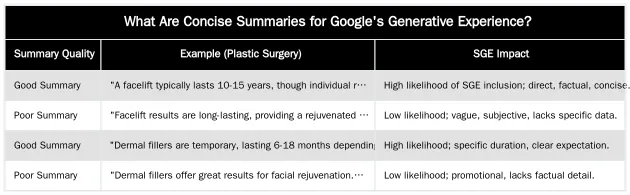
What Are Concise Summaries for Google’s Generative Experience?
Concise summaries for Google’s Generative Experience (SGE) are brief, factual distillations of information presented directly in Google’s search results. These AI Overviews provide immediate answers to user queries without requiring a click to a website. An ideal summary is 2-3 sentences (40-60 words), providing a direct, unambiguous response to a specific question. This format is critical for visibility in generative search.
Google’s SGE is a shift in information retrieval, offering generative AI answers above traditional search results. Content creators must optimize for direct answerability and semantic clarity. Websites must provide content easily summarized by natural language processing models. This approach is fundamental to Generative Engine Optimization (GEO), making content a candidate for inclusion in AI-generated responses.
The Role of AI Overviews in Modern Search
AI Overviews are the first point of contact for many search queries, synthesizing information from various sources into a coherent answer. This reduces the need for users to browse multiple websites for basic information. For businesses, especially in competitive sectors like private healthcare, appearing in these overviews provides direct exposure to potential patients. This shift requires definitive information that generative AI can cite.
Why Are Clear, Factual Summaries Critical for Medical SEO in SGE?
For YMYL (Your Money Your Life) content like medical and plastic surgery information, clarity and factual accuracy in AI Overviews are critical. Misinformation in health queries can have severe consequences, so Google’s generative AI prioritizes authoritative and unambiguous sources. Clear, factual summaries reduce misinterpretation, conveying sensitive health information responsibly. This impacts patient trust and the clinic’s reputation, making precise content a cornerstone of medical SEO.
Medical content, detailing a rhinoplasty procedure or explaining post-operative care, must be accurate. Generative AI prioritizes content with verifiable facts and expert consensus. For London’s private healthcare clinics, content for SGE summaries must be fact-checked and reflect current medical understanding. This precision helps Google’s AI extract and present your information, positioning your practice as a reliable source.
Establishing E-E-A-T Through Direct Answers
Well-crafted summaries reinforce Expertise, Experience, Authoritativeness, and Trust (E-E-A-T) signals, vital for medical content ranking in SGE. Direct, accurate answers demonstrate the author’s and institution’s knowledge and reliability. Medical practices should attribute content to GMC-registered consultant surgeons or other qualified medical professionals. This transparency builds trust with users and search algorithms. Establishing E-E-A-T for YMYL content is a requirement for responsible medical information dissemination.
Crafting SGE-Optimized Summaries: Best Practices & Techniques
For effective SGE summaries, structure content for machine readability and direct answers. Identify common patient questions like “What is the recovery time for breast augmentation?” or “Are dermal fillers permanent?”. Answer these questions directly and concisely, ideally in the first paragraph of a relevant section. Use clear, simple language, avoiding or explaining technical terms. Semantic clarity helps generative AI parse the core message and extract answers.
Integrating relevant keywords and semantic variations helps search engines understand the topic’s scope. The focus is answering user intent accurately. A question-and-answer format aligns with how AI Overviews present information. This approach aids SGE and improves the user experience for users seeking quick answers.
Structuring Content for AI Overviews and Rich Snippets
Semantic HTML, clear headings (H2, H3), and a logical content flow help AI parse and summarize content. Structured data like Schema markup explicitly defines entities and relationships for search engines. This helps generative AI extract precise information for AI Overviews and rich snippets. For medical procedure pages, clearly define the procedure, its benefits, risks, recovery, and cost. Structuring medical procedure pages effectively makes content user-friendly and machine-readable, maximizing SGE visibility.
Leveraging Semantic Engineering for SGE Success in Medical Practices
Abdurrahman Simsek’s approach to SGE optimization uses semantic engineering to build SGE-friendly content. It involves Entity-Attribute-Value (EAV) modeling, defining medical procedures, conditions, and treatments as entities with specific attributes. For example, a “Breast Augmentation” entity might have attributes like “Implant Type,” “Recovery Time,” and “Anesthesia.” Structuring content around these relationships creates a knowledge base Google’s generative AI can understand and trust.
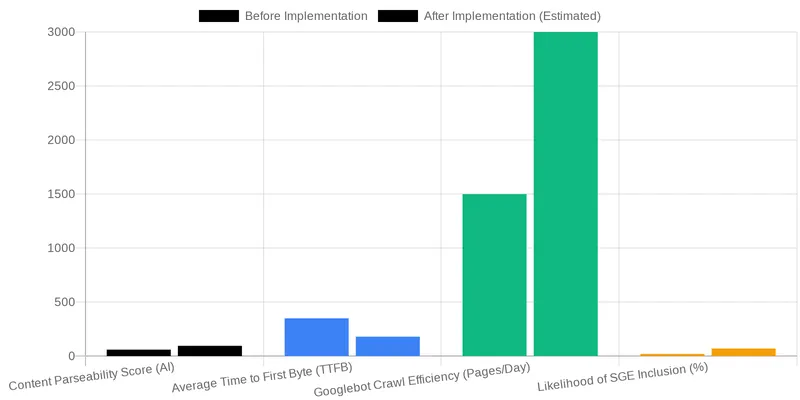
This semantic architecture, using tools like Ruxi Data, reduces Google’s “Cost of Retrieval” (CoR). Semantically clear, structured content requires less computational effort for search engines to understand and summarize. This efficiency is a competitive advantage for complex YMYL topics. For London’s private plastic surgery clinics, this means creating content that is efficient for Google to process, improving visibility in AI Overviews.
Ruxi Data & Automated Content Briefs for Generative AI
Ruxi Data is central to this semantic strategy. It analyzes SERP data and topical maps to identify semantic gaps and opportunities. This analysis informs automated content briefs that guide writers to produce SGE-optimized summaries and content covering all relevant entities and attributes. This ensures topical authority and semantic completeness, making content appealing to generative AI. Using Ruxi Data, medical practices can scale content production while maintaining the precision required for SGE visibility.
Measuring Impact & Adapting Your Strategy for Generative Search
Monitoring content performance in SGE and AI Overviews requires tracking new signals alongside traditional SEO metrics like organic traffic and keyword rankings. Track impressions and clicks from AI Overviews, if available, and observe how often your content is cited. Tools for monitoring brand mentions and content sourcing in generative answers are invaluable. This feedback loop allows for refining your content strategy to align with Google’s generative AI.
Adapt your strategy by analyzing which queries trigger AI Overviews and which content is successfully summarized. If topics fail to appear, re-evaluate their structure, clarity, and E-E-A-T signals. SGE optimization requires regular content audits and updates. This iterative process helps maintain and improve visibility to attract high-value patients.
Monitoring Brand Mentions and SGE Sourcing
Tracking when your clinic’s name or content is cited in AI Overviews provides direct insight into SGE performance. Use advanced search operators and monitoring tools to identify these instances. When your content is sourced, analyze the context. This feedback helps refine content for future generative summaries. Understanding how generative AI interprets and presents your information is key to optimizing for this new search paradigm.
Optimizing for Generative Engine Optimization (GEO) with a Specialist
SGE optimization for YMYL medical content demands specialized expertise. Abdurrahman Simsek, a London-based Semantic SEO Strategist, offers the technical knowledge and semantic engineering required for organic visibility. His focus on building Semantic Content Networks using Ruxi Data positions London’s private healthcare practices for success in generative search. Partner with an expert in medical SEO and AI Overviews. Book a Semantic SEO Audit. Direct WhatsApp Strategy Line: +90 506 206 86 86.
Conclusion
Google’s Generative Experience makes clear, concise, factual summaries critical. For medical and plastic surgery clinics in London, optimizing for AI Overviews is imperative for patient acquisition and digital authority. Using semantic engineering, prioritizing E-E-A-T, and structuring content for machine readability helps practices get featured. This approach to generative search optimization secures a competitive edge. For a tailored strategy, contact us. Direct WhatsApp Strategy Line: +90 506 206 86 86.
Frequently Asked Questions
What is the ideal length for summaries for SGE?
For optimal performance, aim for 2-3 concise sentences, typically between 40-60 words. This length allows Google’s AI to quickly parse and present definitive summaries for SGE in its AI Overviews. The objective is to deliver a direct, factual response that fully addresses the user’s query without unnecessary detail.
How do clear content summaries impact medical SEO within Google’s Generative Experience?
For Your Money Your Life (YMYL) topics, especially in the medical field, clear content summaries are paramount for establishing E-E-A-T (Experience, Expertise, Authoritativeness, Trustworthiness). Crafting effective summaries for SGE helps position your site as an authoritative source. This directly improves visibility in AI Overviews for high-value patient queries, enhancing trust and credibility.
Is it beneficial to use bullet points in summaries for SGE?
Yes, incorporating bullet points or numbered lists can be highly effective. This structured format enables Google’s Generative Experience to quickly extract and present key information, such as treatment benefits, procedural steps, or lists of symptoms. It makes the information more digestible for AI and users, contributing to better summaries for SGE.
Should I use my meta description as the basis for summaries for SGE?
It is generally not recommended to simply copy your meta description. A meta description’s primary purpose is to entice clicks in traditional SERP snippets, often using marketing language. In contrast, a summary for generative AI should be a direct, factual, in-content answer to a specific query, designed purely for information extraction and presentation by the AI.
How does schema markup contribute to effective content summaries for generative AI?
Absolutely. While schema markup isn’t a direct ranking factor for generative AI, it provides crucial context to search engines about your content’s nature and structure. Implementing relevant schema, such as `Article` or `MedicalProcedure`, helps Google better understand the information. This semantic clarity makes it significantly easier for the AI to generate accurate and relevant content summaries.
How can I get expert assistance with optimizing my content for Google’s Generative Experience?
To ensure your medical content is fully optimized for generative AI and achieves maximum visibility, consider a specialized Semantic SEO Audit. Abdurrahman Şimşek offers expert guidance in crafting content strategies tailored for SGE success. You can book a Semantic SEO Audit directly through his website to begin enhancing your online presence.
Ruxi Data brings together multi-model AI, automated website crawling, live indexation checks, topical authority mapping, E-E-A-T enrichment, schema generation, and full pipeline automation — from crawl to WordPress publish to social posting — all in one platform built for agencies and freelancers who run on results.