Patient Intent Mapping: Optimizing High-value Procedure Conversions
Patient intent mapping is a strategic SEO framework for medical clinics to align digital content with specific patient needs. This approach decodes the motivations behind search queries, guiding potential patients through their healthcare journey. By understanding evolving search intent, practices can optimize content for high-value procedures, from initial research to booking consultations. This framework ensures content resonates with user behavior, builds trust, and drives conversion rate optimization, particularly crucial for competitive markets like London’s Harley Street. It transforms generic inquiries into confirmed appointments for plastic surgeons and aesthetic clinics.
Abdurrahman Şimşek, a London-based Semantic SEO Strategist with 10 years of experience, specializes in building high-authority semantic content networks for medical clinics. His expertise in medical SEO and semantic engineering ensures content strategies effectively target high-value patients, particularly in competitive markets like Harley Street.
To explore your options, contact us to schedule your consultation.
Attracting high-value patients to your medical practice in a competitive market like London requires more than just keywords; it demands a deep understanding of their needs. This guide will demystify patient intent mapping, an advanced SEO framework designed to align your content precisely with what potential patients are searching for, leading to higher conversions for high-value procedures. By understanding the motivations behind each search query, medical clinics can craft targeted content that resonates, builds trust, and guides patients effectively through their decision-making journey. This strategic approach ensures your online presence serves genuine patient needs, transforming inquiries into appointments.
What is Patient Intent Mapping & Why It’s Critical for High-Value Procedures?
Patient intent mapping is a strategic SEO process that identifies and categorizes the underlying motivation behind a patient’s search queries. It moves beyond simple keyword matching to understand what a potential patient truly seeks at each stage of their healthcare journey. This approach allows medical practices to align their digital content with specific patient needs, ensuring maximum relevance and engagement.
For high-value procedures, such as plastic surgery or advanced aesthetic treatments, generic SEO strategies often fall short. Patients considering these significant investments conduct extensive research, driven by specific concerns, desires, and financial considerations. Understanding their evolving intent—from initial curiosity about a procedure to comparing specialists in London—is paramount. Effective intent mapping ensures that a clinic’s website provides precise answers and compelling reasons to choose their services, directly addressing the patient’s emotional and practical needs. This targeted content strategy is crucial for converting complex, high-stakes inquiries into confirmed appointments, especially in competitive markets like Harley Street.
Decoding the Patient Journey: How Search Intent Evolves in Healthcare
The patient journey in healthcare is rarely linear; it typically involves several stages, each characterized by distinct information needs and search behaviors. From the moment a patient recognizes a need or desire for a medical procedure to the point of booking a consultation, their search intent evolves significantly. Recognizing these shifts is fundamental for medical marketing, allowing clinics to deliver the right content at the right time.
Initially, patients might be in an awareness phase, seeking general information. As they progress, they enter a consideration phase, comparing options and providers. Finally, they reach a decision phase, ready to take action. Each phase corresponds to different types of search queries: informational, commercial investigation, and transactional. Understanding this progression enables medical practices to build a comprehensive content strategy that nurtures potential patients through their entire journey, from initial query to conversion.
Understanding Informational Intent: Early-Stage Patient Queries
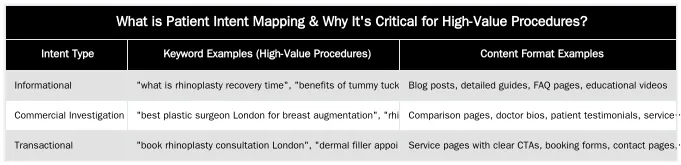
Informational intent characterizes the earliest stages of the patient journey. Here, individuals are seeking knowledge, understanding symptoms, conditions, or general details about a procedure without immediate intent to book. Examples include “what is rhinoplasty,” “causes of acne,” or “benefits of non-surgical facelift.” Content designed for informational intent should be educational, comprehensive, and authoritative. Blog posts, guides, FAQs, and explainer videos serve this purpose, establishing the clinic as a trusted source of information and building initial rapport. This content builds topical authority around specific medical conditions and treatments.
Navigating Commercial Investigation: Comparing Medical Options
As patients move into the commercial investigation phase, their queries become more specific and comparative. They are actively researching different treatment options, comparing clinics, evaluating specialists, and considering costs. Examples include “rhinoplasty vs. non-surgical nose job,” “best plastic surgeon London,” “cost of breast augmentation UK,” or “clinic reviews Harley Street.” Content for this stage should highlight differentiators, showcase expertise, and provide transparent information. Comparison pages, detailed service descriptions, doctor bios, patient testimonials, and case studies are effective here. This content helps patients narrow down their choices and build confidence in a particular provider.
Building Query Networks: Identifying & Categorizing Medical Keywords
Identifying the underlying intent behind medical keywords is a nuanced process that goes beyond simple keyword research. It involves semantic analysis and understanding the broader “query network” surrounding a specific procedure or condition. A query network maps out all related searches, showing how different keywords connect and what questions patients are asking at various points in their journey. This holistic view ensures no critical patient need is overlooked.
Categorizing these queries accurately is essential for effective content planning. Tools that analyze search engine results pages (SERPs) for common features (e.g., “People Also Ask,” local packs, shopping results) can provide clues about intent. Manual review of top-ranking content also reveals what Google perceives as the best answer for a given query. By clustering semantically related keywords, medical marketers can build a robust understanding of patient needs and design content that addresses them comprehensively.
From Keywords to Intent: Semantic Analysis for Medical SEO
Semantic analysis is crucial for uncovering the true intent behind patient queries, especially in the complex medical field. It involves understanding the meaning and context of words, rather than just their literal form. For instance, “lip filler” might imply a transactional intent, while “lip filler side effects” clearly indicates informational intent. By analyzing the entities, attributes, and relationships within a query, semantic SEO helps to accurately classify intent. This deeper understanding allows for the creation of content that precisely matches what the patient is looking for, improving relevance and search visibility. For a deeper dive into this process, explore deconstructing SERP intent.
Optimizing for Conversion: Content Strategies for Each Intent Type
Once patient intent is mapped, the next step is to develop content strategies that cater specifically to each intent type, guiding patients seamlessly through the medical marketing funnel. For high-value procedures, this means not just attracting traffic, but converting it into consultations and bookings. Each piece of content must serve a clear purpose, moving the patient closer to making a decision.
A well-structured content architecture ensures that informational content builds awareness and trust, commercial investigation content helps patients compare and choose, and transactional content facilitates the final booking. This integrated approach maximizes conversion rates by addressing patient needs at every touchpoint. It’s about creating a cohesive digital experience that anticipates and answers every potential question a patient might have, from initial research to scheduling their procedure.
Crafting Informational Content That Builds Trust & Authority
Informational content is the foundation of trust and authority for any medical practice. For high-value procedures, this content must be meticulously accurate, evidence-based, and easy to understand. Strategies include creating in-depth articles on conditions, detailed explanations of procedures, and comprehensive guides on recovery and aftercare. Content should be written by or reviewed by medical professionals, showcasing E-E-A-T (Experience, Expertise, Authoritativeness, Trustworthiness). Incorporating patient stories (anonymized where necessary) and expert opinions can further enhance credibility. The goal is to educate patients thoroughly, positioning the clinic as a reliable and knowledgeable resource, even before they consider a specific treatment.
Designing Transactional Content for High-Value Procedure Pages
Transactional content is designed for patients ready to take action. For high-value procedures like plastic surgery and aesthetic treatments, these pages must be highly persuasive and conversion-focused. Key elements include clear calls-to-action (e.g., “Book a Consultation,” “Request a Quote”), prominent contact information, and easy-to-use booking forms. Social proof, such as patient testimonials, before-and-after galleries, and surgeon credentials, should be strategically placed to build confidence. Detailed procedure descriptions, transparent pricing information (or clear explanation of consultation fees), and financing options can also address common patient concerns. Optimizing these pages for speed and mobile responsiveness is also critical to reduce friction in the conversion process. For more on building a robust content strategy for plastic surgery, refer to Plastic Surgery Topical Authority: A Content Blueprint for Growth.
The Abdurrahman Şimşek Framework: Advanced Intent Mapping for London Clinics
Leveraging over a decade of experience in semantic SEO and web development, Abdurrahman Şimşek has developed an advanced framework for patient intent mapping specifically tailored for the competitive London private healthcare market. This framework moves beyond conventional keyword analysis, integrating sophisticated semantic engineering principles and data-driven insights to create highly effective content architectures for plastic surgeons and aesthetic clinics. The approach recognizes the unique nuances of high-value patient acquisition in premium postcodes like Harley Street, Marylebone, and Mayfair.
The Abdurrahman Şimşek framework emphasizes building comprehensive topical authority, ensuring that every piece of content contributes to a clinic’s overall expertise and trustworthiness in the eyes of both patients and search engines. This involves meticulous analysis of query networks, entity relationships, and the competitive landscape to identify precise content gaps and opportunities. By focusing on the specific needs of London’s discerning patient base, this framework delivers a strategic advantage, driving organic growth and attracting high-value patients who are actively seeking specialized care. For further insights into semantic content structures, consult resources like Wikipedia on Semantic Networks.
Integrating Ruxi Data & Semantic Engineering for Precision Mapping
The Abdurrahman Şimşek framework incorporates Ruxi Data, a core semantic infrastructure, to achieve unparalleled precision in patient intent mapping. Ruxi Data allows for the granular analysis of vast datasets, identifying subtle semantic connections and emerging patient queries that traditional methods might miss. By applying semantic engineering principles, content is structured not just for keywords, but for entities and their attributes, creating a rich, interconnected knowledge base that Google’s algorithms favor. This advanced approach ensures that content is not only relevant but also contextually rich, providing comprehensive answers to complex medical queries. This level of detail is critical for medical SEO, where accuracy and depth are paramount. Learn more about structuring medical content effectively through Content Configuration for Clinical Accuracy: A Workflow for Medical SEO.
Measuring Success: ROI of Intent Mapping for Your Practice
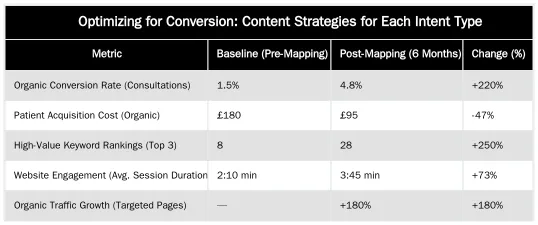
Implementing a robust patient intent mapping strategy requires investment, and measuring its return on investment (ROI) is crucial for medical practice owners. The effectiveness of this framework can be quantified through several key performance indicators (KPIs) that directly impact patient acquisition and revenue. Tracking these metrics provides actionable insights into content performance and overall digital marketing success.
Primary KPIs include conversion rates from specific content types (e.g., informational articles leading to consultation bookings), patient acquisition costs (PAC) via organic search, and the growth in organic visibility for high-value procedure keywords. Monitoring engagement metrics like time on page, bounce rate, and click-through rates for different intent-based content can also indicate relevance and user satisfaction. Ultimately, a successful intent mapping strategy translates into a higher volume of qualified leads, reduced marketing spend per patient, and a stronger, more authoritative online presence for the medical practice. This data-driven approach ensures continuous optimization and sustained growth.
Ready to Attract High-Value Patients? Partner with an Expert
Attracting high-value patients for plastic surgery and aesthetic treatments in London demands a specialized approach. Generic SEO strategies are insufficient for capturing the nuanced intent of discerning patients. If your clinic aims to dominate local organic search, enhance conversion rates, and build a robust online presence, expert guidance is essential. Abdurrahman Şimşek specializes in semantic SEO and web development for medical clinics, with a proven track record in the London market. Partner to transform your digital strategy and secure your position as a leader in private healthcare. Contact Abdurrahman Şimşek today to discuss a tailored solution for your practice.
Conclusion
Patient intent mapping is a foundational strategy for medical practices aiming to attract and convert high-value patients in competitive markets. By meticulously understanding and addressing the evolving needs of potential patients through their search queries, clinics can create a highly effective content architecture. This semantic approach, particularly when enhanced with advanced frameworks like those offered by Abdurrahman Şimşek, ensures that every piece of digital content serves a purpose, building trust, demonstrating expertise, and ultimately driving conversions. For London-based plastic surgeons and aesthetic clinics, mastering this framework is not just an SEO tactic; it is a strategic imperative for sustainable growth and market leadership. Elevate your digital presence and connect with the patients who matter most by implementing a precise intent-driven strategy. Explore how expert semantic SEO can benefit your clinic.
Frequently Asked Questions
What is the primary output of a patient intent mapping project?
The core outcome of a patient intent mapping project is a detailed strategic content plan. This plan precisely aligns specific page types and content formats to each stage of the patient’s decision-making journey, from initial research to booking. It dictates whether a query requires an in-depth informational guide, a comparative analysis page, or a direct service page with a clear call to action. This ensures every piece of content serves a specific purpose in guiding potential patients.
Why is generic keyword research insufficient for high-value procedures, and how does patient intent mapping address this?
Generic keyword research often prioritizes search volume, which doesn’t always correlate with patient value or conversion potential for specialized medical services. Patient intent mapping shifts the focus to understanding the specific, nuanced questions and concerns high-value patients have when seriously considering a procedure. This allows clinics to attract highly qualified leads who are genuinely interested in their services, rather than just general website traffic.
How does a strategic intent framework help convert more website visitors into consultations?
By precisely matching your content to the visitor’s current stage of consideration, this framework builds trust and provides immediate, relevant value. A user with informational intent receives a comprehensive guide that answers their initial questions, while a user with transactional intent finds clear pricing, clinic details, and booking information. This tailored approach streamlines the path to conversion, guiding potential patients effectively towards booking a consultation.
Does patient intent mapping influence a website’s technical SEO and structure?
Yes, insights derived from patient intent mapping significantly inform the website’s internal linking structure and overall architecture. We strategically organize the site to logically guide users from broader informational content to specific transactional pages, such as service or booking pages. This not only enhances user experience but also creates strong semantic signals for search engines, improving crawlability and authority.
How frequently should a medical clinic review and update its patient journey map?
A comprehensive review of your patient journey map should ideally be conducted annually, or whenever a significant new procedure is introduced to your services. However, continuous refinement is crucial, based on ongoing performance data, shifts in SERP landscapes, and new patient questions identified through tools like Google Search Console and direct patient interactions. This ensures the map remains relevant and effective in a dynamic healthcare market.
How can London clinics specifically leverage this approach for high-value procedures?
London clinics, especially those on Harley Street, can leverage this advanced approach by focusing on the unique nuances of their target demographic’s search behavior for high-value aesthetic and medical procedures. Abdurrahman Şimşek’s framework integrates deep semantic analysis and Ruxi Data to uncover precise patient needs, allowing for highly targeted content strategies. This ensures clinics attract and convert discerning patients seeking specialized treatments in a competitive market.
Ruxi Data brings together multi-model AI, automated website crawling, live indexation checks, topical authority mapping, E-E-A-T enrichment, schema generation, and full pipeline automation — from crawl to WordPress publish to social posting — all in one platform built for agencies and freelancers who run on results.