
Breadcrumb Schema for SEO: Enhancing Site Structure and Visibility
Implementing breadcrumb schema for SEO significantly improves website structure and search engine understanding. This article details how ‘WebPage’ and ‘BreadcrumbList’ schema types clarify content hierarchy, enhancing crawl efficiency and user experience. Proper JSON-LD implementation enables rich results, boosting visibility and click-through rates. Understanding these schema types is crucial for building robust information architecture and strengthening technical SEO foundations, especially for complex sites requiring clear navigational trails.
Abdurrahman Şimşek, a Semantic SEO Strategist, applies deep expertise in semantic engineering to optimize site-wide structure. His focus on advanced schema markup enhances information architecture and search engine understanding for complex websites, ensuring precise content relationships are communicated effectively.
To explore your options, contact us to schedule your consultation. You can also reach us via: Book a Semantic SEO Audit, Direct WhatsApp Strategy Line: +90 506 206 86 86
Implementing breadcrumb schema for SEO enhances a website’s structural clarity for users and search engines. ‘WebPage’ and ‘BreadcrumbList’ schema types improve site visibility, user experience, and technical health by helping Google understand content relationships, which can lead to better indexing and rich results. For complex medical sites, structured navigation is crucial for conveying expertise and trustworthiness.
Implementing BreadcrumbList Schema: A Practical JSON-LD Guide
Implementing BreadcrumbList schema with JSON-LD requires embedding a script in the page’s HTML. This script defines the hierarchical path from the homepage to the current page, with each step represented as an item in an ordered list. Accurate hierarchy and consistent naming are essential for search engines to correctly interpret the site’s structure.
Crafting Your Breadcrumb JSON-LD: Step-by-Step Implementation
To create the JSON-LD script, define the @context as Schema.org and the @type as BreadcrumbList. The itemListElement array contains each step in the breadcrumb path. Each item requires an @type of ListItem, a position (starting from 1), and an item object with the page’s @id (full URL) and name (display text). Below is an example for a medical procedure page:
<script type="application/ld+json">
{
  "@context": "https://schema.org",
  "@type": "BreadcrumbList",
  "itemListElement": [{
    "@type": "ListItem",
    "position": 1,
    "name": "Home",
    "item": "https://example.com/"
  },{
    "@type": "ListItem",
    "position": 2,
    "name": "Plastic Surgery",
    "item": "https://example.com/plastic-surgery/"
  },{
    "@type": "ListItem",
    "position": 3,
    "name": "Rhinoplasty",
    "item": "https://example.com/plastic-surgery/rhinoplasty/"
  }]
}
</script>
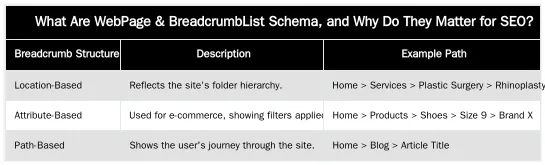
Sites use different breadcrumb structures based on their content organization. Understanding these variations helps select the most appropriate one.
Validating Your Schema: Tools and Common Pitfalls
After implementation, validate your structured data. Google’s Rich Results Test and the Schema Markup Validator are essential tools for checking errors and rich snippet eligibility. Common pitfalls include incorrect URLs, missing required properties like @id or name, improper nesting, or inconsistent position ordering. Addressing these issues ensures search engines correctly interpret your breadcrumb markup.
The Impact of Effective Breadcrumb Schema on User Experience & SEO Performance
Effective breadcrumb implementation benefits user experience (UX) and SEO performance. Breadcrumbs enhance site usability, reduce user frustration, and improve engagement metrics. These improvements positively influence how search engines perceive and rank a website.
Enhanced Navigation and Reduced Bounce Rates
Clear breadcrumbs help users understand their location and navigate to parent categories or the homepage. This intuitive navigation reduces user confusion, improving the site experience. Improved usability often lowers bounce rates and increases time on site—positive signals for search engines. For further insights, see UX best practices for web navigation.
Monitoring Rich Results and Performance in Google Search Console
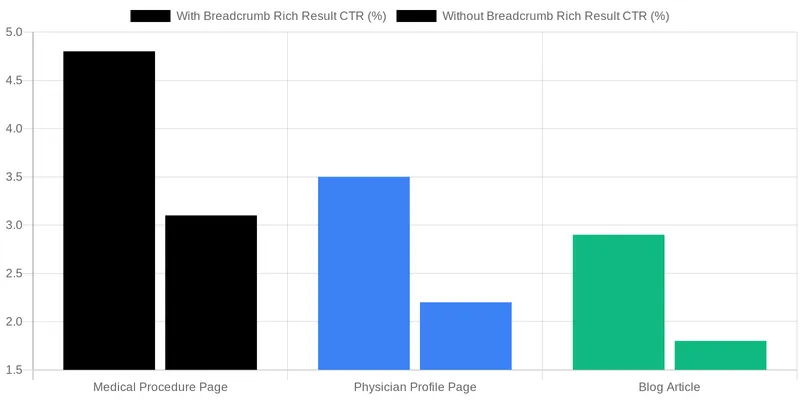
Google Search Console (GSC) provides insights into structured data performance. The ‘Enhancements’ section’s ‘Breadcrumbs’ report lets you monitor page eligibility for breadcrumb rich results, identify errors or warnings, and track their resolution. By analyzing ‘Performance’ reports in GSC, you can see how breadcrumb rich snippets impact click-through rates (CTR) from SERPs. A higher CTR for pages with rich results indicates the enhanced visibility is attracting more user engagement.
Here’s an example of how breadcrumb rich results can impact CTR:
Ready to Optimize Your Medical Website’s Structure?
A structured website with accurate WebPage and BreadcrumbList schema is essential for medical clinics aiming for top organic visibility. Abdurrahman Şimşek specializes in semantic SEO frameworks for London’s elite plastic surgeons and aesthetic clinics. His expertise ensures your site’s architecture earns rich results and builds topical authority and E-E-A-T. Book a Semantic SEO Audit to improve your digital presence. Direct WhatsApp Strategy Line: +90 506 206 86 86.
Conclusion
Implementing WebPage and BreadcrumbList schema is a cornerstone of technical SEO, particularly for medical websites. This structured data provides hierarchical context for search engines, leading to rich results, improved crawl efficiency, and stronger E-E-A-T signals. By clarifying site structure for users and algorithms, breadcrumbs improve user experience and online authority. For medical practitioners in London seeking organic search visibility, mastering these structural elements is essential for long-term success. Contact us to optimize your semantic structure.
Frequently Asked Questions
What are the primary SEO benefits of implementing breadcrumb schema for seo?
Implementing breadcrumb schema for seo helps search engines understand your site’s hierarchy, which can lead to rich results like breadcrumb trails in the SERPs. This not only improves user experience by clarifying navigation but also enhances click-through rates from search results. For medical sites, this structural clarity reinforces trustworthiness and ease of access to vital information.
How does using breadcrumb schema for seo impact crawlability and site structure?
Correct breadcrumb schema for seo provides clear, structured navigational paths for search engine crawlers, reinforcing your internal linking strategy. This helps search engines discover and index content more efficiently, especially crucial for large medical websites with deep content hierarchies. It strengthens the overall information architecture, making your site easier to process.
Is ‘WebPage’ schema essential for every page, especially for medical clinics?
While not strictly mandatory, using ‘WebPage’ schema (or a more specific subtype like ‘MedicalWebPage’) is a best practice for every page. It explicitly tells search engines about the page’s fundamental properties and its place within the site structure. For YMYL (Your Money Your Life) content like medical information, this clarity is vital for establishing E-E-A-T.
Beyond technical aspects, how does breadcrumb schema for seo enhance user experience and E-E-A-T for medical websites?
Effective breadcrumb schema for seo significantly improves user navigation by showing their current location within your site’s hierarchy, reducing bounce rates. For medical clinics, clear navigation builds trust and demonstrates a well-organized, authoritative resource, directly contributing to E-E-A-T signals. It helps users quickly find relevant information, which is critical in healthcare settings.
What tools can I use to verify my breadcrumb schema for seo implementation?
To ensure your breadcrumb schema for seo is correctly implemented, Google’s Rich Results Test tool is invaluable. Simply enter the URL or code snippet, and the tool will report any errors or warnings, helping you troubleshoot. This validation step is crucial for ensuring your structured data is eligible for rich results in search.
How can I get expert assistance with implementing breadcrumb schema for seo for my medical practice?
Abdurrahman Şimşek, a London-based Semantic SEO Strategist, specializes in building high-authority Semantic Content Networks for medical clinics. You can book a Semantic SEO Audit directly via his website at abdurrahmansimsek.com/contact/ or reach out through his WhatsApp strategy line for tailored guidance on implementing effective breadcrumb schema for seo and other advanced strategies.
Ruxi Data brings together multi-model AI, automated website crawling, live indexation checks, topical authority mapping, E-E-A-T enrichment, schema generation, and full pipeline automation — from crawl to WordPress publish to social posting — all in one platform built for agencies and freelancers who run on results.