
Automating E-e-a-t Signals: Scaling Medically Accurate Content
This article details how automating eeat signals enables medical clinics and plastic surgeons to scale medically accurate content efficiently. It outlines practical workflows for content governance and medical review, emphasizing structured data implementation for author and organization schema. Readers will learn to enhance YMYL compliance and boost organic visibility by systematically embedding E-E-A-T indicators. This strategic approach to automating E-E-A-T signals ensures content quality and accuracy, leveraging programmatic SEO for superior search performance in competitive healthcare niches.
Abdurrahman Şimşek, a Semantic SEO Strategist with over 10 years of experience, specializes in building high-authority Semantic Content Networks for medical clinics. His expertise in Semantic Engineering and Medical SEO helps healthcare providers achieve topical authority and YMYL compliance.
To explore your options, contact us to schedule your consultation.
In the highly regulated world of medical content, establishing and demonstrating Expertise, Experience, Authoritativeness, and Trustworthiness (E-E-A-T) is paramount. This article explores how automating eeat signals can help medical clinics and plastic surgeons scale medically accurate content efficiently, ensuring YMYL compliance and boosting organic visibility. We’ll delve into practical workflows, structured data implementation, and strategic insights for achieving superior search performance. Understanding these automated processes is crucial for any medical practice aiming to thrive in the competitive digital landscape of 2026.
What are Automated E-E-A-T Signals & Why They Matter for YMYL?
Automated E-E-A-T signals refer to the programmatic implementation of technical elements and content workflows that consistently demonstrate Expertise, Experience, Authoritativeness, and Trustworthiness to search engines. This automation is critical for medical content, especially in Your Money Your Life (YMYL) niches, because it ensures compliance, builds patient trust, and significantly enhances organic search visibility. By systematically embedding E-E-A-T indicators, medical practices can scale their content production without compromising quality or accuracy.
The Imperative of E-E-A-T in Medical SEO
E-E-A-T comprises four core pillars: Expertise (demonstrated knowledge), Experience (practical engagement with the topic), Authoritativeness (reputation among peers and industry), and Trustworthiness (legitimacy, accuracy, and safety). For YMYL topics like health and medical advice, Google places heightened emphasis on these signals. Content related to plastic surgery, aesthetic medicine, or any medical procedure directly impacts a person’s health, finances, or well-being. Therefore, search engines prioritize content from highly credible sources, making the consistent demonstration of E-E-A-T non-negotiable for ranking.
Key Ways to Start Automating E-E-A-T Signals
Initiating the automation of E-E-A-T signals involves several practical steps:
- Programmatic structured data implementation for authors, reviewers, and organizations.
- Automated “Last Updated” or “Last Reviewed” dates to signal content freshness.
- Systematic citation management systems for medical references.
- Integration of author biographies and credentials across relevant content.
- Leveraging content governance workflows to ensure consistent quality and review.
Crafting a Robust Workflow: Automating Medical Review & Content Governance
A successful strategy for scaling medically accurate content relies on a robust workflow that integrates human expertise with technical automation. This approach ensures content integrity while streamlining the publishing process. Content governance in a medical context involves clear guidelines for creation, review, approval, and maintenance, all of which can be supported by automated systems. The goal is to create a seamless pipeline from content ideation to publication and ongoing updates, maintaining clinical accuracy and compliance.
Implementing Algorithmic Authorship and Reviewer Schema
Algorithmic authorship involves programmatically assigning and displaying author and reviewer information using structured data. For medical content, this means consistently attributing articles to named experts, such as GMC-registered consultant surgeons. Their credentials, affiliations, and professional profiles can be linked via `Author` and `reviewedBy` schema markup. This method allows for scaling content production while ensuring that each piece carries the weight of a verified medical professional’s endorsement. Automated systems can pull expert details from a central database, ensuring accuracy and consistency across hundreds or thousands of pages. For instance, a system can automatically update an author’s latest publications or affiliations across all their attributed articles, reinforcing their expertise.
Managing Content Freshness and Citation Management at Scale
Maintaining content freshness is vital for YMYL topics, as medical information evolves. Automation can manage programmatic “last reviewed” dates, triggering alerts for content requiring updates or re-verification by medical professionals. This ensures that information remains current and accurate. Similarly, citation management systems can automate the display and linking of medical references to authoritative sources, such as the NHS, NICE guidelines, or peer-reviewed journals. This systematic approach to content configuration for clinical accuracy not only enhances E-E-A-T but also builds trust with readers and search engines. By integrating these processes, medical practices can demonstrate ongoing commitment to providing reliable, up-to-date information.
Leveraging Structured Data: Essential Schema for E-E-A-T Automation
Structured data, particularly Schema.org markup, is the language search engines use to understand the context and authority of your content. For medical websites, implementing specific schema types programmatically is fundamental to effectively communicating E-E-A-T signals. This technical layer helps search engines identify authors, reviewers, and the organizational backing behind the information, directly impacting how content is perceived and ranked. Consistent and accurate schema implementation across a site is a cornerstone of effective E-E-A-T automation.
Critical Schema Types for Medical E-E-A-T
Several schema types are crucial for medical E-E-A-T:
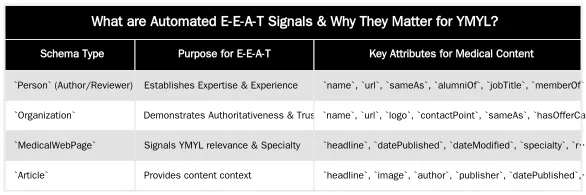
- `Author` and `Person` schema: Identifies the individual writer, including properties like `name`, `url`, `sameAs` (links to social profiles or professional pages), `alumniOf`, and `jobTitle`.
- `reviewedBy` and `Person` schema: Specifies the medical professional who reviewed the content, often a GMC-registered surgeon, with similar properties to the author.
- `Organization` schema: Represents the clinic or practice, detailing `name`, `url`, `logo`, `contactPoint`, and `sameAs` links to official profiles.
- `MedicalWebPage` and `Article` schema: Provides context for the content itself, indicating its medical nature and allowing for properties like `datePublished`, `dateModified`, and `specialty`.
- `Citation` schema: Used to mark up references to external authoritative sources, enhancing the trustworthiness of the information presented.
Programmatic Implementation of E-E-A-T Schema
Implementing E-E-A-T schema programmatically involves injecting JSON-LD markup into web pages, often through a Content Management System (CMS), custom scripts, or a semantic layer. This ensures consistency and scalability. For example, a CMS plugin can automatically generate `Author` and `reviewedBy` schema based on user profiles, or a custom script can update `dateModified` properties. The following table outlines key schema types and their attributes for medical content:
Beyond Automation: The Strategic Impact on Organic Growth & YMYL Compliance
The implementation of automated E-E-A-T signals extends far beyond technical SEO; it represents a strategic investment in a medical practice’s long-term digital health. This approach directly influences organic growth, patient trust, and regulatory compliance. By systematically demonstrating expertise and trustworthiness, medical websites can secure higher rankings, attract more qualified leads, and build a reputation as a reliable source of information. This proactive stance on E-E-A-T automation mitigates risks associated with YMYL content and fosters sustainable success.
Achieving Sustainable Organic Growth and Patient Trust
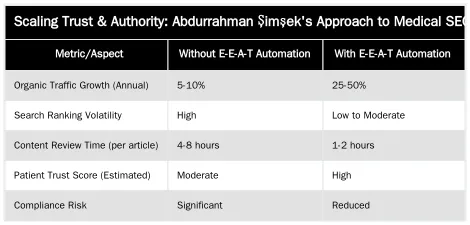
Consistently demonstrating E-E-A-T through automation directly correlates with improved search engine rankings and increased organic traffic. When search engines recognize a website as a highly authoritative and trustworthy source, they prioritize its content for relevant queries. This leads to a steady influx of potential patients actively seeking medical information or services. For medical practices, this translates into a higher return on investment (ROI) from their digital marketing efforts. Patients are more likely to trust and engage with content that clearly showcases expert authorship and rigorous review processes, fostering a stronger connection with the brand. This builds a foundation for long-term patient relationships and referrals.
Ensuring YMYL Compliance and Mitigating Risk
Google’s stringent YMYL guidelines demand that medical content be held to the highest standards of accuracy and reliability. A well-structured E-E-A-T automation workflow helps medical businesses meet these requirements, significantly reducing the risk of algorithmic penalties or demotions. By ensuring every piece of content is attributed to a qualified expert, regularly reviewed, and supported by structured data, practices can demonstrate their commitment to patient safety and ethical information dissemination. This proactive compliance strategy is essential for maintaining a strong online presence in the highly regulated healthcare sector. For further insights into technical automation, explore advanced WordPress SEO automation. Additionally, understanding the nuances of automated E-E-A-T signals for YMYL is crucial for risk management.
Consider the impact of E-E-A-T automation on various aspects of a medical practice’s online presence:
Conclusion
Automating E-E-A-T signals is not merely a technical optimization; it is a strategic imperative for medical clinics and plastic surgeons in 2026. By systematically integrating expert authorship, robust content governance, and precise structured data, practices can scale medically accurate content while building unparalleled trust and authority. This approach ensures YMYL compliance, mitigates risks, and drives sustainable organic growth, positioning medical businesses for long-term success in competitive markets like London. Embrace the power of semantic engineering to transform your digital presence.
Ready to elevate your medical practice’s online authority and achieve significant organic growth? Partner with an expert in semantic SEO and medical content strategy. Visit abdurrahmansimsek.com to learn how to implement advanced E-E-A-T automation workflows for your clinic.
Frequently Asked Questions
What is the most effective way to start automating E-E-A-T signals?
The most effective approach involves programmatically inserting structured data across your content. This includes adding ‘Author’ and ‘reviewedBy’ schema to every article and ensuring your Organization schema is complete. Additionally, using code to automatically display ‘Last Updated’ dates helps signal content freshness to search engines. This systematic implementation is key to effectively automating E-E-A-T signals.
Does automating E-E-A-T signals replace the need for human medical experts?
No, automating E-E-A-T signals is designed to scale the process of signaling human expertise, not replace it. A qualified medical professional must still review and approve the content for accuracy and safety. Automation then ensures this expert validation is clearly and consistently communicated to search engines, enhancing trust and authority.
How does ‘algorithmic authorship’ contribute to automating E-E-A-T signals?
Algorithmic authorship uses data and automation to consistently associate content with its rightful, expert author across an entire website. It involves structured data and internal processes to build a verifiable link between the content and the expert’s credentials. This ensures that every piece of content clearly attributes its expertise, a core component of automating E-E-A-T signals.
How can a CMS like WordPress be used for automating E-E-A-T signals?
In a CMS like WordPress, custom fields can be created for ‘Medical Reviewer’ and ‘Review Date’. This data can then be used by a custom function or plugin to automatically inject the correct ‘reviewedBy’ schema. Displaying this information on the front end further reinforces the content’s credibility and review status.
Can automating E-E-A-T signals help prevent content decay for medical content?
Yes, absolutely. By creating an automated system that flags content for medical review after a set period, such as 12 months, you can build a proactive content refreshment process. This systematically prevents information from becoming outdated, which is a critical aspect of maintaining strong E-E-A-T.
How can medical clinics get started with implementing these automated E-E-A-T strategies?
Medical clinics, plastic surgeons, and aesthetic practices can begin by consulting with a specialist in semantic SEO and medical content strategy. Abdurrahman Şimşek offers tailored strategic consulting to build high-authority semantic content networks. You can explore his services at abdurrahmansimsek.com to learn more about implementing these advanced workflows.
Ruxi Data brings together multi-model AI, automated website crawling, live indexation checks, topical authority mapping, E-E-A-T enrichment, schema generation, and full pipeline automation — from crawl to WordPress publish to social posting — all in one platform built for agencies and freelancers who run on results.