
Javascript Rendering SEO: Optimizing Clinic Site Visibility
Effective javascript rendering seo is crucial for JavaScript-heavy clinic websites to ensure Googlebot fully indexes dynamic content. This article details Googlebot’s two-wave rendering process and common challenges like hidden content and incomplete indexing that impact YMYL and E-E-A-T signals for medical clinics. It explores strategic solutions such as server-side rendering (SSR) and dynamic rendering, emphasizing how optimizing JavaScript execution improves search visibility, patient trust, and overall search performance for medical content.
Abdurrahman Şimşek, a London-based Semantic SEO Strategist, specializes in optimizing complex web architectures for medical clinics. His expertise in holistic SEO, semantic engineering, and technical web development ensures YMYL sites achieve robust search visibility and topical authority.
To explore your options, contact us to schedule your consultation.
Clinic websites use JavaScript for dynamic content, but unoptimized code can create hurdles for search engines like Google, impacting javascript rendering seo. Proper rendering ensures medical content is indexed and ranks competitively. For YMYL (Your Money Your Life) medical information, how Google processes dynamic content affects visibility, patient trust, and search performance.
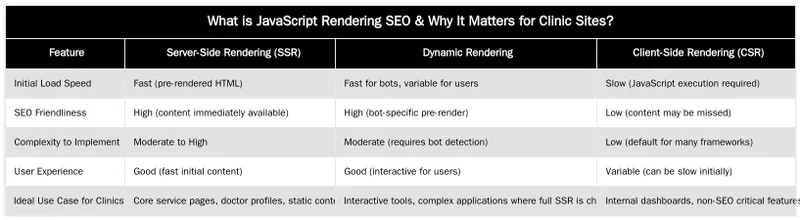
What is JavaScript Rendering SEO & Why It Matters for Clinic Sites?
JavaScript rendering in SEO is the process by which search engines like Google execute JavaScript code to build a webpage. For clinic websites using JavaScript for interactive elements, appointment booking forms, and dynamic content, proper rendering is fundamental for indexability and search visibility. If Googlebot cannot fully render the page, critical content may be missed, impacting rankings and patient acquisition.
Understanding Googlebot’s Rendering Process for Dynamic Content
Googlebot processes pages in two waves. The first wave crawls the initial HTML response. If the page contains JavaScript, Googlebot queues it for rendering. In the second wave, the Googlebot Rendering Service (GWCS) uses a headless Chrome browser to execute the JavaScript and see the fully rendered DOM (Document Object Model). This process consumes resources, so Google has a rendering “budget” per page. Complex or slow-loading JavaScript can exhaust this budget, leading to incomplete rendering and indexing.
The Direct Impact of Rendering on YMYL & E-E-A-T for Medical Clinics
For YMYL (Your Money Your Life) medical websites, rendering issues can undermine E-E-A-T (Experience, Expertise, Authoritativeness, Trustworthiness) signals. If elements like doctor bios, medical qualifications, patient testimonials, or procedure descriptions are loaded via JavaScript and not rendered, Google may not fully recognize the site’s expertise or trustworthiness. This affects how a clinic’s content is perceived in search results, reducing patient trust and conversion rates.
Common JavaScript Rendering Challenges for London’s Aesthetic Clinics
For London’s aesthetic clinics, JavaScript-heavy websites can present rendering challenges that hinder search performance. These issues range from content being missed by search engines to performance bottlenecks, impacting the clinic’s ability to attract patients.
Hidden Content & Incomplete Indexing: The Silent SEO Killer
On JavaScript-reliant clinic sites, content can remain “hidden” from Googlebot. Information such as procedure descriptions, surgeon profiles, before-and-after galleries, or pricing might only load after client-side JavaScript execution. If Googlebot’s rendering budget is exceeded or if the JavaScript executes too slowly, this content may not be indexed. This incomplete indexing means Google sees a partial version of the page, resulting in poor rankings for relevant queries.
Performance Bottlenecks: How JavaScript Impacts Core Web Vitals
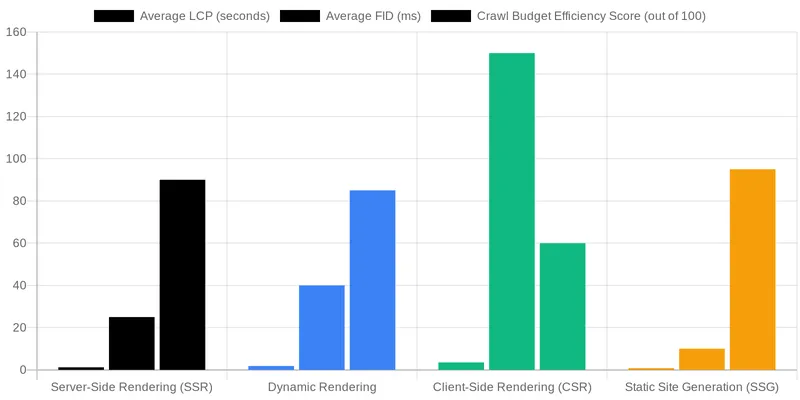
Heavy JavaScript execution impacts Core Web Vitals. Excessive JavaScript can delay the Largest Contentful Paint (LCP), cause high First Input Delay (FID), and contribute to Cumulative Layout Shift (CLS). For image-rich medical sites showcasing before-and-after photos, optimizing LCP on procedure pages is important. These performance issues signal a poor user experience to Google, negatively affecting search rankings. For more insights into Core Web Vitals for Surgeons, especially optimizing LCP on procedure pages, further resources are available.
Strategic Solutions: Server-Side Rendering (SSR) vs. Dynamic Rendering
To overcome JavaScript rendering challenges, medical clinics can implement Server-Side Rendering (SSR) or Dynamic Rendering. Both approaches make content accessible to users and search engines and have distinct use cases for medical websites.
Implementing Server-Side Rendering (SSR) for Critical Content
Server-Side Rendering (SSR) pre-renders a JavaScript application into a full HTML page on the server before sending it to the browser. Googlebot or a user receives complete, crawlable HTML content immediately. For clinic sites using frameworks like React or Vue.js, SSR provides faster initial page loads, improved Core Web Vitals, and guaranteed content availability for crawlers. After the initial HTML is delivered, client-side JavaScript “hydrates” the page, making it interactive. SSR is beneficial for content like service pages, doctor profiles, and educational articles, ensuring their immediate indexation.
Leveraging Dynamic Rendering for Specific Use Cases
Dynamic rendering detects if a request is from a search engine bot or a user. If it’s a bot, the server serves a pre-rendered, static HTML version. If it’s a user, it delivers the standard client-side rendered (CSR) version. This is a fallback for complex JavaScript applications that are difficult to fully SSR, or for pages where interactivity is needed alongside bot access to content. Dynamic rendering is effective for sections like interactive booking calendars or calculators, ensuring users get a rich experience while search engines receive a crawlable version.
Optimizing ‘Cost of Retrieval’ Through Efficient JavaScript Rendering
Efficient JavaScript rendering optimizes Google’s ‘Cost of Retrieval’ (CoR), which affects how search engines allocate resources to crawl and index websites. As a Semantic SEO Strategist and Web Developer, Abdurrahman Şimşek emphasizes that reducing CoR is critical for medical websites with extensive content networks. Minimizing the effort Googlebot expends to understand a page improves crawl budget, indexability, and topical authority.
For a deeper understanding of Optimizing Cost of Retrieval for complex medical websites, exploring the core principles is essential.
Minimizing Googlebot’s Resource Consumption on Clinic Sites
Every byte of JavaScript Googlebot downloads and executes adds to the ‘Cost of Retrieval’. SSR or dynamic rendering presents Googlebot with pre-rendered HTML, reducing JavaScript execution. This conserves crawl budget, allowing Googlebot to discover and index more pages. Techniques such as code splitting, lazy loading non-critical assets, and deferring non-essential JavaScript create a lighter page for crawlers, improving indexing efficiency and the ability to rank for a broader range of medical queries.
The Role of Technical Web Development in Rendering Efficiency
Optimal rendering efficiency requires technical web development expertise. A developer can implement rendering solutions, configure server-side rendering environments, and optimize client-side JavaScript for performance. This includes optimizing bundle sizes, implementing lazy loading for images and videos, and deferring non-critical JavaScript to ensure essential content loads first. For instance, deferring non-critical JavaScript on surgical service pages can improve initial load times and Googlebot’s ability to process the page quickly. These technical optimizations are fundamental to how search engines perceive a medical website’s content, influencing its search visibility and patient acquisition.
Verifying Google’s Rendering: Tools & Best Practices for Clinics
After implementing rendering optimizations, clinic owners and their SEO teams must verify that Google is correctly processing their JavaScript-driven content. This ensures that all medical information, surgeon profiles, and patient resources are visible to search engines, preventing indexing gaps.
Using Google Search Console’s URL Inspection Tool
The Google Search Console’s URL Inspection tool shows how Googlebot perceives your pages. In Search Console, enter a URL and select “Test Live URL.” This provides a screenshot of how Googlebot renders the page, along with the rendered HTML. Comparing this to what a user sees in their browser helps identify discrepancies, missing content, or JavaScript errors that might prevent full indexation. For detailed instructions, refer to Google’s official guide on the URL Inspection tool.
Leveraging Lighthouse & PageSpeed Insights for Rendering Performance
Lighthouse and PageSpeed Insights diagnose rendering-related performance issues. They analyze JavaScript execution time, main-thread work, and page speed, providing recommendations for optimizing JavaScript, such as reducing bundle sizes, deferring offscreen images, and minimizing main-thread blocking time. For medical websites with high-resolution images and interactive elements, these insights are critical for improving Core Web Vitals and user experience. Regularly running audits helps maintain optimal rendering performance. Access these tools at Google PageSpeed Insights.
Future-Proofing Your Clinic’s Website: A Holistic Approach to Rendering SEO
Optimizing JavaScript rendering is an ongoing process. Implementing SSR or dynamic rendering, minimizing ‘Cost of Retrieval’, and continuously verifying Google’s interpretation of your content safeguards search rankings and enhances the patient journey. This technical diligence improves visibility, patient acquisition, and sustained growth. For London’s private healthcare sector, a specialist who understands web development and semantic SEO is needed to navigate these complexities.
To ensure your clinic’s website prioritizes both patient experience and search engine performance, consider a strategic consultation. Visit abdurrahmansimsek.com to learn how semantic SEO and web development can elevate your online presence and drive patient leads.
Frequently Asked Questions
Why do modern clinic websites often have JavaScript rendering SEO issues?
Many modern clinic websites use JavaScript frameworks like React or Vue.js for interactive features such as ‘before and after’ sliders or booking forms. If not configured correctly, the main content might only load on the client-side, making it difficult for Googlebot to see and index, impacting javascript rendering seo. This can severely hinder visibility for critical medical information.
What is the most reliable solution for improving JavaScript rendering SEO?
Server-Side Rendering (SSR) is widely considered the most robust solution for improving javascript rendering seo. With SSR, the server sends a fully rendered HTML page to both the user and Googlebot, ensuring all content is immediately visible and indexable without requiring the crawler to execute JavaScript. This approach guarantees optimal indexability for your clinic’s vital information.
Is ‘Dynamic Rendering’ a good alternative for addressing JavaScript rendering SEO challenges?
Dynamic Rendering is an excellent alternative, specifically designed to address challenges with javascript rendering for SEO. It involves serving a pre-rendered, static HTML version of a page to search engine bots while serving the dynamic, client-side rendered version to human users. This provides the best of both worlds: optimal indexability and a rich user experience for your patients.
How can I test if Google can properly see my clinic site’s content?
The best tools for verifying Google’s rendering are the Mobile-Friendly Test or the URL Inspection Tool within Google Search Console. These tools provide a screenshot of the rendered HTML that Googlebot sees, allowing you to confirm if your critical medical content, service descriptions, and booking forms are fully visible and indexable. Regular checks are crucial for YMYL sites.
Can poorly implemented JavaScript affect my clinic’s Core Web Vitals?
Yes, poorly implemented JavaScript can heavily impact your Core Web Vitals. Large, unoptimized JavaScript files can block the main thread, significantly delaying the Largest Contentful Paint (LCP) and increasing Interaction to Next Paint (INP). Implementing proper code splitting, deferring non-critical scripts, and optimizing execution are essential for both rendering performance and user experience.
How can Abdurrahman Şimşek help my clinic improve its website’s rendering for search engines?
Abdurrahman Şimşek specializes in holistic SEO strategies for medical clinics, including optimizing complex JavaScript-heavy sites for Google. Leveraging 10+ years of experience in semantic engineering and technical SEO, we ensure your critical YMYL content is fully discoverable and ranks competitively. Contact us via our website to discuss a tailored strategy for your London-based clinic.
Ruxi Data brings together multi-model AI, automated website crawling, live indexation checks, topical authority mapping, E-E-A-T enrichment, schema generation, and full pipeline automation — from crawl to WordPress publish to social posting — all in one platform built for agencies and freelancers who run on results.