
Connect Surgeon to Procedures: Enhance E-e-a-t and Search Visibility
To connect surgeon to procedures effectively for medical SEO, clinics must implement structured data to define explicit entity relationships. This semantic linking, using schema markup like Physician and MedicalProcedure with the ‘performer’ property, helps search engines understand a surgeon’s expertise. Establishing these semantic triples enhances E-E-A-T signals, feeds the Google Knowledge Graph, and improves visibility for specialized queries. This strategy is crucial for attracting high-value patients by accurately attributing procedures to qualified practitioners, thereby boosting topical authority and search performance.
Abdurrahman Şimşek, a Semantic SEO Strategist, emphasizes that direct entity connections are foundational for building E-E-A-T in YMYL medical niches. His expertise in semantic engineering and structured data helps medical clinics achieve higher search rankings and attract target patients.
To explore your options, contact us to schedule your consultation. You can also reach us via: Book a Semantic SEO Audit, Direct WhatsApp Strategy Line: +90 506 206 86 86
Understanding how to connect surgeon to procedures is critical for SEO success in private healthcare. Semantically linking surgeons with their specialized treatments using structured data builds topical authority and E-E-A-T for your London clinic. Explicitly defining these entity relationships enhances visibility in search results, attracting high-value patients seeking specific treatments.
What is Entity-Based Connection for Surgeons and Procedures?
Entity-based connection for surgeons and procedures explicitly defines the relationship between a medical professional (the surgeon entity) and the treatments they perform (the procedure entity) using structured data. This semantic linking helps search engines understand a surgeon’s expertise and a clinic’s services, feeding the Knowledge Graph and enhancing E-E-A-T signals. Without this connection, search engines cannot confidently attribute procedures to practitioners, limiting visibility for specialized queries.
The Role of Semantic Triples in Medical SEO
The relationship between a surgeon and a procedure forms a semantic triple: Subject-Predicate-Object. For example, “Dr. Smith (Subject) performs (Predicate) Rhinoplasty (Object).” Google uses these triples to understand entities and their relationships in its knowledge base. In medical SEO, establishing these triples helps Google accurately recognize a surgeon’s expertise. This data is stored in a relational database, allowing search engines to retrieve relevant information when a patient searches for a procedure or specialist. These entity relationships are a key component of an E-E-A-T-driven SEO strategy.
Why is Connecting Surgeons to Procedures Critical for E-E-A-T?
In YMYL (Your Money Your Life) niches like private healthcare, E-E-A-T (Experience, Expertise, Authoritativeness, Trustworthiness) is critical. Linking surgeons to their procedures provides direct, verifiable signals to search engines about their qualifications and experience. This builds trust for the surgeon and the clinic. If Google identifies a surgeon as an expert in a procedure, it is more likely to rank their content and the clinic’s pages higher for relevant queries. This is vital for London’s competitive market, where patients seek reputable specialists.
Abdurrahman Şimşek, a Semantic SEO Strategist specializing in medical clinics, states this direct entity connection is foundational. “For a plastic surgeon in Harley Street, merely listing procedures isn’t enough. You must semantically tie each procedure to the specific surgeon who performs it, detailing their qualifications and experience. This is how you build true algorithmic authority.” This approach helps search engines recognize and reward medical expertise, aligning with Google’s quality guidelines for health content.
Building Algorithmic Authorship and Trust Signals
Linking a surgeon (as an author entity) to the medical procedures they perform (as content entities) strengthens their E-E-A-T profile. This process, known as building algorithmic authorship, shows search engines who is responsible for the medical information. When a surgeon’s profile is consistently associated with their specialized procedures, Google gains confidence in their expertise and trustworthiness. This builds a strong digital reputation, attracting patients in the London private healthcare sector. It also establishes the clinic as a reliable source of medical information, enhancing its authority.
Implementing Physician & MedicalProcedure Schema with ‘Performer’
The most effective method to connect surgeons to procedures is JSON-LD schema markup. Use the MedicalProcedure schema and embed or reference a Physician schema object with the performer property. This creates a machine-readable link for search engines. This structured data implementation is a cornerstone of advanced medical schema for surgeons.
Step-by-Step: Nesting Physician Schema within MedicalProcedure
On a procedure page, place a MedicalProcedure schema block. Within this block, define the performer property to point to a Physician schema object. This nested structure gives search engines granular detail.
<script type="application/ld+json">
{
  "@context": "https://schema.org",
  "@type": "MedicalProcedure",
  "name": "Rhinoplasty (Nose Reshaping)",
  "description": "Surgical procedure to reshape the nose, improving proportion and enhancing facial harmony.",
  "medicalSpecialty": "https://schema.org/PlasticSurgery",
  "performer": {
    "@type": "Physician",
    "name": "Dr. Eleanor Vance",
    "url": "https://yourclinic.com/surgeons/dr-eleanor-vance",
    "image": "https://yourclinic.com/images/dr-vance.jpg",
    "medicalSpecialty": "https://schema.org/PlasticSurgery",
    "knowsAbout": "Rhinoplasty, Septoplasty, Facial Rejuvenation",
    "alumniOf": "University College London",
    "hasCredential": {
      "@type": "EducationalOccupationalCredential",
      "credentialCategory": "FRCS (Plast)"
    },
    "memberOf": {
      "@type": "Organization",
      "name": "British Association of Plastic, Reconstructive and Aesthetic Surgeons (BAPRAS)"
    }
  },
  "procedureType": "Surgical",
  "bodyLocation": "Nose",
  "status": "Active"
}
</script>
This snippet defines the procedure and states that “Dr. Eleanor Vance” is the performer, linking to her physician profile. This detail helps search engines understand and display your clinic’s expertise.
Handling Multiple Surgeons or Procedures
Schema handles multiple surgeons or procedures using arrays. For a procedure with multiple surgeons, the performer property contains an array of Physician objects. A surgeon’s profile can list their procedures using the performerIn property, referencing MedicalProcedure objects.
Schema structures differ for single versus multiple performers:
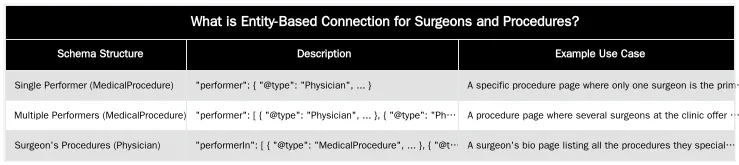
Correctly managed array structures ensure all relationships are communicated to search engines, providing a view of your clinic’s offerings and expertise.
Beyond Schema: Advanced Entity Modeling for Surgical Practices
While schema markup is essential, semantic engineering offers deeper control over entity relationships. Entity-Attribute-Value (EAV) modeling, for instance, provides a granular way to structure data about procedures and surgeons, reducing the ‘Cost of Retrieval’ for search engines. This approach builds an interconnected knowledge base for your medical website. For more, explore Entity-Attribute-Value (EAV) SEO.
Leveraging EAV Modeling for Granular Procedure Data
EAV modeling defines detailed attributes for procedures and surgeons. For “Rhinoplasty,” attributes could include ‘recovery time’, ‘anesthesia type’, or ‘post-operative care’. For a surgeon, attributes might include ‘years of experience’ or ‘number of procedures performed’. Structuring content and data with EAV creates machine-readable information that search engines can process. This precision helps Google match services with complex patient queries. This detail is critical for building a semantic network and is covered in our EAV modeling for procedures guide.
The Ruxi Data Advantage: Automating Entity Relationships
Platforms like Ruxi Data, used by Abdurrahman Şimşek, automate structuring complex entity relationships. This automation scales topical authority for London clinics with many services and specialists. Ruxi Data generates and maintains schema markup and EAV models automatically. This reduces the ‘Cost of Retrieval’ for search engines, so Google uses less effort to understand your content. Lower Cost of Retrieval can lead to more efficient crawling, better indexing, and improved search visibility. This automation is a differentiator in private healthcare SEO.
Impact on Knowledge Panels, Rich Results, and Local SEO
Correct entity connections, especially when you connect surgeon to procedures, yield benefits across search results. These include enhanced visibility in Google’s Knowledge Panels for surgeons, increased eligibility for rich results, and stronger local SEO signals for clinics in competitive areas like Harley Street. When Google links a surgeon to their expertise, it elevates their search presence.
Impact metrics:
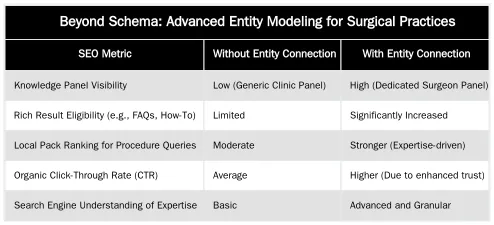
These improvements attract high-value patients. This detail is necessary for local SEO in London.
Enhancing Google’s Understanding of Your Clinic’s Expertise
An entity graph, built by connecting surgeons to procedures and other entities, helps Google associate your clinic with specific treatments and medical professionals. This clarity is crucial for ranking for long-tail queries. When Google understands your clinic has qualified surgeons for a procedure, your website becomes a more authoritative source. This leads to higher visibility, driving qualified traffic and patient inquiries.
Future-Proof Your Medical SEO with Semantic Engineering
Semantic entity connections are a future-proof approach to medical SEO, extending beyond current ranking factors. As search engines evolve toward entity-centric understanding, websites with a defined semantic architecture will perform better. This provides resilience against algorithm updates, ensuring long-term visibility and authority.
Abdurrahman Şimşek’s expertise in Semantic Engineering equips London medical practices with this advantage. By focusing on how entities like surgeons, procedures, and clinics relate, he builds a foundational, scalable SEO strategy. This prepares your clinic’s digital presence for the future of search, where understanding entity relationships is key. This is part of a technical SEO framework for medical websites.
Ready to Master Semantic SEO for Your Clinic?
Connecting surgeons to procedures with semantic strategies requires specialized expertise. To build topical authority, enhance E-E-A-T, and improve organic search for your London clinic, partner with an experienced semantic SEO strategist. Leverage Abdurrahman Şimşek’s decade of experience in medical SEO and Semantic Engineering.
Book a Semantic SEO Audit or reach out via WhatsApp Strategy Line: +90 506 206 86 86.
Frequently Asked Questions
What is the primary technical method to connect surgeon to procedures for SEO?
The most effective technical method to connect surgeon to procedures is by using nested JSON-LD Schema markup. Within your `MedicalProcedure` schema for a specific treatment, you utilize the `performer` property to reference and embed a `Physician` schema object for the surgeon specializing in that procedure. This explicit semantic link provides clear instructions to search engines about the relationship.
Why is it critical from an SEO perspective to connect surgeon to procedures?
Explicitly linking medical professionals to the treatments they perform is crucial for E-E-A-T (Experience, Expertise, Authoritativeness, Trustworthiness). This connection signals to Google that a recognized expert performs a specific procedure, transferring the surgeon’s authority to the content. It significantly boosts page credibility for high-stakes YMYL (Your Money Your Life) queries, helping your clinic outrank competitors.
How can consistently linking a surgeon to their performed procedures influence their Google Knowledge Panel?
When you consistently connect a surgeon to procedures across your website using structured data, you feed Google’s Knowledge Graph with rich information about their specializations. This structured input helps Google build a more comprehensive and detailed Knowledge Panel for the surgeon. It reinforces their expertise and authority in their specific medical fields.
How should the association between a medical professional and their treatments be presented visually on a website?
On each procedure page, it’s vital to prominently feature a profile block of the performing surgeon. This block should include their photo, name, credentials, and a clear link to their full biography. This user-facing element builds trust with potential patients by mirroring the backend semantic connection.
What is a common error when attempting to establish the relationship between a surgeon and their medical services?
A frequent mistake is merely linking to the surgeon’s biography page without implementing structured data. While internal linking is beneficial for navigation, it lacks the explicit, machine-readable instruction that `performer` schema provides. Without this semantic markup, the precise relationship remains ambiguous to search engines.
How can I get expert help to optimize my clinic’s semantic connections for surgeons and procedures?
To master semantic SEO for your clinic and effectively link your medical professionals to their specialized treatments, consider a specialized audit. You can book a Semantic SEO Audit with Abdurrahman Şimşek or reach out directly via WhatsApp at +90 506 206 86 86 for strategic consulting. This ensures your website leverages advanced entity modeling for maximum visibility.
Ruxi Data brings together multi-model AI, automated website crawling, live indexation checks, topical authority mapping, E-E-A-T enrichment, schema generation, and full pipeline automation — from crawl to WordPress publish to social posting — all in one platform built for agencies and freelancers who run on results.