
SEO Traffic Forecasting: Projecting Patient Leads for Medical Clinics
SEO traffic forecasting provides medical clinics with a data-driven framework to predict future organic search performance and patient leads. This process quantifies potential organic traffic projection, clarifies patient acquisition, and justifies digital marketing investments for plastic surgeons and aesthetic clinic owners. By analyzing keyword search volume, click-through rates, and conversion rates, clinics can build robust SEO ROI models. Accurate seo traffic forecasting informs strategic business planning and resource allocation, ensuring growth in competitive healthcare markets.
Abdurrahman Şimşek, a Semantic SEO Strategist with over 10 years of experience, specializes in building high-authority semantic content networks for medical clinics. His expertise in holistic SEO strategy and semantic engineering ensures reliable forecasting and data-driven growth for healthcare providers.
To explore your options, contact us to schedule your consultation.
Forecasting organic traffic and patient leads from SEO provides London’s private healthcare clinics a data-driven framework to project growth and demonstrate ROI for business planning. For plastic surgeons and aesthetic clinic owners, accurate seo traffic forecasting clarifies patient acquisition, justifies digital marketing spend, and informs business decisions.
What is SEO Traffic Forecasting for Medical Clinics?
SEO traffic forecasting uses current and historical data to predict future organic search performance. It sets realistic expectations and builds a business case for SEO investment by projecting growth in organic traffic and patient leads over a defined period, like 12 to 24 months.
For London’s private medical practices, this process grounds SEO strategies in quantifiable outcomes. It helps clinic directors understand the potential return on investment (ROI) from improving visibility for key medical procedures. Projecting patient acquisition allows clinics to allocate resources, plan staff capacity, and manage their digital marketing budget, supporting growth in competitive aesthetic and surgical markets.
Key Data Inputs for Accurate Patient Lead Projections
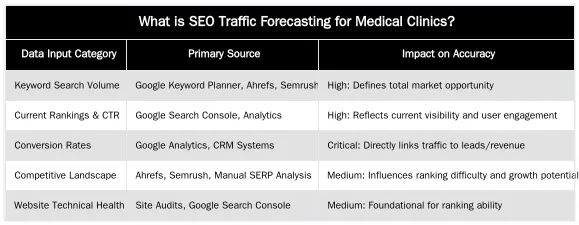
Accurate forecast models depend on several data points. Correctly interpreting these inputs is fundamental for predicting patient inquiries and revenue and for credible SEO ROI modeling.
Data sources and their impact on forecasting accuracy:
Estimating Keyword Search Volume & Intent
Keyword search volume is the starting point for traffic projections. Tools like Google Keyword Planner, Ahrefs, and Semrush provide monthly search data for medical procedures and conditions. For London-specific queries, searches must be refined to reflect local interest, such as “plastic surgeon Harley Street” or “dermatologist Mayfair.” Understanding patient search intent—informational (“what is rhinoplasty recovery time”) or transactional (“book rhinoplasty consultation”)—helps target high-value leads. This approach to how to conduct keyword research aligns projected traffic with patient needs.
Projecting Click-Through Rates (CTR) and Conversion Rates
Projecting click-through rates (CTR) estimates the percentage of searchers who click a clinic’s listing. CTR depends on ranking positions, rich snippets, and meta description quality. Industry benchmarks are a starting point, but historical Google Search Console data provides a more tailored estimate. Projecting conversion rates translates traffic into patient actions, like consultation bookings or form submissions. This requires analyzing historical data from Google Analytics and CRM systems to determine how many organic visitors convert.
Building Your Forecast Model: Steps to Project Organic Growth
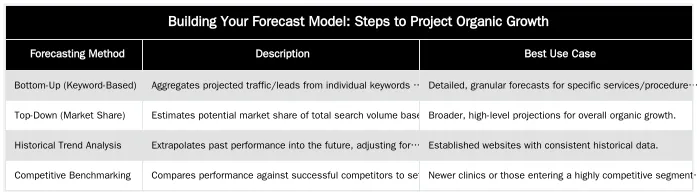
Building an organic traffic and lead forecast model requires a systematic approach, blending data analysis with realistic assumptions. This helps London medical clinics anticipate patient acquisition and plan SEO activities.
Common forecasting methodologies:
Mapping Market Opportunity and Ranking Potential
Analyzing the total addressable market for relevant medical keywords is a key step for an seo traffic forecasting model. This involves identifying potential search queries for your clinic’s services and estimating their collective search volume. Assessing ranking potential requires evaluating current positions, competitor strength, and the impact of planned SEO efforts. Factors like topical authority and E-E-A-T (Expertise, Experience, Authoritativeness, Trustworthiness) influence ranking velocity, especially in the YMYL (Your Money Your Life) sector. Google Search Console data provides insights into current impressions and click-through rates, informing improvement projections.
Integrating Seasonality and Growth Factors
Aesthetic medicine clinics often experience seasonal fluctuations in patient interest; for example, demand for some procedures may peak before summer. Integrating these seasonal patterns into your projection model improves accuracy. Applying growth multipliers based on planned SEO activities—like content creation, technical optimizations, or link building—and competitive analysis also refines projections.
Beyond Traffic: Forecasting Patient Leads and ROI for Surgeons
For plastic surgeons and aesthetic clinic owners, the goal of SEO is to attract patient leads and generate a measurable return on investment. This requires translating projected organic traffic into business outcomes.
Forecasting patient leads from SEO is critical for business planning. It connects digital visibility to practice growth, helping justify marketing budgets and demonstrating the value of an organic search strategy.
Calculating Potential Patient Leads and Revenue
To calculate potential revenue, multiply projected organic traffic by the estimated conversion rate (e.g., 2%) to find potential patient leads. Then, factor in the clinic’s average patient value. For instance, if 100 leads result in 20 procedures with an average value of £5,000, the estimated revenue is £100,000. This enables marketing ROI calculations.
Aligning SEO Forecasts with Clinic Business Planning
Accurate lead generation forecasts are a tool for business planning, informing budget allocation, staff hiring, and resource management. Integrating SEO forecasts helps clinic directors set growth targets, anticipate patient volumes, and decide on expansion or service offerings. This aligns SEO with the clinic’s financial and operational strategy.
Why a Specialist’s Approach Ensures Reliable Medical SEO Forecasts
For medical niches like plastic surgery in London, a specialist semantic SEO strategist offers more accurate forecasting. Abdurrahman Şimşek has over 10 years of experience in the London private healthcare market. This expertise in semantic engineering and advanced data leads to more precise organic traffic projections.
Generalist agencies often lack the understanding required for YMYL (Your Money Your Life) sectors, where algorithms prioritize E-E-A-T signals. A specialist integrates these factors into the forecasting model, providing a more dependable roadmap for patient acquisition.
The Impact of Semantic Engineering and Ruxi Data on Accuracy
Semantic analysis and proprietary data infrastructure like Ruxi Data improve organic traffic projection accuracy. Semantic engineering analyzes entities, attributes, and relationships within a medical topic, going beyond keyword analysis to understand patient search intent and how algorithms interpret content. Using Ruxi Data, Abdurrahman Şimşek identifies topical gaps, predicts algorithmic shifts, and models ranking potential more accurately, leading to more precise forecasting for medical websites.
Navigating YMYL & E-E-A-T in Forecasting for Healthcare
Healthcare is a YMYL category, requiring high standards of E-E-A-T. A medical SEO expert understands how these signals—Expertise, Experience, Authoritativeness, and Trustworthiness—influence ranking potential and organic traffic. Integrating E-E-A-T into the forecast model involves assessing a clinic’s online reputation, the authority of its medical professionals, and content quality. This ensures projections are realistic, accounting for the standards Google applies to medical information, as outlined in Google’s helpful content guidelines.
Setting Realistic SEO Goals: How Accurate Forecasting Helps Clinic Directors
Accurate organic traffic and lead forecasting helps clinic directors set achievable SEO goals and key performance indicators (KPIs). Without data-driven projections, goals can be arbitrary and lead to misaligned expectations. A forecast provides a measurable baseline for achievable results.
This process is key to setting realistic SEO goals and KPIs for your clinic’s growth. It ties targets to financial health and patient acquisition objectives, not vanity metrics. Understanding the projected impact of SEO informs marketing strategy.
From Projections to Measurable KPIs
Forecast projections provide a foundation for establishing key performance indicators (KPIs) tied to clinic revenue and growth. Instead of website visitors, KPIs can include metrics like “qualified patient leads from organic search,” “organic consultation bookings,” or “revenue generated from organic patients.” The forecast enables setting specific, measurable, achievable, relevant, and time-bound (SMART) goals. For example, a projection for a 20% increase in organic leads over 12 months becomes a measurable KPI, linking digital efforts to business outcomes.
Partner with an Expert for Data-Driven Clinic Growth
Accurate organic traffic and patient lead forecasting is a strategic imperative for London’s private healthcare clinics. Partnering with a specialist like Abdurrahman Şimşek provides a data-driven roadmap for growth. Use semantic SEO strategy and data analysis to turn your digital presence into a source of patient leads. Tailored forecasting informs business planning and can provide a competitive edge. Connect with Abdurrahman Şimşek today to discuss your clinic’s forecasting needs.
Conclusion
Forecasting organic traffic and patient leads is essential for London’s private healthcare clinics to achieve growth and a return on SEO investment. By analyzing keyword search volume, click-through rates, and conversion metrics, clinics can build models to project patient acquisition. A data-driven approach, guided by a medical semantic SEO specialist, translates digital efforts into business outcomes and aligns SEO strategy with clinic objectives. Accurate projections help clinic directors set realistic goals and navigate the competitive aesthetic and surgical medicine landscape.
Frequently Asked Questions
What is the purpose of seo traffic forecasting for a clinic?
The purpose of seo traffic forecasting is to set realistic expectations and build a robust business case for SEO investment. This model uses data to project potential growth in organic traffic and, crucially, patient leads over a specific period, such as 12 months, enabling strategic planning for London’s private healthcare clinics.
What are the key inputs for accurate patient lead projections from SEO?
Reliable organic traffic projections require three essential inputs: a list of target keywords with their monthly search volumes, estimated click-through rates (CTR) based on target ranking positions, and the website’s historical conversion rate from organic traffic to patient leads. These data points form the foundation of any robust forecast for patient acquisition.
How accurate can an seo traffic forecasting model be for medical clinics?
While no forecast is 100% accurate due to dynamic factors like algorithm updates and competitor actions, a data-driven seo traffic forecasting model is a highly reliable strategic tool. It’s best practice to present a range of outcomes—conservative, realistic, and optimistic—to account for various market variables and provide a comprehensive outlook for medical clinics.
Can a new clinic website benefit from seo traffic forecasting?
Yes, even a brand-new clinic website can benefit from seo traffic forecasting, though it requires making more initial assumptions. For new sites, industry-average data for click-through rates and conversion rates are typically used. The accuracy of these projections will naturally improve as the site gathers its own historical performance data over time.
How does projecting organic growth help prioritize SEO efforts for surgeons?
An effective organic growth projection model can clearly show which keywords or topic clusters have the highest potential for generating valuable patient leads. This insight allows medical clinics and surgeons to strategically prioritize content creation and optimization efforts on the areas that will drive the most significant business impact and ROI first. It ensures resources are allocated where they will yield the best results.
How can London-based clinics get started with a professional SEO forecast?
London-based private healthcare clinics, including plastic surgeons and aesthetic clinic owners, can get started by contacting a specialist like Abdurrahman Şimşek. An initial consultation helps define specific business goals and gather necessary data inputs to build a tailored forecast model. This process aligns SEO strategy with patient acquisition targets for optimal growth.
Ruxi Data brings together multi-model AI, automated website crawling, live indexation checks, topical authority mapping, E-E-A-T enrichment, schema generation, and full pipeline automation — from crawl to WordPress publish to social posting — all in one platform built for agencies and freelancers who run on results.