
Future of Medical Search: Adapting to AI Overviews
The future of medical search in 2026 is defined by AI Overviews and Google’s Search Generative Experience (SGE), fundamentally changing how patients access healthcare information. This article provides a strategic blueprint for medical clinics and plastic surgeons to adapt their SEO, ensuring visibility in an AI-driven landscape. Readers will learn to optimize for generative AI search, leverage semantic understanding, and build E-E-A-T to thrive amidst zero-click searches. Understanding these shifts is crucial for maintaining online presence and attracting high-value patients through enhanced information retrieval strategies.
Abdurrahman Şimşek, a Semantic SEO Strategist, specializes in building high-authority Semantic Content Networks for medical clinics. His expertise in medical SEO, semantic engineering, and information retrieval provides actionable strategies for navigating the evolving digital landscape and securing topical authority.
To explore your options, contact us to schedule your consultation.
The future of medical search in 2026 is undergoing a profound transformation, with AI Overviews and Google’s Search Generative Experience (SGE) reshaping how users find healthcare information. For medical clinics and plastic surgeons, understanding these shifts is not merely an advantage; it is a necessity for maintaining online visibility and attracting high-value patients. This article delves into these evolving paradigms, providing a strategic blueprint for adapting your medical SEO strategy to thrive in a generative AI-driven landscape. We will explore practical optimization strategies and the enhanced importance of semantic understanding.
What Are AI Overviews & Google’s SGE, and How Do They Reshape Medical Search?
AI Overviews, powered by Google’s Search Generative Experience (SGE), are AI-generated summaries that appear at the top of search results. They synthesize information from multiple sources to provide direct answers to user queries, often eliminating the need to click through traditional blue links. For medical search, this means patients receive immediate, consolidated information about conditions, treatments, and procedures, fundamentally altering the initial stages of information retrieval.
This shift represents a significant evolution in how search engines process and present information. Instead of simply listing relevant pages, generative AI search aims to understand the user’s intent deeply and provide a comprehensive, conversational response. This impacts medical SEO by prioritizing content that is clear, factually accurate, and easily digestible by AI models. Clinics must ensure their content is structured to be the definitive source for these AI-generated summaries.
Understanding the Shift to Generative AI in Healthcare Information Retrieval
Generative AI processes and synthesizes vast amounts of medical information, from research papers to clinic websites, to formulate its responses. For complex medical queries, this means AI can explain intricate procedures or conditions in a simplified manner, directly within the search results. This impacts user interaction by providing instant gratification, but also places a greater emphasis on the underlying data quality. Websites that serve as authoritative, well-structured knowledge bases are more likely to be cited by these AI systems. Building algorithm-proof topical authority through robust content architecture is crucial for this new paradigm. Learn more about semantic SEO for surgeons.
The core functionality of SGE is to provide a more holistic answer, drawing connections between entities and concepts that traditional keyword matching might miss. For instance, a query about “rhinoplasty recovery” might trigger an AI Overview that not only lists recovery timelines but also suggests related entities like “post-operative care” or “surgeon selection criteria.” This semantic understanding is key to the new information retrieval landscape. For further reading on Google’s SGE, refer to Google’s official announcements.
Why E-E-A-T and Semantic Understanding Are Now Paramount for Medical Clinics
In the era of AI Overviews, the importance of E-E-A-T (Experience, Expertise, Authoritativeness, Trustworthiness) for medical content has intensified. For Your Money Your Life (YMYL) topics like healthcare, AI models are designed to prioritize information from highly credible sources. This means content authored by verified medical professionals, backed by scientific evidence, and hosted on reputable clinic websites is significantly more likely to be featured in generative AI results. Semantic understanding further aids AI in accurately interpreting the context and nuances of complex medical information, ensuring precise and safe answers.
AI models rely on a deep comprehension of entities and their relationships to provide accurate summaries. A clinic’s website must not only contain expert-level content but also present it in a way that AI can easily process and validate. This involves clearly defining medical conditions, treatments, and the qualifications of practitioners. Without strong E-E-A-T signals and a clear semantic structure, medical content risks being overlooked by AI Overviews, regardless of its factual accuracy.
The Role of Structured Data and Knowledge Graphs in AI Overviews
Structured data, particularly using Schema.org markup, is fundamental for making medical content machine-readable. By explicitly tagging entities like `MedicalClinic`, `Physician`, and `MedicalProcedure` with their attributes, clinics provide AI with a clear roadmap to understand their offerings. This data feeds into knowledge graphs, which are vast networks of interconnected entities and their relationships. When a clinic’s information is part of these knowledge graphs, AI can more effectively retrieve and present it.
For example, marking up a plastic surgeon’s profile with `Physician` schema, including their specializations (`medicalSpecialty`), educational background (`alumniOf`), and affiliations (`memberOf`), helps AI understand their expertise. Similarly, detailing a procedure like `Rhinoplasty` with its `description`, `indications`, and `risks` through `MedicalProcedure` schema allows AI to synthesize comprehensive answers. This structured approach is vital for implementing advanced medical schema effectively.
Consider the following impact of structured data on AI’s ability to process medical information:
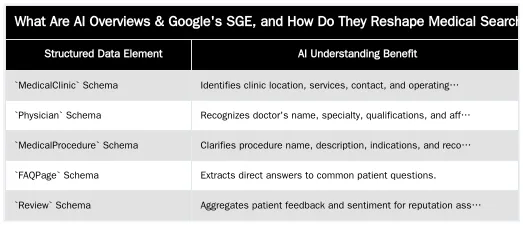
Implementing comprehensive structured data is a cornerstone of preparing for AI Overviews. For detailed guidance, explore implementing advanced medical schema.
Optimizing for Generative Engine Optimization (GEO): A Strategic Blueprint
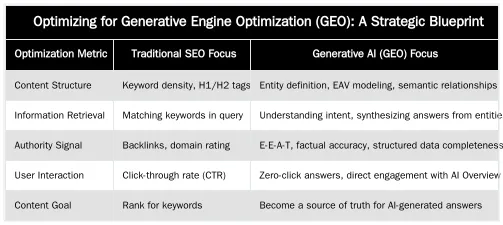
Generative Engine Optimization (GEO) represents the new frontier for medical SEO, moving beyond traditional keyword ranking to focus on becoming a trusted source for AI-generated answers. For clinics, this involves a strategic blueprint centered on content clarity, conciseness, and factual accuracy. Proactive GEO optimization means structuring content to be easily consumed and cited by AI Overviews, ensuring that your practice’s expertise is reflected directly in search results. This approach helps clinics secure future visibility in a rapidly evolving search landscape.
A key aspect of GEO is anticipating the types of questions AI will answer and providing the most direct, authoritative responses. This often means creating content that functions as a definitive knowledge base for specific medical entities and procedures. Clinics must prioritize content that is not only informative for human readers but also highly machine-readable, reducing the ‘Cost of Retrieval’ for search engines.
From Keywords to Entities: Structuring Content for AI Overviews and Semantic Search
The shift from keyword-centric optimization to entity-based content structuring is fundamental for GEO. Instead of targeting individual keywords, clinics should focus on defining and interlinking medical entities. For example, rather than just optimizing for “rhinoplasty London,” content should establish ‘Rhinoplasty’ as a core entity, detailing its attributes (e.g., surgical techniques, recovery time, ideal candidates) and linking it to other entities like ‘Dr. Smith’ (the surgeon), ‘Harley Street Clinic’ (the location), and ‘Nasal Aesthetics’ (the broader field).
This approach builds a robust semantic network that AI can easily process, understand, and cite. Each piece of content contributes to a comprehensive understanding of a medical topic, positioning the clinic as an authority. This is particularly important for the future of medical search, where AI seeks to understand the full context of a query. For practical steps on this, refer to structuring content for AI Overviews.
Consider the following metrics for content optimization in the GEO era:
Leveraging Semantic Engineering & Ruxi Data for Future-Proof Medical SEO
Semantic engineering, combined with advanced data methodologies like Ruxi Data, provides medical clinics with a significant competitive edge in the AI search era. This specialized approach focuses on building algorithm-proof topical authority by meticulously mapping out entities, attributes, and their relationships within a medical niche. By optimizing for ‘Cost of Retrieval,’ clinics can ensure their content is not only comprehensive but also efficiently processed by search engines and generative AI, making them prime candidates for AI Overviews.
Abdurrahman Şimşek’s expertise in semantic engineering and the application of Ruxi Data allows for the creation of highly structured, interconnected content networks. This goes beyond simple topic clusters, establishing a deep semantic understanding that AI models can leverage. For London’s private healthcare market, this means building a digital presence that is resilient to algorithm updates and consistently positions the clinic as an authoritative source.
EAV Modeling and Cost of Retrieval: The Technical Advantage for Medical Content
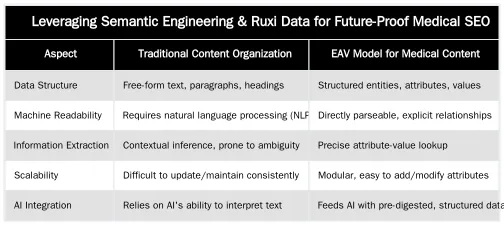
Entity-Attribute-Value (EAV) modeling is a powerful technique for organizing complex medical information in a machine-readable format. Instead of unstructured text, EAV breaks down medical concepts into discrete entities (e.g., ‘Breast Augmentation’), their attributes (e.g., ‘Implant Type’, ‘Incision Location’, ‘Recovery Time’), and the specific values for those attributes (e.g., ‘Saline’, ‘Inframammary Fold’, ‘2-4 weeks’). This structured approach significantly reduces the ‘Cost of Retrieval’ for search engines.
When content is organized using EAV, AI models can quickly identify, extract, and synthesize precise pieces of information, rather than having to parse through lengthy, unstructured paragraphs. This efficiency makes your content more attractive to AI Overviews. For instance, a query about “breast augmentation recovery time” can be answered directly from the ‘Recovery Time’ attribute of the ‘Breast Augmentation’ entity. This technical advantage is crucial for clinics aiming to dominate local organic search across Harley Street and premium London postcodes. For a deeper dive, explore the EAV model for surgical procedures.
Here’s a comparison of traditional content organization versus an EAV model for a medical procedure:
The Future Is Now: Partnering for Semantic SEO Success in London’s Medical Market
The evolving search landscape, driven by AI Overviews and generative AI, demands a proactive and sophisticated approach from medical clinics. Understanding and adapting to the future of medical search is no longer optional; it is critical for maintaining visibility and attracting high-value patients. For plastic surgeons, aesthetic clinic owners, and medical directors in London, navigating these changes requires specialized expertise.
Abdurrahman Şimşek specializes in building high-authority Semantic Content Networks specifically for medical clinics, skin clinics, and plastic surgeons. By leveraging advanced semantic engineering, EAV modeling, and Ruxi Data, clinics can establish themselves as definitive sources of truth for AI-generated answers, dominate local organic search across Harley Street and premium London postcodes, and attract high-value patients. Partner with an elite SEO strategist and web development partner who understands the nuances of the London private healthcare market. Discover how to future-proof your medical practice’s online presence and secure your position at the forefront of patient acquisition. Contact Abdurrahman Şimşek today.
Frequently Asked Questions
What is the single most important thing a clinic can do to prepare for the future of medical search?
The single most important thing is to build a structured, comprehensive, and verifiably authoritative knowledge base. AI models are trained on data, and by creating the best, most machine-readable dataset in your niche, you position your practice to be the source of truth for AI-generated answers, which is crucial for the future of medical search.
How will user behavior and website clicks evolve in the future of medical search?
While informational queries may see fewer direct clicks to websites due to AI Overviews, high-stakes decisions like choosing a surgeon will always require deeper research. Your website’s role will be to provide comprehensive detail, case studies, and trust signals that an AI summary cannot, capturing the user after the initial AI answer. This ensures you remain a vital resource for prospective patients.
How does a Holistic SEO strategy align with the future of medical search?
Holistic SEO is perfectly aligned with this future. Its core principles—building machine-readable knowledge bases, demonstrating verifiable E-E-A-T, and reducing the Cost of Retrieval—are exactly what is required to become a trusted data source for the next generation of search engines and to thrive in the future of medical search.
Will traditional keywords become irrelevant in an AI-driven search landscape?
Keywords as a singular tactic will become less relevant, but understanding the underlying user intent and entities behind them will be more critical than ever. The focus shifts from merely ‘ranking for a keyword’ to ‘being the definitive answer for a concept’ through semantic understanding. This evolution demands a deeper, more nuanced approach to content strategy.
How does Ruxi Data provide an advantage in preparing for advanced search capabilities?
Ruxi Data is specifically designed to build the structured, entity-driven content networks that AI models are built to consume. It automates the process of turning your expertise into the kind of machine-readable knowledge base that will power the future of medical search. This gives medical clinics a significant edge in establishing topical authority and becoming a trusted source for AI-generated answers.
How can medical clinics begin optimizing for the evolving search landscape?
Medical clinics can start by assessing their current content for semantic depth and E-E-A-T signals. Partnering with a specialist like Abdurrahman Şimşek can provide a strategic blueprint for building a robust, machine-readable knowledge base. This proactive approach ensures your practice is well-positioned for the future of medical search.
Ruxi Data brings together multi-model AI, automated website crawling, live indexation checks, topical authority mapping, E-E-A-T enrichment, schema generation, and full pipeline automation — from crawl to WordPress publish to social posting — all in one platform built for agencies and freelancers who run on results.