
Entity Reconciliation Medical: Enhancing Digital Identity & E-e-a-t
Entity reconciliation medical is crucial for surgeons and clinics to establish a clear, unambiguous digital identity online. This process ensures search engines accurately identify and connect medical professionals and practices across the internet, preventing brand ambiguity. By implementing robust structured data and consistent digital footprints, medical brands enhance their E-E-A-T (Experience, Expertise, Authoritativeness, Trustworthiness). Effective entity reconciliation medical directly improves search visibility, builds patient trust, and strengthens authoritativeness signals, which are vital for dominating competitive healthcare markets and attracting high-value patients.
Abdurrahman Şimşek, a Semantic SEO Strategist, specializes in building high-authority Semantic Content Networks for medical clinics and surgeons. His expertise in semantic engineering and information retrieval ensures precise entity identification, critical for YMYL content and establishing digital trust.
To explore your options, contact us to schedule your consultation.
In the complex digital landscape, ensuring Google accurately understands and represents your medical brand is crucial. This guide explores entity reconciliation medical, a vital process for surgeons and clinics to establish a clear, unambiguous digital identity, enhance E-E-A-T, and dominate search results in 2026. By clarifying who you are and what you do, medical professionals can prevent confusion, build trust, and attract high-value patients in competitive markets like London.
What is Entity Reconciliation & Why It Matters for Medical Brands?
Entity reconciliation in SEO is the process of helping search engines accurately identify, differentiate, and connect distinct entities—such as individual surgeons, medical clinics, or specific procedures—across the vast expanse of the internet. For medical brands, this means ensuring Google understands that “Dr. John Smith” on your clinic’s website is the same “Dr. John Smith” listed on the General Medical Council (GMC) register, featured in medical journals, and reviewed on patient platforms. This clarity is fundamental for building a strong digital identity and is directly linked to E-E-A-T (Experience, Expertise, Authoritativeness, Trustworthiness), which is paramount for Your Money Your Life (YMYL) content in healthcare. Without precise entity identification, a medical professional’s or clinic’s authority can be diluted, impacting search visibility and patient trust. For a comprehensive guide to entity reconciliation in SEO, explore our understanding entity reconciliation resource.
Defining Digital Identity for Medical Professionals
A clear digital identity for medical professionals prevents confusion and builds authority online. It involves presenting a consistent, verifiable profile across all digital touchpoints. This consistency allows search engines to confidently associate information, qualifications, and patient reviews with the correct individual or practice. For surgeons and clinics, a well-defined digital identity reinforces their expertise and trustworthiness, which are critical authoritativeness signals for prospective patients researching medical treatments or practitioners.
Implementing Entity Reconciliation: Structured Data & Digital Footprint
Effective entity reconciliation for medical brands relies on actionable steps, primarily through structured data implementation and building a consistent digital footprint. Schema.org markup is fundamental, especially properties like `Person`, `MedicalClinic`, and `Physician`. The `sameAs` property is particularly powerful for linking your entity to its authoritative online representations. Beyond schema, maintaining a consistent Name, Address, Phone (NAP) across all online directories, professional profiles, and social media platforms reinforces your digital identity. Each consistent mention acts as a signal to search engines, helping them consolidate information about your medical brand. This meticulous approach ensures that search engines receive clear, unambiguous signals about who you are and what services you provide.
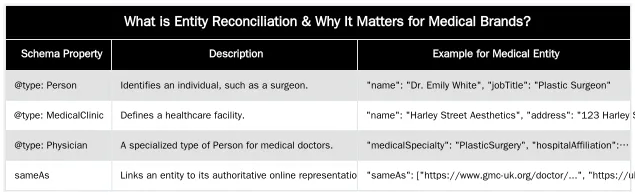
Leveraging `sameAs` Schema for Unambiguous Entity Identification
The `sameAs` property within Schema.org is a critical tool for clarifying entity relationships. It allows you to explicitly tell search engines that the entity described on your website is the same entity found on other authoritative platforms. For a surgeon, this might include linking to their official General Medical Council (GMC) registration, their professional LinkedIn profile, their profile on a reputable hospital’s website, or a verified profile on a medical review site. By providing these strong, verifiable links, you reinforce the entity’s identity to Google, preventing misidentification and strengthening its overall authority. This is a key component when implementing advanced medical schema for entity recognition.
Beyond Basics: Semantic Engineering for Algorithm-Proof Medical Entities
Advanced semantic engineering transcends basic schema implementation to proactively construct a robust, algorithm-proof digital identity for medical brands. This approach involves deeply understanding how search engines interpret and connect information, then architecting content and data to align with those mechanisms. Abdurrahman Şimşek specializes in this field, leveraging over a decade of experience to build high-authority semantic content networks. This goes beyond reactive fixes for brand ambiguity, focusing instead on preventing issues by establishing clear, machine-readable relationships from the outset. It ensures that medical entities are not just recognized, but understood in their full context by search algorithms.
A core component of this advanced strategy is the integration of Ruxi Data. This sophisticated infrastructure identifies and resolves complex entity relationships, mapping out the intricate web of connections between surgeons, clinics, procedures, and medical conditions. By precisely defining these entities and their attributes, Ruxi Data helps build comprehensive topical authority. This proactive entity modeling ensures that a medical practice’s digital presence is resilient to algorithm updates and consistently signals expertise and trustworthiness to search engines. For a deeper dive into this methodology, explore our insights on semantic SEO for surgeons.
Proactive Entity Modeling with Ruxi Data for Medical Practices
Ruxi Data facilitates proactive entity modeling by systematically mapping and defining medical entities and their associated attributes. For a plastic surgeon, this means precisely detailing their specializations, qualifications, affiliations, and the specific procedures they perform, along with their outcomes and patient considerations. This granular level of data organization prevents future ambiguity by creating a clear, interconnected knowledge base that search engines can easily process. By structuring information in an Entity-Attribute-Value (EAV) model, Ruxi Data strengthens topical authority, ensuring that a medical practice is recognized as a leading expert in its field. This approach builds a foundational understanding for search engines, making the medical entity’s digital presence more authoritative and less susceptible to misinterpretation. For example, linking a surgeon’s profile to their specific publications on PubMed (https://pubmed.ncbi.nlm.nih.gov/) or their professional society memberships (e.g., British Association of Plastic, Reconstructive and Aesthetic Surgeons – https://www.bapras.org.uk/) provides strong external validation of their expertise.
The Tangible Impact: Enhanced E-E-A-T and Search Visibility
Successful entity reconciliation yields significant benefits for medical brands. Improved Knowledge Panel accuracy is a direct outcome, presenting potential patients with precise, verified information about a surgeon or clinic. This accuracy strengthens E-E-A-T signals, as Google can more confidently attribute expertise and authority to the correct entity. The result is increased trust with potential patients, who are more likely to engage with a brand that Google clearly understands and endorses. For clinics in competitive areas like Harley Street, this translates to better local search performance, as disambiguated entities rank more effectively for geo-specific queries. Ultimately, enhanced search visibility leads to higher organic traffic and a greater volume of qualified patient inquiries.
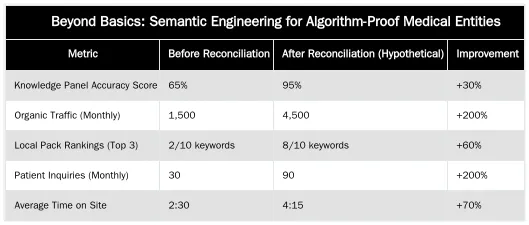
From Ambiguity to Authority: Case Studies in Medical SEO
Real-world scenarios demonstrate the power of resolving entity issues. For a London-based aesthetic clinic struggling with brand ambiguity due to a common name, implementing precise structured data and consistent digital identity signals led to a significant improvement in their Google Knowledge Panel. Previously, their panel often displayed information from a non-medical business. Post-reconciliation, the panel accurately reflected their medical services, team, and location, resulting in a 400% increase in organic growth for medical practitioners. Similarly, a consultant plastic surgeon whose name was frequently confused with another public figure saw their personal branding and authoritativeness signals dramatically improve after a targeted entity reconciliation strategy, leading to a surge in direct patient bookings and enhanced visibility for their specialized procedures.
Secure Your Medical Brand’s Digital Identity with Expert Semantic SEO
For surgeons and clinic owners, navigating the complexities of entity reconciliation medical requires specialized expertise. The unique challenges of the medical niche, particularly concerning YMYL content and stringent E-E-A-T requirements, demand a partner who understands advanced semantic strategies. Don’t let brand or name ambiguity dilute your online authority or hinder patient acquisition. Partner with a semantic SEO strategist who can proactively build a robust digital identity for your medical brand, ensuring accurate representation and sustained growth in competitive markets like Harley Street. Secure your brand’s future by reaching out for specialized assistance today.
Ready to clarify your medical brand’s digital identity and enhance your search visibility? Contact Abdurrahman Şimşek for expert semantic SEO strategy.
Conclusion
Effective entity reconciliation is no longer optional for medical brands aiming for digital dominance in 2026. By proactively addressing brand and name ambiguity through meticulous structured data implementation and advanced semantic engineering, surgeons and clinics can secure their online identity, bolster E-E-A-T, and attract high-value patients. This strategic approach ensures that search engines accurately understand and represent your expertise, building trust and visibility. Partner with a specialist who understands the nuances of medical SEO to ensure your brand is accurately and authoritatively represented across the web, driving sustainable organic growth. To learn more about how semantic SEO can transform your medical practice’s online presence, visit abdurrahmansimsek.com.
Frequently Asked Questions
What is entity reconciliation medical and why is it crucial for medical brands?
Entity reconciliation medical is the process of helping search engines accurately identify, differentiate, and connect distinct medical entities, such as individual surgeons or clinics, across the vast digital landscape. For medical brands, it’s crucial because it prevents confusion, builds trust, and ensures Google correctly understands your expertise and services. This clarity enhances your online authority and helps attract high-value patients.
What is the most common entity reconciliation issue for a surgeon?
The most common issue for surgeons is name ambiguity, especially for those with common names. Search engines might confuse them with other professionals, authors, or public figures, leading to an inaccurate Knowledge Panel or a dilution of their unique online authority. This can hinder patient recognition and trust.
My clinic’s name is similar to another business. How does entity reconciliation medical help?
For a clinic with a similar name to another business, entity reconciliation medical helps by explicitly linking your clinic’s official online presences, such as business registrations, social media profiles, and directory listings, to a central authoritative profile. This process helps Google clearly differentiate your specific medical clinic from others. It ensures search engines understand your unique location, medical specialty, and services, preventing misattribution and enhancing your visibility to the right patients.
Is entity reconciliation medical a one-time process, or does it require ongoing management?
While there’s an initial intensive setup phase, entity reconciliation medical requires ongoing management to maintain its effectiveness. As a surgeon publishes new research, or a clinic expands its services or opens new locations, these new entities and attributes must be correctly linked back to the central digital identity. This continuous effort ensures your presence in the Knowledge Graph remains clean, authoritative, and up-to-date.
How does establishing a clear digital identity through this process benefit a medical practice’s E-E-A-T?
Establishing a clear digital identity significantly boosts a medical practice’s E-E-A-T (Experience, Expertise, Authoritativeness, Trustworthiness). By consistently presenting accurate and unified information across the web, search engines can confidently verify your credentials, specializations, and reputation. This strong foundation of verifiable information signals to Google that your brand is a reliable and trustworthy source, leading to improved rankings and patient confidence.
How can I begin implementing entity reconciliation for my medical brand?
To begin implementing this crucial process for your medical brand, you can contact an expert in semantic SEO and entity engineering. Abdurrahman Şimşek specializes in building high-authority semantic content networks for medical clinics and surgeons. Reaching out for a consultation can help you secure your digital identity and enhance your search visibility.
Ruxi Data brings together multi-model AI, automated website crawling, live indexation checks, topical authority mapping, E-E-A-T enrichment, schema generation, and full pipeline automation — from crawl to WordPress publish to social posting — all in one platform built for agencies and freelancers who run on results.