
Topic Cluster Case Study: Boosting Clinic Rankings & Patient Acquisition
This topic cluster case study details how a London aesthetic clinic significantly improved its organic search performance. It outlines the strategic implementation of a topic cluster strategy, leveraging semantic SEO principles to build topical authority. The study demonstrates tangible medical SEO results, including substantial organic traffic growth, improved keyword rankings, and increased lead generation. Readers will gain insights into content marketing ROI and a data-driven approach for healthcare marketing analytics.
Abdurrahman Şimşek, a Semantic SEO Strategist, applies advanced content architecture to enhance digital visibility. This approach focuses on establishing expertise and trustworthiness for YMYL content, crucial for competitive medical niches.
To explore your options, contact us to schedule your consultation. You can also reach us via: Book a Semantic SEO Audit, Direct WhatsApp Strategy Line: +90 506 206 86 86
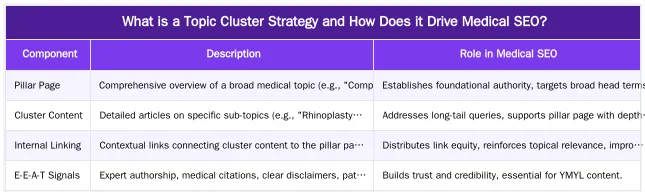
What is a Topic Cluster Strategy and How Does it Drive Medical SEO?
A topic cluster strategy organizes website content around “pillar pages” covering a core subject, supported by “cluster content” articles on specific sub-topics. In medical SEO, this structure signals topical authority to search engines, which is crucial for Your Money Your Life (YMYL) niches, by demonstrating expertise and interconnected information.
Key Components of a High-Performing Medical Topic Cluster
Medical topic clusters require precise content architecture to establish expertise, authoritativeness, and trustworthiness (E-E-A-T). This structure helps search engines understand a clinic’s knowledge, particularly for complex medical procedures.
Measuring Success: Core Metrics in a Topic Cluster Case Study
The impact of a content strategy is evaluated by tracking key performance indicators (KPIs). For a medical clinic, these metrics include traffic numbers and patient acquisition signals to demonstrate content marketing ROI.
- Organic Traffic Growth: Percentage increase in visitors from search engines.
- Keyword Ranking Improvements: Position changes for targeted high-value keywords and long-tail variations.
- Impressions and Clicks: Data from Google Search Console indicating visibility and user engagement.
- Topical Authority Score: A qualitative or quantitative measure of a website’s perceived expertise on a subject.
- Qualified Lead Generation: Increase in consultation requests, phone calls, or form submissions directly attributable to organic search.
- Conversion Rate: Percentage of organic visitors who complete a desired action (e.g., booking an appointment).
The Challenge: Stagnant Organic Growth for a London Aesthetic Clinic
A London-based aesthetic clinic struggled with low organic visibility, poor keyword rankings for competitive terms, and limited qualified leads despite its high-quality services. The clinic’s content strategy was fragmented, consisting of individual blog posts without a cohesive structure, resulting in low perceived topical authority by search engines.
This is common in London’s competitive private healthcare market, where clinics compete for visibility in areas like Harley Street. The clinic’s content did not address patient queries comprehensively or signal practitioner expertise, a critical factor in the YMYL (Your Money Your Life) search landscape.
Identifying the Root Causes of Underperformance in a YMYL Niche
The clinic’s underperformance was caused by fragmented content; articles on related procedures were isolated, lacking hierarchy or interconnectedness. This unstructured content network prevented search engines from understanding the clinic’s expertise in specific aesthetic treatments. Insufficient E-E-A-T signals, such as clear authorship, medical citations, and ‘About Us’ pages, hindered ranking for sensitive medical queries.
Without a clear content strategy, the website failed to communicate its authority on core topics. This prevented Google from presenting its content to users seeking reliable medical information, impacting patient acquisition from organic search.
The Competitive Landscape of London’s Private Healthcare SEO
Ranking for medical procedures in London is challenging. The market is saturated with clinics investing in digital marketing. Aesthetic procedure queries have high commercial intent and require demonstrated trust and credibility. Effective competition requires understanding patient intent, medical accuracy, and projecting E-E-A-T across all digital touchpoints, not just targeting keywords. A topic cluster strategy is therefore essential for capturing market share.
Implementation: Executing the Topic Cluster Strategy for Tangible Results
Implementation involved content creation, internal linking, and technical optimization to transform the clinic’s fragmented content into a cohesive, authoritative semantic network. Each piece of content served a specific purpose within the topical architecture.
Content Development and E-E-A-T Integration
Medically accurate content was the core of the strategy. Each pillar and cluster article had expert authorship, clear citations, and a patient-centric approach. Content addressed every stage of the patient journey, from awareness to procedure details. E-E-A-T signals like surgeon bios, professional qualifications, and disclaimers were integrated to build trust. Adherence to Google’s helpful content guidelines was critical for ranking in the YMYL space.
Strategic Internal Linking and Technical SEO Enhancements
Internal linking was crucial for reinforcing topical authority. Contextual links from cluster pages to their pillar pages, and between related articles, distributed link equity and signaled semantic relationships. This building topical authority through internal linking helped search engines understand the clinic’s expertise. Technical SEO was also optimized. This included implementing schema markup (MedicalBusiness, Physician, MedicalProcedure JSON-LD), improving Core Web Vitals (LCP, FID, CLS), and ensuring a clean semantic HTML5 structure for crawlability and indexing.
The Impact: Significant Organic Growth and Patient Acquisition
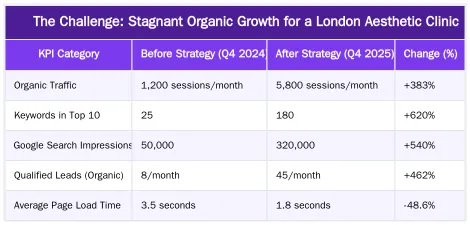
The semantic topic cluster strategy increased the London aesthetic clinic’s organic visibility and patient engagement within 12 months. The results demonstrate a clear return on investment and the effectiveness of a structured, entity-based content approach in a competitive medical niche.
Quantifying Organic Traffic and Keyword Ranking Improvements
Google Search Console and Ahrefs data showed significant growth. Organic traffic increased +383%, from 1,200 to 5,800 sessions per month. Keywords in the top 10 on Google increased by +620%, from 25 to 180. This included high-value, commercially intent keywords for specific aesthetic procedures. Google Search impressions increased by +540%, indicating broader reach and visibility. These metrics align with findings in Ahrefs SEO case studies on the effectiveness of content strategies.
Translating SEO Performance into Patient Leads and ROI
Improved organic visibility led to a +462% increase in qualified leads, with monthly consultation bookings from organic search rising from 8 to 45. This growth provided a clear return on investment (ROI). Attracting patients searching for specific treatments optimized marketing spend and built a patient acquisition pipeline. Understanding how to connect these dots is key to measuring the true ROI of SEO.
Key Takeaways for Medical Practices: Building a Future-Proof SEO Strategy
This case study shows a semantic, entity-based approach is essential for long-term medical SEO success. Fragmented content or basic keyword targeting is insufficient for competing in the YMYL landscape. Medical practices must build topical authority and signal E-E-A-T to search engines.
Clinics should invest in a structured content strategy that maps to patient intent and medical entities. Use tools like Ruxi Data for automated topical map creation and content planning. Reduce Google’s Cost of Retrieval through content architecture and technical optimization. Continuous monitoring and adaptation based on performance data are critical for maintaining a competitive edge in 2026 and beyond.
Conclusion
This case study highlights the effectiveness of a semantic topic cluster strategy. By focusing on topical authority, E-E-A-T, and efficient information retrieval instead of keywords, medical practices can increase organic growth and patient acquisition. This framework provides a foundation for improving search results in competitive healthcare markets.
For a data-driven semantic SEO strategy, contact us to build a high-authority content network for your practice. You can also Book a Semantic SEO Audit or reach us via WhatsApp Strategy Line: +90 506 206 86 86.
Frequently Asked Questions
What key metrics are featured in a topic cluster case study?
A strong topic cluster case study will feature metrics like the percentage increase in organic traffic to the cluster’s pages and the number of new keywords ranking on page one. It also tracks the growth in impressions and clicks in Google Search Console for the target topic, alongside the increase in qualified leads or consultation requests generated from the cluster.
What was the primary goal of implementing the strategy highlighted in this topic cluster case study?
The primary goal was to establish the clinic as a definitive topical authority for a high-value surgical procedure. This strategic move aimed to transcend basic head term rankings, instead dominating search results for hundreds of related long-tail informational and commercial queries.
How long did it take to observe significant results in this particular topic cluster case study?
Initial positive movement in rankings for long-tail keywords was observed within 3 months of completing the content cluster. A significant, measurable lift in organic traffic and leads, demonstrating a clear positive return on investment, was achieved at the 8-month mark.
Beyond rankings, what other impacts did the strategy demonstrate in this topic cluster case study?
Yes, the strategy had broader impacts beyond just organic search rankings. By creating a comprehensive and valuable resource, the clinic’s content was more frequently shared on social media and referenced by other publications, leading to an increase in referral traffic and natural backlinks. This holistic approach reinforced the overall domain authority, a key finding of this topic cluster case study.
What is the most important takeaway from this topic cluster case study for other medical practices?
The most important takeaway from this topic cluster case study is that a focused, systematic approach to content creation is far more powerful than a scattered one. Proving deep expertise on one core topic first builds a foundational trust with Google, which can then be leveraged to expand into other service areas more effectively and efficiently.
How can my clinic begin implementing a similar semantic SEO strategy?
To explore how a semantic SEO strategy can benefit your clinic, you can book a Semantic SEO Audit with Abdurrahman Şimşek. This audit will provide a tailored roadmap for building topical authority and improving patient acquisition. Alternatively, you can reach out directly via WhatsApp for a strategy discussion at +90 506 206 86 86.
Ruxi Data brings together multi-model AI, automated website crawling, live indexation checks, topical authority mapping, E-E-A-T enrichment, schema generation, and full pipeline automation — from crawl to WordPress publish to social posting — all in one platform built for agencies and freelancers who run on results.