
Attract Rhinoplasty Patients: Semantic Strategy for High-value Leads
To attract rhinoplasty patients effectively, a semantic content strategy is crucial for plastic surgeons. This approach moves beyond basic keywords, focusing on comprehensive topic coverage and understanding the patient journey mapping. By building a robust semantic content network and establishing topical authority, clinics can connect with high-value patients seeking detailed, expert-led information. This strategy ensures content addresses specific search intents, from initial curiosity to final decision-making, helping to attract rhinoplasty patients and differentiate practices in competitive markets like London.
Abdurrahman Şimşek, a Semantic SEO Strategist with 10 years of experience, specializes in building high-authority semantic content networks for medical clinics and plastic surgeons. His expertise ensures content aligns with E-E-A-T principles, driving organic growth and high-value patient acquisition.
To explore your options, contact us to schedule your consultation.
To attract rhinoplasty patients online, a semantic content strategy is essential, moving beyond basic SEO tactics. Plastic surgeons and aesthetic clinics can use these digital marketing techniques to connect with ideal patients, build trust, and drive consultations in competitive markets like London. This guide covers understanding patient intent, crafting expert-led content, and establishing topical authority for high-value patient acquisition.
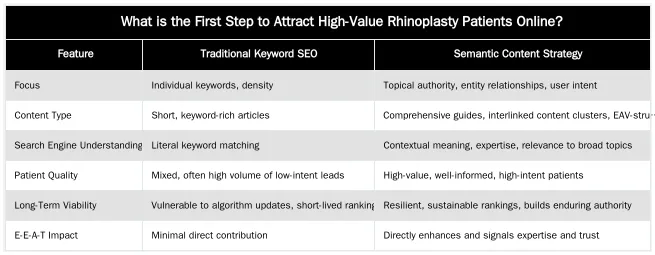
What is the First Step to Attract High-Value Rhinoplasty Patients Online?
The first step to attract high-value rhinoplasty patients online is understanding patient search intent and patient journey mapping. Content must address the questions and concerns of potential patients at each stage of their decision-making process. This means anticipating complex queries and providing comprehensive, authoritative answers.
Understanding intent moves beyond keyword matching; it means discerning the need or question behind a search query. For instance, a search for “rhinoplasty cost London” indicates a different intent than “rhinoplasty recovery timeline.” Tailoring content to these intents builds trust and positions a clinic as a reliable source of information, attracting discerning clients.
Decoding the Rhinoplasty Patient Journey
The rhinoplasty patient journey has several stages, each requiring targeted content. It begins with curiosity, when individuals might search for “types of nose jobs” or “what is rhinoplasty.” This awareness phase requires broad, educational content. They then enter the consideration phase, researching “best rhinoplasty surgeon London,” “rhinoplasty before and after,” or “revision rhinoplasty options.” At this stage, detailed procedure pages, surgeon biographies, and patient testimonials are vital.
High-value patients have specific characteristics: they conduct extensive research, prioritize surgeon expertise and safety over cost, and seek personalized care. Their journey might involve more complex queries, such as “ethnic rhinoplasty specialist” or “rhinoplasty for breathing issues.” Mapping these considerations allows for creating relevant content that meets their needs and elevates the practice’s perceived value.
Beyond Keywords: Why Semantic SEO Wins for Rhinoplasty Marketing
Traditional keyword-stuffing is ineffective. Semantic SEO focuses on the meaning and context behind search queries, not just words. This means creating content that comprehensively covers a topic, addressing related entities and concepts. Search engines evaluate a website’s overall topical relevance and authority, especially for Your Money Your Life (YMYL) medical content.
E-E-A-T (Experience, Expertise, Authoritativeness, and Trust) is paramount in the medical field. Search algorithms prioritize content from experts. A semantic content network allows plastic surgeons to showcase their knowledge, surgical experience, and patient trust. This approach helps search engines recognize the clinic as an authority on rhinoplasty, driving qualified traffic.
Building Topical Authority for Surgical Procedures
Building topical authority means creating content clusters around core entities related to rhinoplasty. Instead of isolated blog posts, a semantic content network interlinks articles covering aspects like “types of nose jobs,” “rhinoplasty recovery,” “revision rhinoplasty,” and “rhinoplasty risks.” This signals deep expertise to search engines. For example, a clinic might have a pillar page on rhinoplasty, supported by cluster content detailing specific techniques, patient stories, and post-operative care.
This strategy improves search visibility and user experience by providing patients with information within a single, authoritative domain. Learn more about content structuring by exploring building topic clusters.
Crafting Content That Converts: A Semantic Approach for Plastic Surgeons
Content that converts potential rhinoplasty patients focuses on their questions, concerns, and aspirations. This requires developing detailed, expert-led content for plastic surgeons that addresses the entire patient journey. Content should inform and build confidence and trust in the surgeon’s capabilities.
Examples of high-converting content include detailed procedure guides, FAQs, before-and-after galleries with patient stories, video testimonials, and articles comparing rhinoplasty techniques. Using long-tail keywords from patient queries helps content answer specific, complex questions, attracting motivated individuals.
Leveraging Entity-Attribute-Value (EAV) Modeling for Procedure Pages
Entity-Attribute-Value (EAV) modeling structures detailed information about medical procedures like rhinoplasty. It breaks down a procedure into its core entities (e.g., “Rhinoplasty”) and their associated attributes (e.g., “Procedure Duration,” “Anesthesia Type,” “Recovery Time,” “Cost Range,” “Ideal Candidate”). Each attribute has a specific value.
For example, for the entity “Rhinoplasty,” attributes might include:
- Procedure Type: Open Rhinoplasty, Closed Rhinoplasty, Preservation Rhinoplasty
- Anesthesia: General Anesthesia
- Duration: 2-4 hours
- Recovery: 1-2 weeks initial swelling, 6-12 months for final results
- Cost: £X – £Y (in London)
- Benefits: Improved facial harmony, enhanced breathing, corrected asymmetry
- Risks: Swelling, bruising, infection, asymmetry, numbness
This structured data is digestible for users and interpretable for search engines, improving content relevance and discoverability. For more on structuring medical content, refer to our guide on Entity-Attribute-Value (EAV) Modeling for Surgical Procedures.
Optimizing for High-Value Patients: What London Surgeons Need to Know
Attracting affluent patients in competitive markets like London (e.g., Harley Street, Marylebone, Mayfair) requires a specific approach. These patients seek surgical excellence, a personalized experience, discretion, and a surgeon’s demonstrated reputation. Abdurrahman Şimşek’s expertise in the London private healthcare market shows local organic search dominance is critical for nose job marketing in the UK.
Strategies include hyper-local SEO to rank for searches like “Harley Street rhinoplasty specialist” or “best nose surgeon Mayfair.” High-value patients rely on referrals and online reviews, so reputation management and authentic patient testimonials are paramount. The digital presence must reflect the premium service offered, from website design to content tone.
For context on medical authority in search, resources like the General Medical Council (GMC) provide guidelines for medical professionals that reinforce the need for verifiable credentials and ethical online representation.
The Role of E-E-A-T in London’s Competitive Aesthetic Market
In London’s competitive aesthetic market, demonstrating Experience, Expertise, Authoritativeness, and Trust (E-E-A-T) is essential to attract discerning clients. Search engines scrutinize medical content for these signals, especially for YMYL topics. Experience is shown through years in practice, procedures performed, and specializations. Expertise is conveyed through case studies, peer-reviewed publications, and educational content.
Authoritativeness is built through citations from reputable sources, an online presence on professional platforms, and industry recognition. Trust is established through transparent patient reviews, clear communication of qualifications, adherence to medical ethics, and a secure, professional website. For example, a surgeon’s profile on a directory like the British Association of Aesthetic Plastic Surgeons (BAAPS) contributes to their online E-E-A-T.
Measuring Success: Key Metrics for Your Rhinoplasty Marketing Strategy
To evaluate a semantic content strategy for rhinoplasty, track specific Key Performance Indicators (KPIs) for content performance, patient engagement, and conversion rates. Key metrics include organic search visibility for semantic clusters, website traffic from high-intent long-tail queries, engagement rates (time on page, bounce rate), and conversion rates (consultation requests, form submissions).
Monitoring lead quality is crucial. High-value patient acquisition focuses on securing consultations with well-informed, serious individuals, not high volumes of general inquiries. Analyzing lead sources and their website journey helps refine content and targeting.
Comparing Traditional vs. Semantic SEO Outcomes
Different SEO approaches have distinct outcomes. This table compares traditional keyword-focused SEO with a semantic content strategy for rhinoplasty.
| Metric Category | Traditional SEO (Avg. Annual Growth) | Semantic SEO (Avg. Annual Growth) |
|---|---|---|
| Organic Traffic Volume | +15% | +70% |
| High-Intent Lead Volume | +5% | +120% |
| Conversion Rate (Traffic to Consult) | 1.2% | 3.8% |
| Average Time on Page (seconds) | 90 | 240 |
| Top 3 Ranking Keywords | 15 | 85 |
Ready to Transform Your Rhinoplasty Patient Acquisition?
A semantic content strategy is essential for plastic surgeons and aesthetic clinic owners to attract high-value rhinoplasty patients. An entity-based approach beyond basic SEO builds topical authority and trust, connecting your practice with the right cosmetic surgery leads, particularly in competitive markets like London.
To establish a semantic content network and dominate local organic search, expert consultation is recommended. A specialist understands medical SEO and the demands of high-value patient acquisition. Learn how a tailored semantic strategy can improve your online presence and drive consultations by visiting Abdurrahman Şimşek’s website.
Frequently Asked Questions
What is the first step to attract rhinoplasty patients online?
The first step to attract rhinoplasty patients online is to deeply understand their search intent and map out their entire patient journey. This involves identifying every question a potential patient has, from initial research into procedure types to specific queries about surgeons in London. Creating comprehensive, expert-led content that directly addresses these questions is crucial for engagement.
How does a semantic strategy help attract rhinoplasty patients more effectively?
A semantic strategy moves beyond isolated blog
Ruxi Data brings together multi-model AI, automated website crawling, live indexation checks, topical authority mapping, E-E-A-T enrichment, schema generation, and full pipeline automation — from crawl to WordPress publish to social posting — all in one platform built for agencies and freelancers who run on results.