
Information Retrieval SEO: Optimizing Medical Content Visibility
Information retrieval SEO is crucial for medical content visibility, guiding how search engines interpret, index, and rank healthcare information. This article explains how advanced search engine algorithms move beyond keywords, utilizing natural language processing, entity recognition, and semantic search to understand complex medical queries and content. Effective information retrieval SEO ensures content aligns with user intent and meets E-E-A-T standards, critical for sensitive YMYL topics. Understanding these mechanisms allows strategists to optimize for relevance and trustworthiness, improving discoverability for patients.
Abdurrahman Şimşek, a Semantic SEO Strategist, specializes in optimizing complex content for search engine understanding. His expertise helps medical professionals enhance their digital presence by aligning content with advanced information retrieval principles. This approach ensures accuracy and authority in healthcare search results.
To explore your options, contact us to schedule your consultation. You can also reach us via: Book a Semantic SEO Audit, Direct WhatsApp Strategy Line: +90 506 206 86 86
In the complex world of online search, understanding how search engines process information is paramount for SEO success, especially for medical content. This article delves into information retrieval SEO and its critical role in how search engines like Google understand, index, and rank medical content, offering insights for strategists aiming for top visibility. By exploring the mechanisms search engines use to interpret queries and content, medical professionals can optimize their digital presence to connect with patients effectively. This foundational knowledge is crucial for building a robust online strategy in the healthcare sector.
What is Information Retrieval and Why Does it Matter for SEO?
Information Retrieval (IR) is the science of finding relevant information from large collections of data. For search engines, IR encompasses the entire process from understanding a user’s query to delivering the most pertinent results. This process is fundamental to search engine optimization, as effective SEO aims to make content easily discoverable and understandable by these complex systems, particularly for sensitive Your Money Your Life (YMYL) medical topics.
The core objective of IR in search is to bridge the gap between a user’s information need and the vast ocean of available documents. This involves sophisticated algorithms that not only match keywords but also interpret context, intent, and the overall meaning of both the query and the content. For medical content, where accuracy and trustworthiness are paramount, the precision of IR systems directly impacts patient safety and the credibility of information presented.
The Core Goal of Search Engines: Relevance and Trust
Search engines strive to deliver the most relevant, authoritative, and trustworthy results to users. For medical queries, this goal is critical. IR systems analyze numerous factors to ensure that a search result is not only topically relevant but also comes from a credible source. This involves deep query understanding, where the search engine deciphers the true intent behind a user’s words, even if the phrasing is ambiguous or uses colloquial terms. For instance, a query like “tummy tuck cost” requires understanding the medical procedure, its financial implications, and potentially local service providers. The ability of IR to assess E-E-A-T (Experience, Expertise, Authoritativeness, Trustworthiness) signals is especially crucial for medical content, ensuring that only qualified and reliable information ranks highly.
Beyond Keywords: How Search Engines Process Medical Content
Modern search engines move far beyond simple keyword matching to understand content. This is particularly true for medical information, which often involves complex terminology, nuanced conditions, and specific procedures. The process begins with document indexing, where search engine crawlers systematically visit and analyze web pages. They then store information about these pages in a massive index, making them searchable. This indexing process has evolved significantly, incorporating advanced techniques like Natural Language Processing (NLP) to interpret the semantic meaning of content rather than just its lexical components.
The shift from lexical search (matching exact words) to semantic understanding allows search engines to grasp the context and relationships between concepts. For a plastic surgery clinic, this means content about “rhinoplasty” is understood in relation to “nasal surgery,” “nose reshaping,” “facial aesthetics,” and the specific surgeon performing the procedure. This deeper comprehension ensures that search results are more accurate and helpful, even when user queries don’t use the exact phrasing found on a page.
From Text to Meaning: Natural Language Processing (NLP)
Natural Language Processing (NLP) is a branch of artificial intelligence that enables computers to understand, interpret, and generate human language. In the context of medical content, NLP helps search engines interpret the nuances, context, and intent behind both medical texts and patient queries. It can identify medical conditions, treatments, symptoms, and anatomical terms, even when presented in varying linguistic forms. For example, NLP can distinguish between “breast cancer screening” and “breast augmentation recovery,” understanding the distinct medical contexts. Advanced NLP techniques also include sentiment analysis, which can gauge the emotional tone of patient testimonials, and entity extraction, which identifies specific entities like “Dr. Emily White” or “Harley Street Clinic” within the text.
The Role of Document Indexing and Ranking Signals
Document indexing is the process by which search engines collect, parse, and store data from web pages. When a search engine crawls a medical website, it analyzes the content, structure, and metadata of each page, adding it to its vast index. Once indexed, content becomes eligible for ranking. Ranking signals are the various criteria that IR systems consider when evaluating medical content for relevance and quality. These signals include traditional factors like backlinks and user experience, but also increasingly sophisticated metrics such as E-E-A-T, content freshness, and the depth of topical coverage. For YMYL content, signals related to author expertise, medical citations, and institutional authority are heavily weighted to ensure accuracy and trustworthiness. Google’s own documentation provides insights into how search works, emphasizing the importance of relevance and quality.
Semantic Search & Entity Recognition: The Core of Modern IR
Semantic search and entity recognition are central pillars of modern Information Retrieval. Semantic search moves beyond keyword matching to understand the contextual meaning of words and phrases, connecting them to real-world entities and concepts. This allows search engines to deliver more precise and relevant results, even for complex or ambiguous medical queries. Entity recognition, on the other hand, is the process of identifying and categorizing specific entities within content, such as people, places, organizations, medical conditions, or procedures. For medical SEO, this means recognizing ‘Rhinoplasty’ as a surgical procedure, ‘Dr. John Smith’ as a physician, and ‘Harley Street Clinic’ as a medical facility.
These identified entities are then linked within a vast network of information known as the Knowledge Graph. The Knowledge Graph helps search engines understand the relationships between different entities, building a richer, more interconnected view of the world. For example, it connects ‘Dr. John Smith’ to ‘Harley Street Clinic’ and to ‘Rhinoplasty’ as a procedure he performs. This interconnected understanding is vital for accurately assessing the relevance and authority of medical content.
Understanding Entities in Medical SEO
Entities in medical SEO are distinct, identifiable concepts or things that have attributes and relationships. These include medical procedures (e.g., ‘Breast Augmentation’, ‘Liposuction’), medical conditions (e.g., ‘Acne’, ‘Rosacea’), anatomical parts (e.g., ‘Nose’, ‘Skin’), medications, and, crucially, people (e.g., ‘Dr. Jane Doe’, ‘Consultant Plastic Surgeon’) and places (e.g., ‘London’, ‘Chelsea Clinic’). Search engines identify and categorize these entities within medical content to build a richer understanding of the topic. For a plastic surgery practice, clearly defining entities like specific surgical techniques, recovery times, and associated risks allows search engines to connect this information to relevant patient queries. This structured understanding helps in establishing topical authority and contributes to a stronger Google Knowledge Graph presence.
The Rise of Vector Search and its Impact on Relevance
Vector search represents an advanced Information Retrieval technique that is increasingly influencing how search engines understand and rank content. Instead of relying on keyword matches, vector search converts queries and documents into numerical representations called embeddings. These embeddings capture the semantic meaning and context of the text. Documents and queries with similar meanings will have embeddings that are “close” to each other in a multi-dimensional vector space. This allows search engines to find highly relevant content even if it doesn’t contain the exact keywords from the query. For complex medical queries, where patients might describe symptoms or conditions in various ways, vector search significantly enhances relevance by understanding the underlying intent. This technology, often powered by large language models, has profound implications for future SEO strategies, requiring content to be semantically rich and contextually accurate rather than just keyword-optimized. Research in medical information retrieval highlights the growing importance of semantic approaches.
Optimizing for Google’s Cost of Retrieval in Healthcare SEO
Google’s “Cost of Retrieval” (CoR) is a critical, though often overlooked, concept in efficient Information Retrieval. It refers to the computational resources (processing power, energy, time) a search engine expends to crawl, index, understand, and rank a piece of content. For medical websites, which often contain vast amounts of complex information, optimizing CoR is paramount. By making content easier and faster for search engines to process, medical websites can improve their indexing efficiency, enhance crawl budget allocation, and ultimately achieve better rankings. This optimization directly impacts how effectively a clinic’s expertise and services are discovered by potential patients. Abdurrahman Şimşek specializes in this area, leveraging advanced semantic engineering to reduce CoR for London’s private healthcare sector.
A high CoR can lead to slower indexing, less frequent crawling, and a reduced ability for search engines to fully understand the depth and breadth of a website’s topical authority. Conversely, a low CoR signals to search engines that a site is well-structured, semantically clear, and efficient to process, which can translate into a competitive advantage in the highly competitive medical SEO landscape.
Reducing CoR with Semantic Content Networks and EAV Modeling
A well-structured semantic content network and Entity-Attribute-Value (EAV) modeling are powerful strategies for reducing the “cost” for search engines to understand complex medical information. A semantic content network organizes content around core entities and their relationships, creating a clear, interconnected web of information. EAV modeling takes this a step further by explicitly defining entities (e.g., ‘Rhinoplasty’), their attributes (e.g., ‘Procedure Time’, ‘Recovery Period’, ‘Anesthesia Type’), and their values. This structured approach provides search engines with unambiguous data points, making it significantly easier and faster to process and interpret. Ruxi Data, a semantic SEO infrastructure, automates the creation of these topical maps and EAV models, streamlining the process of building algorithm-proof topical authority. This automation helps medical clinics present their expertise in a format that search engines can efficiently digest, improving indexing and ranking efficiency. Implementing semantic HTML for SEO is a foundational step in this process.
Structured Data vs. Unstructured Data in Medical IR
The way search engines process data significantly impacts CoR. Structured data, like Schema.org markup, provides explicit semantic signals, while unstructured text requires more computational effort to interpret. For medical content, this distinction is crucial for E-E-A-T signals.
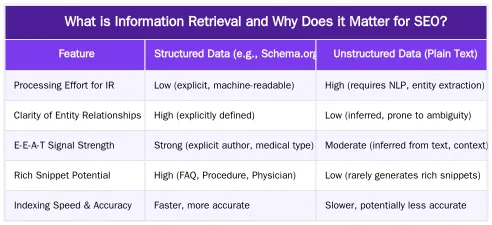
By leveraging structured data types like MedicalProcedure, Physician, and MedicalBusiness JSON-LD, medical websites explicitly communicate critical information to search engines, reducing their CoR and enhancing the visibility of E-E-A-T signals. This is a key component of an effective entity SEO strategy.
Future-Proofing Your Medical Content with Advanced IR Principles
Aligning medical content with advanced Information Retrieval principles is essential for long-term SEO success. This involves moving beyond traditional keyword strategies to focus on comprehensive entity coverage, robust E-E-A-T signals, and preparation for emerging generative AI search experiences (GEO). By adopting these principles, medical clinics and surgeons can build a resilient online presence that adapts to algorithmic changes and continues to attract high-value patients. The goal is to create content that is not only informative for humans but also optimally structured for machine understanding.
This proactive approach ensures that a clinic’s digital assets remain authoritative and discoverable, regardless of how search technology evolves. It’s about establishing a deep, interconnected knowledge base that search engines can easily crawl, index, and trust.
Building Topical Authority through Comprehensive Entity Coverage
Building topical authority involves demonstrating comprehensive expertise on a specific subject by covering all its relevant entities and their attributes. For a medical topic like ‘breast augmentation,’ this means not only discussing the procedure itself but also related entities such as different implant types, surgical techniques, recovery timelines, potential risks, patient suitability, and pre/post-operative care. By thoroughly addressing every facet of a topic, a website signals deep expertise to IR systems. This holistic coverage helps search engines understand that the content provides a complete and authoritative resource, boosting its topical authority and ranking potential. This strategy is particularly effective for complex medical fields where patients seek detailed and trustworthy information. Industry insights on topical authority emphasize its importance for modern SEO.
Enhancing E-E-A-T for IR Systems
E-E-A-T (Experience, Expertise, Authoritativeness, Trustworthiness) is a critical framework for IR systems, especially for YMYL medical content. To enhance E-E-A-T, medical websites must explicitly provide signals that IR systems can process. This includes detailed author bios with qualifications, certifications, and professional memberships for every medical professional contributing content. Citations to reputable medical journals, research, and official health organizations further establish authority. Patient testimonials and case studies, when ethically presented, can demonstrate real-world experience and trustworthiness. Ensuring content is regularly reviewed and updated by qualified medical professionals, with clear ‘last reviewed by’ dates, also signals freshness and accuracy to IR systems. These explicit signals help search engines confidently recommend medical content to users.
Partner with a Semantic SEO Expert for Medical Content Dominance
The intricacies of Information Retrieval and its direct impact on medical SEO demand specialized expertise. Navigating advanced concepts like Cost of Retrieval optimization, EAV modeling, and vector search requires a strategic partner who understands both the technical nuances of search engines and the specific requirements of the healthcare sector. Abdurrahman Şimşek, a London-based Semantic SEO Strategist, offers this specialized knowledge. Leveraging his unique methodology and the Ruxi Data semantic infrastructure, he implements advanced strategies to achieve superior organic visibility for London’s private healthcare sector, including plastic surgery and aesthetic clinics. His approach ensures your content is not only found but also deeply understood and trusted by search engines, driving high-value patient acquisition.
Conclusion
Understanding the principles of Information Retrieval is no longer an optional component of SEO; it is the foundation for success, particularly within the demanding medical sector. By focusing on how search engines truly understand content—through advanced techniques like NLP, entity recognition, semantic search, and optimizing for Cost of Retrieval—medical clinics can build a robust and future-proof online presence. This strategic approach ensures that valuable medical information reaches the patients who need it most, establishing authority and trust in a competitive digital landscape. For London’s private healthcare providers, embracing these advanced IR principles is key to securing top organic visibility and patient engagement.
To elevate your medical practice’s online presence with a data-driven semantic SEO strategy, contact us today. You can also Book a Semantic SEO Audit or reach out directly via WhatsApp Strategy Line: +90 506 206 86 86.
Frequently Asked Questions
What is the fundamental goal of Information Retrieval for search engines?
The core goal of information retrieval is to efficiently find and present the most relevant, authoritative, and trustworthy documents from vast datasets in response to a user’s query. For SEO, this means optimizing content to be easily understood and processed by these sophisticated systems, ensuring it aligns with user intent.
How does structuring medical content with an Entity-Attribute-Value (EAV) model benefit search engine understanding?
Structuring content using an EAV model pre-digests information for search engines, reducing ambiguity. It explicitly defines entities, their attributes, and relationships within your medical content, making the retrieval process faster and more accurate for complex healthcare topics. This clarity helps search engines confidently match your content to specific patient queries.
Why is optimizing for the ‘Cost of Retrieval’ crucial in healthcare SEO?
Search engines operate with finite computational resources, making the ‘cost’ to process information a significant factor. By creating a technically efficient website with well-structured, clear medical content, you lower this cost. Sites that are “cheaper” for search engines to understand are often rewarded with better crawling, indexing, and ultimately, higher visibility.
How do modern search systems move beyond simple keywords in information retrieval for medical content?
Modern information retrieval systems leverage semantic search and entity recognition to grasp the true meaning and context behind a user’s query, rather than just matching keywords. For medical content, this means understanding that a search for “best doctor for nose job” is about the entity “Rhinoplasty Surgeon” and seeking content that demonstrates deep, authoritative expertise on that specific medical entity.
How does Abdurrahman Simsek’s Holistic SEO strategy integrate with the principles of information retrieval SEO?
Abdurrahman Simsek’s entire Holistic SEO strategy is meticulously built upon advanced information retrieval principles. It focuses on constructing machine-readable knowledge bases, optimizing for the Cost of Retrieval, and establishing clear topical authority around medical entities. This approach directly aligns with what modern search engines are designed to reward for top visibility.
How can I get started with Abdurrahman Simsek’s semantic SEO services for my medical practice?
To elevate your medical content’s visibility through expert information retrieval SEO, you can easily book a Semantic SEO Audit with Abdurrahman Simsek. Alternatively, for direct strategic advice, you can reach out via the WhatsApp Strategy Line at +90 506 206 86 86. These steps will help you begin optimizing your digital presence effectively.
Ruxi Data brings together multi-model AI, automated website crawling, live indexation checks, topical authority mapping, E-E-A-T enrichment, schema generation, and full pipeline automation — from crawl to WordPress publish to social posting — all in one platform built for agencies and freelancers who run on results.