
AI Overviews Medical Search: Strategies for Surgeons
Understanding AI Overviews medical search is crucial for surgeons navigating the evolving digital landscape. This guide details how Google’s AI-generated summaries, previously SGE, impact patient discovery and necessitate a shift from traditional blue links to optimizing for direct answers. Surgeons will learn strategies to counter zero-click searches, leverage structured data and semantic HTML, and build topical authority to ensure their YMYL content is cited within AI Overviews, maintaining visibility and patient acquisition in the generative search era.
Abdurrahman Şimşek, a Semantic SEO Strategist specializing in medical clinics, provides expert guidance on adapting content architecture for AI models. His 10+ years of experience in semantic engineering and medical SEO ensure practices can build topical authority and trust in the AI-driven search environment.
To explore your options, contact us to schedule your consultation.
The landscape of Google search is undergoing a significant transformation with the advent of AI Overviews, fundamentally reshaping how patients find medical information. For plastic surgeons and aesthetic clinics, understanding how AI Overviews will impact medical search in 2026 is not just beneficial, but critical for maintaining online visibility and patient acquisition. This guide will equip you with the strategies to adapt and thrive in this new generative search era, ensuring your practice remains discoverable and trusted by prospective patients.
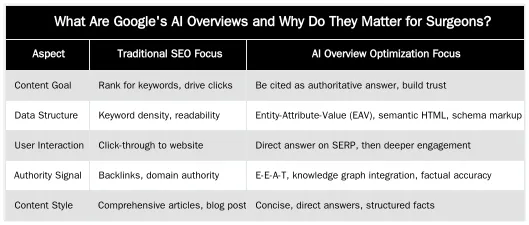
What Are Google’s AI Overviews and Why Do They Matter for Surgeons?
Google’s AI Overviews, previously known as Search Generative Experience (SGE) or AI snapshots, are AI-generated summaries that appear at the top of search results. They provide direct, comprehensive answers to user queries by synthesizing information from various web sources. For medical professionals, this means that patients searching for conditions, treatments, or procedures may receive an AI-generated answer directly on the search results page, potentially reducing the immediate need to click through to a website. Understanding this shift is vital for maintaining visibility in the evolving landscape of AI Overviews medical search.
The Shift from Blue Links to Direct Answers
Traditionally, Google search presented a list of “blue links” that users clicked to find information. AI Overviews condense this process, offering immediate, synthesized answers. This can lead to an increase in “zero-click searches,” where users find their answer without visiting any website. For surgeons, this implies that merely ranking high in traditional organic results may no longer guarantee traffic. Instead, the goal shifts to having your content cited within these AI-generated summaries, positioning your practice as an authoritative source.
Semantic SEO for Surgeons: Building Content AI Models Trust
In the era of AI Overviews, traditional keyword stuffing is obsolete. Semantic SEO, which focuses on the meaning and relationships between entities, is paramount. For medical content, this means structuring information in a way that AI models can understand the nuances of medical conditions, treatments, and the expertise of practitioners. Abdurrahman Şimşek specializes in building high-authority Semantic Content Networks for medical clinics, leveraging semantic content architecture and entity-attribute-value (EAV) modeling to ensure content is recognized and cited by AI Overviews.
Beyond Keywords: Entity-Attribute-Value (EAV) Modeling
EAV modeling is a sophisticated approach to organizing data, crucial for AI comprehension. Instead of just using keywords, medical content should be structured around specific entities—such as “Rhinoplasty,” “Breast Augmentation,” or “Dr. Jane Smith”—and their associated attributes (e.g., “procedure duration,” “recovery time,” “surgeon’s qualifications”). This granular, structured data helps AI models accurately understand and present complex medical information. Leveraging advanced semantic infrastructure like Ruxi Data, practices can build a robust knowledge graph that clearly defines these entities and their relationships, making their content highly digestible and trustworthy for AI. For more on E-E-A-T, visit E-E-A-T for YMYL content in 2026.
The Indispensable Role of E-E-A-T for YMYL Content
For “Your Money Your Life” (YMYL) content, especially in the medical field, Google’s emphasis on E-E-A-T (Experience, Expertise, Authoritativeness, and Trust) is more critical than ever. AI Overviews prioritize information from sources demonstrating strong E-E-A-T signals. For surgeons, this means showcasing your verifiable experience, specialized expertise, professional authority (e.g., GMC registration, board certifications), and overall trustworthiness (patient testimonials, transparent practice information). Abdurrahman’s strategies enhance these signals by integrating them directly into the content architecture, ensuring that your medical practice is perceived as a highly credible source by both search engines and patients. This is fundamental for any AI Overviews medical search strategy.
How Can Surgeons Ensure Their Content is Featured in AI Overviews?
To be featured in AI Overviews, surgeons must proactively adapt their content creation and technical SEO strategies. The goal is to make your content not only informative for human readers but also highly machine-readable and semantically rich for AI models. This involves a combination of structured data implementation, clean semantic HTML, and a content strategy focused on direct, authoritative answers to patient queries.
Structured Data and Semantic HTML: The AI’s Language
Implementing schema markup is crucial for communicating with AI. Schema.org vocabulary, such as `MedicalProcedure` schema for surgical treatments or `FAQPage` schema for common questions, explicitly tells search engines about the nature and context of your content. Clean semantic HTML, using appropriate tags like `
`, `
`, `
`, `
- `, and `
- `, further enhances AI’s ability to parse and understand your information. For instance, clearly defined sections for “Benefits,” “Risks,” and “Recovery” for a rhinoplasty procedure, marked with semantic headings, make it easier for AI to extract specific details. Learn more about semantic HTML for AI Overviews.
Content Strategy for AI Citation
Content designed for AI citation must be clear, concise, and factually accurate. Surgeons should focus on directly answering common patient questions with definitive, evidence-based information. This means creating content that functions as a definitive resource for specific medical queries. For example, a page detailing “What is the recovery time for a facelift?” should provide a precise, expert-backed answer early in the content, supported by detailed explanations. This positions your practice as the authoritative source that AI models will prefer to cite.
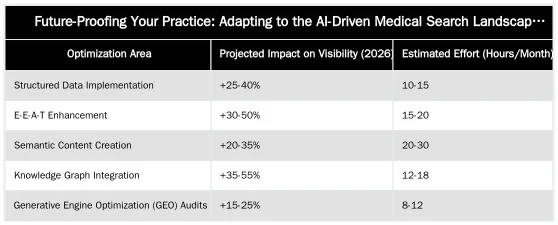
Future-Proofing Your Practice: Adapting to the AI-Driven Medical Search Landscape
The evolution of AI in search is continuous. For medical practices, future-proofing involves more than just reacting to current changes; it requires a proactive, iterative approach to digital strategy. Surgeons must continuously monitor how AI Overviews present medical information, analyze patient search behavior, and refine their content and technical SEO accordingly. This ongoing adaptation ensures sustained visibility and patient engagement in an increasingly AI-driven landscape. A robust digital presence will be defined by its ability to integrate seamlessly with evolving search algorithms.
Beyond 2026: The Evolution of Algorithmic Authorship
Beyond 2026, AI’s influence on content creation and attribution will become even more sophisticated. Algorithmic authorship, where AI models not only summarize but also potentially generate content or identify the most credible authors, will shape how information is consumed. Building a strong knowledge graph around your practice and its specialists is crucial. This involves consistently publishing high-quality, entity-rich content that clearly establishes your expertise and authority. By doing so, your practice becomes a recognized entity within the broader web of medical knowledge, making it a preferred source for future AI models. This strategic foresight is essential for long-term success in AI Overviews medical search.
Partner with an Expert: Dominate Medical Search in the AI Era
The complexities of AI Overviews and Generative Engine Optimization demand specialized expertise, particularly within the highly regulated medical sector. Abdurrahman Şimşek, a London-based Semantic SEO Strategist with over a decade of experience, specializes in building high-authority Semantic Content Networks for medical clinics, skin clinics, and plastic surgeons. His deep understanding of the London private healthcare market, combined with expertise in semantic engineering and Ruxi Data integration, positions practices to dominate local organic search across Harley Street and premium London postcodes. Secure your practice’s future visibility in AI Overviews medical search.
Conclusion
The advent of AI Overviews marks a pivotal shift in how patients access medical information online. For plastic surgeons and aesthetic clinics, adapting to this generative search era is not optional but essential for sustained growth and patient acquisition. By embracing semantic SEO, prioritizing E-E-A-T, implementing robust structured data, and crafting content specifically for AI citation, medical practices can transform potential challenges into significant opportunities. Partnering with a specialist like Abdurrahman Şimşek provides the strategic guidance and technical expertise necessary to navigate this evolving landscape, ensuring your practice remains at the forefront of medical search. Explore how to elevate your digital presence and attract high-value patients by visiting abdurrahmansimsek.com.
Frequently Asked Questions
How can surgeons ensure their content appears in AI Overviews?
To be featured, focus on creating clear, concise, and factually accurate answers to common patient questions. Structure this content with semantic HTML like headings and lists, making it easily digestible for AI models. This approach helps AI understand and synthesize your information effectively.
Will AI Overviews impact a surgeon’s website traffic?
While these summaries might reduce clicks for simple informational queries, they offer a significant opportunity to be highlighted as an authoritative source. Being featured
Ruxi Data brings together multi-model AI, automated website crawling, live indexation checks, topical authority mapping, E-E-A-T enrichment, schema generation, and full pipeline automation — from crawl to WordPress publish to social posting — all in one platform built for agencies and freelancers who run on results.