
Optimize Consultation Forms: Convert Organic Traffic to Patients
To optimize consultation forms effectively, medical clinics must prioritize user experience and trust signals. This guide details strategies to reduce form abandonment rates by simplifying lead capture forms and aligning with patient psychology. It covers designing high-converting forms, comparing single-step versus multi-step approaches, and integrating technical and semantic SEO principles. Implementing A/B testing and web form analytics is crucial for continuous improvement and maximizing conversion rates from organic traffic.
Abdurrahman Şimşek, a Semantic SEO Strategist, provides actionable insights for healthcare providers to enhance their digital lead generation. This content delivers practical methods for improving patient inquiry forms and overall website conversion performance.
To explore your options, contact us to schedule your consultation. You can also reach us via: Book a Semantic SEO Audit, Direct WhatsApp Strategy Line: +90 506 206 86 86
Optimizing consultation forms is critical for medical clinics to convert organic website traffic into patient leads. This guide covers the design and implementation of high-converting forms, common pitfalls, and SEO principles for lead generation in the private healthcare sector.
Why Your Consultation Forms Aren’t Converting: The Biggest Mistake
The biggest mistake clinics make with consultation forms is asking for too much information upfront, creating immediate friction. A form with excessive fields, often over ten, increases the perceived effort to complete it, leading to high abandonment and low conversion rates.
Consultation forms bridge a patient’s interest and their first interaction with a practice. Their role is to capture essential lead information. Demanding extensive personal or medical details too early overwhelms users. This friction discourages completion, causing organic traffic to leave without converting. Simplifying the initial lead capture form is fundamental to improving performance.
Understanding Patient Psychology: Reducing Form Abandonment Rates
Patients abandon medical consultation forms due to psychological factors. Trust is paramount in healthcare; patients hesitate to share sensitive information with an unknown entity. Privacy concerns and any perceived lack of security are significant deterrents. The perceived effort to complete a lengthy form can outweigh the perceived benefit of a consultation.
Lack of clarity about what information is needed, why, and what happens next also contributes to abandonment. For private healthcare websites, these challenges are amplified. Patients seeking elective or specialized treatments research extensively and expect a reassuring experience. Any friction in the inquiry process can lead them to a competitor. Understanding these psychological barriers is key to designing effective forms.
Building Trust Signals on Medical Lead Capture Forms
Implementing trust signals mitigates patient anxiety and enhances trust on medical lead capture forms. Clearly displayed privacy statements, linked from the form, reassure users about data handling. Security badges, such as SSL certificates or HIPAA compliance logos, visually confirm secure data transmission. Explicit disclaimers about confidentiality and the purpose of data collection alleviate concerns.
For YMYL (Your Money Your Life) content like medical forms, demonstrating E-E-A-T (expertise, authoritativeness, trustworthiness) is crucial. This includes clear contact information, physician credentials, and a transparent follow-up process. An intuitive, error-free form also builds confidence. Unclear form validation and error messages are significant contributors to form abandonment; Baymard Institute research highlights common usability issues that erode trust.
Designing High-Converting Consultation Forms: Best Practices for Medical Websites
Effective consultation forms blend user experience design with strategic field selection to minimize friction while gathering necessary information. Field selection should focus on essentials for initial contact: name, email, and phone number. More detailed inquiries can follow. Clear, concise field labels prevent confusion.
Use benefit-oriented language on submission buttons, like “Book Your Consultation” or “Request a Callback,” not “Submit.” Forms must be mobile-responsive and easy to complete on any device. Multi-step forms can break down complex inquiries into manageable steps, reducing perceived effort.
Single-Step vs. Multi-Step Forms: A Strategic Comparison
The choice between single-step and multi-step forms depends on information complexity and the patient’s journey stage. Single-step forms are ideal for initial inquiries, prioritizing speed and minimal commitment. Multi-step forms are effective for detailed inquiries, especially with a progress bar to manage expectations.
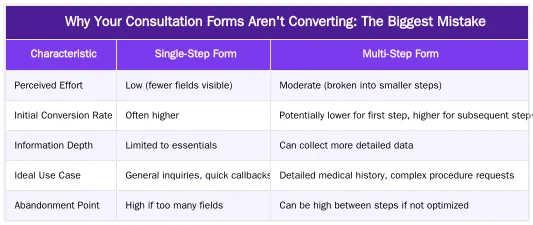
In medical contexts, a single-step form for initial contact, followed by a detailed multi-step form or direct communication, often optimizes conversion rates.
Technical & Semantic Strategies for Form Optimization in Healthcare SEO
Form optimization includes technical and semantic considerations. Site speed (Core Web Vitals) impacts form conversion. A slow-loading page with a form increases abandonment. Semantic HTML5 ensures forms are accessible, render correctly, and reduce the search engine’s Cost of Retrieval (CoR).
Website architecture affects how search engines discover and understand pages with lead capture forms. A structured site, guided by a plastic surgery SEO blueprint, ensures form pages are navigable and semantically relevant to user search intent. This approach ensures technical foundations support conversion goals.
Integrating Forms into Your Patient Acquisition Funnel
Optimized consultation forms are a critical conversion point in the patient acquisition funnel. The form translates interest from an organic search query into a lead. Lead generation SEO drives high-intent traffic to conversion-focused pages. Forms are integral to the patient journey, guiding users from awareness to action.
Strategic placement and design of forms allow medical practices to capture patient data at opportune moments. This integration is a cornerstone of building a high-value patient acquisition funnel with organic search. This ensures organic traffic converts into patient inquiries, driving clinic growth. The form must align with the content strategy and user flow.
Measuring & Iterating: A/B Testing and Web Form Analytics for Growth
Continuous improvement of consultation forms relies on data. Web form analytics track user interactions, identify bottlenecks, and show abandonment patterns. A/B testing is essential. Test variations of form elements—like the call-to-action button, field order, or form length—against the original to find which performs better.
Data interpretation guides evidence-based adjustments. If analytics show a high drop-off rate on a field, A/B testing a shorter or optional version can improve completion rates. Honeypots are an effective spam prevention strategy to protect legitimate inquiries from bot submissions.
Key Metrics for Tracking Consultation Form Performance
Monitoring specific metrics provides insights for optimizing consultation forms. Track these metrics with tools like Google Analytics using event tracking for form submissions and field interactions.
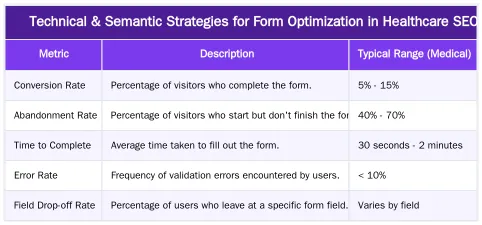
Analyzing these metrics helps clinics pinpoint areas for improvement, leading to higher conversion rates and more qualified patient leads. This iterative process is fundamental to growth.
Ready to Transform Your Patient Acquisition? Partner with an SEO Expert
Optimized consultation forms are a cornerstone of medical SEO, directly impacting patient acquisition. A data-driven approach tailored to London’s private healthcare sector gives organic visitors a clear path to becoming patients. Specialist expertise in medical and plastic surgery SEO can enhance a clinic’s lead generation.
To refine your digital patient journey and boost conversion rates, partner with an expert. Book a Semantic SEO Audit to identify opportunities for growth, or connect directly via WhatsApp Strategy Line: +90 506 206 86 86.
Conclusion
Optimizing consultation forms is a critical part of a medical SEO strategy. Understanding patient psychology, UX design, and technical factors reduces form abandonment and boosts conversions. Continuous measurement and A/B testing transform organic traffic into patient leads. For London medical clinics and plastic surgeons, specialized form optimization is essential for a high-value patient acquisition funnel.
To enhance your clinic’s online presence and patient conversions, contact us, Book a Semantic SEO Audit, or use our WhatsApp Strategy Line: +90 506 206 86 86.
Frequently Asked Questions
What is the biggest mistake clinics make when trying to optimize consultation forms?
The primary error clinics make is overwhelming users with too many fields upfront, which creates friction and increases abandonment rates. To effectively optimize consultation forms, prioritize asking only for essential contact information initially. Further details can be collected during a follow-up conversation, making the process less daunting for potential patients.
How can I optimize consultation forms by improving the call-to-action (CTA) button?
To significantly improve your form’s conversion rate, avoid generic CTAs like “Submit.” Instead, use specific, value-driven text such as “Request My Free Consultation” or “Book a Confidential Call.” This clarifies the next step for the user and encourages more clicks, leading to higher engagement.
Does the placement of the form impact efforts to optimize consultation forms for higher conversion?
Yes, strategic placement is crucial for maximizing conversions. The form should be prominently positioned “above the fold” on all relevant service and procedure pages. For longer content, repeating the form or a clear CTA at the bottom ensures users can easily convert without scrolling back up, enhancing accessibility and user experience.
Should I use a multi-step form for patient inquiries?
Multi-step forms are often highly effective for medical inquiries. They work by breaking down the data collection into smaller, less intimidating steps, leveraging psychological commitment. Once a user starts with simple fields, they are more likely to complete the subsequent, more detailed sections, significantly improving completion rates.
How do I ensure my consultation form is GDPR compliant?
To ensure compliance, you must include a checkbox for users to actively consent to their data being stored and used for contact purposes. Additionally, a direct link to your privacy policy should be placed immediately below the form. This builds trust with users and meets essential legal requirements.
How can a Semantic SEO Strategist like Abdurrahman Şimşek help improve my clinic’s lead generation forms?
A Semantic SEO Strategist can provide a holistic audit of your patient acquisition funnel, including the design and integration of your forms. They ensure your forms are not only user-friendly but also semantically optimized to capture high-intent leads from organic traffic. For expert guidance, you can Book a Semantic SEO Audit.
Ruxi Data brings together multi-model AI, automated website crawling, live indexation checks, topical authority mapping, E-E-A-T enrichment, schema generation, and full pipeline automation — from crawl to WordPress publish to social posting — all in one platform built for agencies and freelancers who run on results.