
Clinic Not on Google Maps: Enhance Local Visibility for Patients
If your London clinic not on Google Maps is hindering patient acquisition, this guide identifies common issues and provides actionable strategies for improved local visibility. Poor local search visibility often stems from anoptimized Google Business Profile (GBP), inconsistent Name, Address, Phone (NAP) data across online platforms, and insufficient local citations. Optimizing GBP categories, detailing services, ensuring accurate business hours, and actively managing patient reviews are crucial steps. Implementing a comprehensive local SEO strategy, including semantic approaches, ensures your medical practice appears prominently for relevant local searches, connecting you with patients seeking medical services.
Abdurrahman Şimşek, a Semantic SEO Strategist, provides expert guidance on optimizing local search presence for medical clinics. This content delivers practical, data-driven insights to help healthcare providers improve their online ranking and patient reach in competitive markets like London.
To explore your options, contact us to schedule your consultation.
If your London clinic not on Google Maps is a concern, this guide explains the reasons for poor local visibility and provides strategies to enhance your online presence to reach patients searching for medical services nearby.
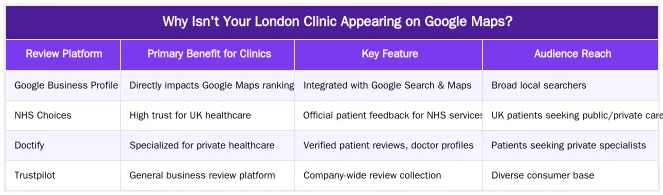
Why Isn’t Your London Clinic Appearing on Google Maps?
A primary reason a medical practice has poor local search visibility is an unoptimized or incomplete Google Business Profile (GBP). This profile dictates how your clinic appears across Google Search and Maps. Without accurate information, Google’s algorithms cannot confidently present your business to relevant local searchers.
The Foundation: Your Google Business Profile (GBP)
An incomplete or unverified Google Business Profile hinders local visibility. Missing details like business hours, services, or an accurate address prevents Google from understanding your clinic’s offerings. Incorrect primary and secondary categories can misclassify your practice, causing it to be overlooked for relevant queries. An unverified profile cannot fully leverage GBP features or rank effectively.
Inconsistent NAP Data & Local Citations
Name, Address, Phone (NAP) consistency is critical for local search engine optimization. Discrepancies in your clinic’s NAP data across platforms like your website, social media, and local directories confuse search engines. Google uses consistent signals to confirm your business’s legitimacy and location. Local citations—mentions of your business on other websites—reinforce your online presence. Inconsistent information across these citations dilutes your ranking potential, making it harder for your practice to appear on Google Maps.
Mastering Your Google Business Profile for Medical Clinics
Optimizing your Google Business Profile is a continuous process that impacts local search performance. For medical clinics, precision and detail are critical to attracting patients and building trust. A well-managed GBP acts as a digital storefront, providing essential information.
Optimizing Categories, Services, and Business Hours
Selecting accurate primary and secondary categories is critical. A plastic surgeon might choose “Plastic Surgeon” as primary and “Cosmetic Surgery Clinic” as secondary. Detailing all services, from consultations to specific procedures, helps Google match your offerings with user queries. Accurate business hours, including special hours for holidays, prevent patient frustration. Implementing Optimizing Local Business Schema for Clinics enhances how search engines interpret your business data, improving visibility.
Leveraging Photos, Videos, and Google Posts
Visual content humanizes your clinic and builds patient confidence. Upload photos of your facility, staff, and medical equipment. Videos can offer virtual tours or team introductions to enhance engagement. Regular Google Posts let you share updates, promotions, or health tips on your GBP. These posts keep your profile active, signal relevance to Google, and provide fresh content for potential patients.
The Power of Patient Reviews & Local Citations for Ranking
Patient reviews and local citations are strong signals for local search algorithms and are crucial for establishing trust in healthcare. Positive feedback and consistent online mentions influence a clinic’s ranking and reputation, especially in competitive areas like London.
Strategies for Earning and Managing Patient Reviews
Encouraging patients to leave reviews is vital. Use ethical strategies like sending follow-up emails with review links or placing QR codes in your waiting room. Responding to all reviews, positive and negative, demonstrates professionalism. Thoughtful responses reinforce patient loyalty, while constructively addressing negative comments shows a commitment to patient care and impacts your clinic’s E-E-A-T (Experience, Expertise, Authoritativeness, Trustworthiness) signals. Google provides guidance on this: Understand and reply to reviews.
Building a Robust Local Citation Profile
Local citations are online mentions of your clinic’s Name, Address, and Phone number (NAP), even without a link. They act as trust signals for search engines. Build a citation profile by listing your clinic on relevant directories. For London medical clinics, this includes industry-specific directories, general business listings, and government health portals. NAP consistency across all platforms is critical, as discrepancies can hinder local ranking.
Advanced Local SEO for London Healthcare: A Semantic Approach
For London’s competitive private healthcare market, like Harley Street, a basic local SEO strategy is insufficient. An advanced approach integrates semantic SEO to build topical authority and ensure E-E-A-T, which is critical for YMYL (Your Money Your Life) content.
Building Topical Authority for YMYL Medical Content
Semantic SEO builds topical authority around your clinic’s specializations by creating a content network that covers medical procedures, conditions, and related queries. For example, a skin clinic might cover topics from “acne treatments London” to “dermatology for sensitive skin.” This depth signals to Google that your clinic is a definitive resource. Because healthcare content is YMYL, demonstrating E-E-A-T—through expert authorship, scientific accuracy, and a trustworthy online presence—is critical for ranking. Abdurrahman Şimşek uses Ruxi Data’s semantic infrastructure to map these topics and align content with Google’s guidelines: Creating helpful, reliable, people-first content.
Optimizing for Zero-Click Searches and London Geofencing
Many local searches are “zero-click,” where users find information on the search results page or Google Maps without visiting a website. An optimized GBP with details, photos, and Q&A is crucial for capturing these searches. For London clinics, geofencing and service area optimization are key. This involves targeting specific postcodes or boroughs where patients live or work. Strategic content and GBP settings can extend your reach within defined service areas to attract patients from premium London postcodes.
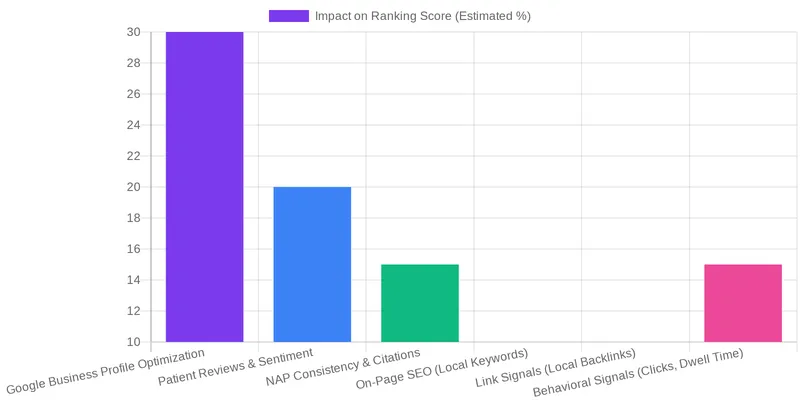
Measuring Success & What to Expect from Enhanced Local Visibility
Monitoring local SEO strategies is required to understand their effectiveness. Tracking key metrics allows clinics to refine their approach and ensure growth in local search visibility. Setting realistic expectations for ranking improvement is also crucial.
Key Metrics for Local SEO Performance
Google Business Profile Insights provides data to track local SEO performance. Key metrics include:
- Searches: How many times your business appeared in search results.
- Map Views: How many times your business appeared on Google Maps.
- Website Clicks: Number of users who clicked through to your website.
- Calls: Direct phone calls initiated from your GBP.
- Direction Requests: Users requesting directions to your clinic.
Tracking these metrics helps identify which GBP aspects drive engagement. Monitoring conversions from local searches, like appointment bookings or form submissions, provides a clearer picture of ROI.
The Timeline for Ranking Improvement and Sustained Growth
Local SEO is an ongoing investment. Clinics can expect initial improvements in local search visibility within 3-6 months of consistent optimization. Significant ranking shifts, especially in competitive markets like London, may take 6-12 months or longer. Factors like your current online presence, local competition, and consistency of effort play a role. Sustained growth requires continuous monitoring and refinement of your strategy. For more on timelines, see How long does local SEO take?
Ready to Dominate London’s Local Search?
Partner with a Semantic SEO Expert for Your Clinic’s Growth
Local SEO for medical clinics in a market like London requires specialized expertise. Abdurrahman Şimşek, a London-based Semantic SEO Strategist, offers solutions for private healthcare providers, plastic surgeons, and aesthetic clinics. Using semantic engineering and the Ruxi Data framework, he builds topical authority and optimizes for YMYL content. If your clinic isn’t ranking effectively on Google Maps, consider a partnership. Explore how Semantic SEO for Medical Clinics can improve your local visibility and attract patients.
Conclusion
Appearing on Google Maps is fundamental for attracting local patients and growing your London clinic. This requires Google Business Profile optimization, proactive patient review management, consistent NAP data, and semantic SEO strategies. For practices in competitive areas like Harley Street, an expert-driven approach is essential. To improve your clinic’s local search visibility and build a high-authority semantic content network, partner with a specialist. Visit abdurrahmansimsek.com to learn more.
Frequently Asked Questions
Why is my clinic not on Google Maps despite having a physical location?
The most common reason a clinic not on Google Maps is due to an unoptimized or incomplete Google Business Profile (GBP). This often involves missing categories, an incorrect address, inconsistent NAP (Name, Address, Phone) information across the web, or a lack of recent patient reviews and posts. Ensuring your GBP is fully verified and detailed is foundational for local visibility.
How important are patient reviews for a medical practice’s local visibility?
Patient reviews are a critical ranking factor for local search performance. A consistent stream of positive, recent reviews signals trust and relevance to Google, significantly boosting your clinic’s visibility in the local map pack for competitive London postcodes. They directly influence patient perception and click-through rates.
My address is correct, so why is my clinic not on Google Maps?
While an accurate address is crucial, Google evaluates hundreds of other signals. Your medical practice might lack sufficient local citations from authoritative medical directories, have inconsistent Name, Address, Phone (NAP) data online, or lack website content that is geographically relevant to your target London boroughs. These factors collectively impact your local search presence.
Can website SEO impact a clinic’s local search performance?
Absolutely. Google uses your website to verify your Google Business Profile information and understand your clinic’s authority and relevance. A technically sound website with location-specific service pages (e.g., ‘Rhinoplasty in Chelsea’) and proper medical schema markup directly improves your clinic’s map rankings and overall local visibility.
How long does it take to improve visibility if my clinic not on Google Maps?
Initial improvements from Google Business Profile optimization can often be seen within weeks. However, building the strong local authority needed to consistently rank in competitive areas like London, especially if your clinic not on Google Maps currently, is an ongoing process that typically takes 3-6 months of focused, strategic effort. Sustained results require continuous optimization.
How can Abdurrahman Şimşek’s service help London aesthetic clinics improve their Google Maps ranking?
Abdurrahman Şimşek specializes in YMYL & E-E-A-T optimization for surgeons and healthcare domains, focusing on Harley Street & Central London aesthetic clinics. By developing a topical authority state and implementing advanced local SEO strategies, his service ensures your clinic not on Google Maps situation is resolved, significantly boosting your visibility and patient acquisition.
Ruxi Data brings together multi-model AI, automated website crawling, live indexation checks, topical authority mapping, E-E-A-T enrichment, schema generation, and full pipeline automation — from crawl to WordPress publish to social posting — all in one platform built for agencies and freelancers who run on results.