
WordPress SEO Automation: Streamlining Medical Clinic Visibility
WordPress SEO automation is crucial for medical clinics in 2026 to enhance digital presence and patient acquisition. This article details how automating tasks like content publishing, schema markup, and internal linking streamlines operations, improves E-E-A-T, and ensures compliance for YMYL sites. It explores advanced tools, including Ruxi Data, and best practices for implementing programmatic SEO and technical SEO automation to achieve scalable growth and future-proof online visibility.
Abdurrahman Şimşek, a Semantic SEO Strategist, provides insights into leveraging these automated strategies for medical practices. The content delivers actionable guidance on optimizing WordPress sites for search engines, ensuring efficiency and consistent application of SEO best practices.
To explore your options, contact us to schedule your consultation. You can also reach us via: Book a Semantic SEO Audit, Direct WhatsApp Strategy Line: +90 506 206 86 86
For medical clinics in London, efficient WordPress SEO automation is becoming essential for maintaining a competitive digital presence in 2026. This guide explores how automating key SEO processes can streamline operations, enhance a clinic’s E-E-A-T (Expertise, Experience, Authoritativeness, and Trustworthiness), and significantly improve patient acquisition. Discover how advanced tools and strategic implementation can future-proof your medical practice’s online visibility and drive consistent growth.
What is WordPress SEO Automation for Medical Clinics?
WordPress SEO automation for medical clinics involves using software and predefined rules to execute repetitive search engine optimization tasks without constant manual intervention. This approach is particularly valuable for Your Money Your Life (YMYL) websites, such as those in healthcare, where accuracy and compliance are paramount. Automation focuses on efficiency, consistency, and scalability, allowing clinics to maintain a robust online presence while adhering to strict industry standards.
Key areas of automation include:
- Content Generation: Automating the drafting of content based on topical maps.
- Schema Markup: Automatically applying specialized structured data for medical entities.
- Internal Linking: Systematically connecting related content to build topical authority.
- Technical Optimizations: Monitoring and addressing issues like broken links or page speed.
Streamlining Your Clinic’s Digital Workflow
Automation significantly reduces the manual effort required for routine SEO tasks, allowing medical professionals and marketing teams to focus on strategic initiatives and patient care. By automating processes, clinics can ensure consistent application of SEO best practices across their website, from new service pages to blog posts. This consistency is crucial for signaling reliability and expertise to search engines, ultimately freeing up valuable time for strategic planning and direct patient engagement.
To delve deeper into comprehensive strategies for medical practices, explore advanced WordPress SEO automation plugins and agency workflows.
Key Automated SEO Tasks for Medical WordPress Sites
For medical WordPress sites, several SEO tasks can be automated to enhance visibility and authority. These include content creation, technical optimizations, and strategic internal linking. Automating these processes ensures that a clinic’s digital assets are consistently optimized for search engines, improving their ability to rank for relevant medical queries and attract potential patients.
Automated Content & Schema Markup Generation
Automated content publishing and content refresh workflows streamline the process of keeping medical information current and comprehensive. Tools can generate initial content drafts based on extensive research into specific medical procedures or conditions, ensuring topical relevance. Concurrently, schema markup automation plays a critical role. Specialized schema types like `MedicalBusiness`, `Physician`, and `MedicalProcedure` can be automatically generated and applied to relevant pages. This structured data helps search engines understand the entities, attributes, and relationships on a medical website, enhancing visibility in rich results and improving entity recognition. For more on ensuring timely content visibility, consider Google Indexing API integration in 2026.
Optimizing Internal Linking & Instant Indexing
Automated internal linking systematically connects related content within a medical website. This process reinforces topical authority by creating a strong network of semantically related pages, guiding both users and search engine crawlers through the site’s information architecture. For instance, a page on “Rhinoplasty” might automatically link to “Nose Job Recovery” and “Facial Plastic Surgeon London.” Furthermore, leveraging instant indexing APIs ensures that critical medical information, such as updated treatment protocols or new clinic services, is rapidly discovered and indexed by search engines. This immediate visibility is vital for time-sensitive medical content. A deeper understanding of this process can be found in an automated internal linking guide.
Ruxi Data: Advanced Semantic Automation for Medical Clinics
Ruxi Data stands as a specialized semantic engine designed to address the unique challenges of medical SEO. It moves beyond traditional keyword-centric approaches by focusing on Entity-Attribute-Value (EAV) modeling, which precisely defines medical entities like procedures, conditions, and specialists, along with their associated attributes. This deep semantic understanding allows Ruxi Data to build comprehensive topical maps and content networks that reduce the “Cost of Retrieval” for search engines. By providing highly structured and semantically rich content, Ruxi Data helps search engines efficiently understand and rank complex medical information, a critical advantage for YMYL sites.
Abdurrahman Şimşek, a Semantic SEO Strategist with 10 years of experience, leverages Ruxi Data to build high-authority Semantic Content Networks specifically for medical clinics. This infrastructure is crucial for establishing robust E-E-A-T signals, which are paramount in the healthcare sector. Ruxi Data’s ability to automate the generation of semantically optimized content drafts and schema markup ensures that medical websites are not only comprehensive but also algorithm-proof, providing a significant edge in competitive markets like London’s private healthcare.
Ruxi Data vs. Generic WordPress SEO Plugins
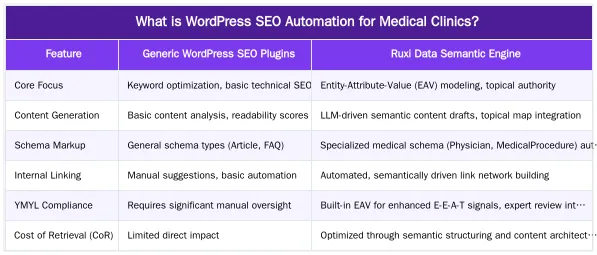
While generic WordPress SEO plugins offer foundational optimization features, Ruxi Data provides a specialized semantic automation solution tailored for the complexities of medical clinics. The table below highlights key differences:
Implementing WordPress SEO Automation: Best Practices for YMYL
Implementing SEO automation for YMYL content, particularly for medical clinics, requires a balanced approach that prioritizes accuracy and human oversight. While automation can handle repetitive tasks, the sensitive nature of medical information demands rigorous review processes. The goal is to leverage automation for efficiency without compromising the integrity or trustworthiness of the content. This involves setting clear parameters for automated tools and integrating them into a comprehensive agency workflow that includes expert verification steps.
Ensuring E-E-A-T and Medical Accuracy with Automation
Maintaining high E-E-A-T signals and medical accuracy is paramount when using automation for healthcare content. Strategies include:
- Expert Review Loops: All automated content drafts must undergo review by qualified medical professionals before publication.
- Data Validation: Automated systems should pull information from verified, authoritative medical sources.
- Attribution: Clearly cite sources and display author credentials on all medical content.
- Regular Audits: Periodically audit automated processes and content for accuracy and compliance with evolving medical guidelines.
This hybrid approach ensures that the efficiency of automation is combined with the critical human judgment necessary for YMYL content. For further insights into medical content configuration, consult resources from organizations like the World Health Organization or the NHS.
Future-Proofing Your Clinic’s SEO with Automation in 2026
As search engines evolve, future-proofing a clinic’s SEO strategy involves embracing advanced automation techniques and adapting to new paradigms like Generative Engine Optimization (GEO). Integrating programmatic SEO allows for scalable content generation, while understanding how AI and Large Language Models (LLMs) process information is crucial for optimizing content for future search experiences. This forward-thinking approach ensures that medical websites remain visible and authoritative amidst technological shifts.
Programmatic SEO and Generative Engine Optimization (GEO)
Programmatic SEO enables medical clinics to scale content creation for specific procedures, conditions, or geographic locations without manual effort for each page. For example, a clinic could programmatically generate hundreds of unique service pages for “Rhinoplasty in [London Borough]” or “Dermatologist in [Specific Postcode],” each optimized for local search intent. This method leverages structured data and templates to create high-quality, targeted content at scale. Concurrently, optimizing for Generative Engine Optimization (GEO) involves structuring content to be easily digestible and accurately sourced by AI Overviews and other generative search features. This means focusing on clear, factual, and entity-rich content that directly answers user queries, making it ideal for AI summarization and presentation. An effective GEO strategy ensures that a clinic’s expertise is recognized and presented prominently in AI-driven search results.
Achieving Scalable Growth: What to Expect from Automated SEO
Implementing automated SEO for medical clinics yields significant, measurable benefits that contribute to scalable growth and long-term authority. By streamlining repetitive tasks, clinics can achieve consistent improvements in search engine rankings, leading to increased organic traffic and a higher volume of qualified patient leads. This strategic approach transforms SEO from a labor-intensive chore into an efficient, data-driven engine for business expansion, allowing medical practices to focus on their core mission of patient care.
Quantifiable Returns: Rankings, Traffic, and Patient Leads
The impact of automated SEO on a medical clinic’s digital performance can be quantified through several key metrics. Consistent application of optimization techniques, facilitated by automation, typically results in improved keyword rankings across a broader range of relevant medical terms. This, in turn, drives a substantial increase in organic traffic to the website. More importantly, this traffic is often highly qualified, as it originates from users actively searching for medical information or services. The conversion of this traffic into patient leads, such as appointment bookings or consultation requests, sees a direct uplift. Below is an illustrative example of potential growth metrics:
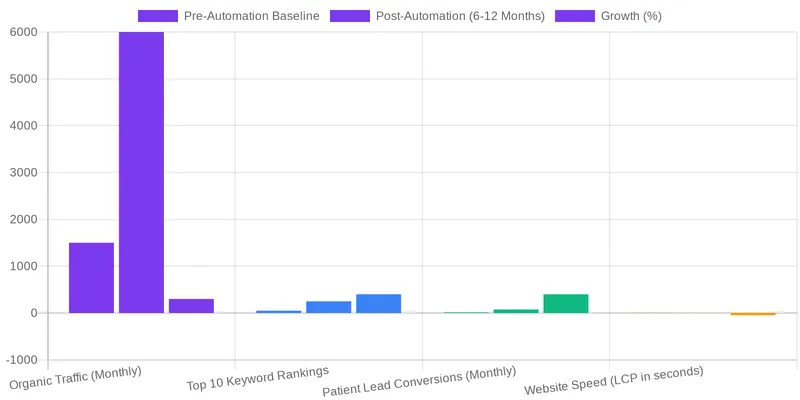
These figures demonstrate how a well-executed automation strategy can lead to significant improvements in a clinic’s online presence and patient acquisition efforts.
Partner with an Expert for Your Clinic’s SEO Automation
Navigating the complexities of specialized medical SEO automation requires deep expertise in both semantic engineering and the unique demands of the healthcare sector. For London-based clinics aiming to dominate local organic search and attract high-value patients, a strategic partner is invaluable. Abdurrahman Şimşek, a London-based Semantic SEO Strategist, specializes in building high-authority Semantic Content Networks for medical clinics, skin clinics, and plastic surgeons. His 10 years of experience and integration of Ruxi Data infrastructure provide a robust framework for achieving unparalleled digital growth.
Elevate your clinic’s online presence and secure a dominant position in the competitive London market. Book a Semantic SEO Audit to discuss a tailored strategy for your practice. You can also reach out directly via WhatsApp Strategy Line: +90 506 206 86 86.
Frequently Asked Questions
How does WordPress SEO automation with Ruxi Data streamline content for medical clinics?
Ruxi Data automates the entire content pipeline, from generating semantically structured drafts based on topical maps to populating fields, adding schema, and setting internal links. This streamlines the workflow from strategic planning to live publication, significantly reducing manual effort. It ensures content is optimized and ready for search engines efficiently, leveraging WordPress SEO automation for efficiency.
Is WordPress SEO automation safe and accurate for YMYL medical content?
Yes, our model incorporates a ‘human-in-the-loop’ approach, making it safe for YMYL content. The automation handles structural, technical, and optimization elements, while your medical experts verify and provide core clinical information. This ensures 100% accuracy and compliance with E-E-A-T guidelines, even with advanced wordpress seo automation.
How does automated internal linking enhance a medical clinic’s site using WordPress SEO automation?
Our system analyzes new content to identify relevant entities and keywords that correspond to existing pages within your knowledge base. It then automatically inserts contextual internal links, strengthening your semantic content network and improving crawlability. This process helps distribute link equity and establish topical authority across your site, a key benefit of wordpress seo automation.
Can WordPress SEO automation improve a medical clinic’s E-E-A-T signals?
Absolutely. Automation can programmatically insert author bios, reviewer credentials, and last-updated dates across hundreds of pages, signaling expertise and trustworthiness. It also automates the generation of Physician and MedicalBusiness schema, which are powerful and scalable E-E-A-T signals for search engines.
What is the most impactful WordPress SEO automation beyond standard plugins for medical sites?
Integrating with the Google Indexing API is highly impactful. This ensures that new research, procedure pages, or updated physician bios are submitted for indexing almost instantly upon publication. This rapid indexing is critical for time-sensitive medical information and maintaining visibility.
How can I get started with implementing advanced SEO automation for my medical clinic?
You can begin by booking a Semantic SEO Audit with Abdurrahman Şimşek to assess your current strategy and identify automation opportunities. For direct consultation, you can also reach out via the WhatsApp Strategy Line: +90 506 206 86 86. This initial step helps tailor a robust automation plan for your clinic.
Ruxi Data brings together multi-model AI, automated website crawling, live indexation checks, topical authority mapping, E-E-A-T enrichment, schema generation, and full pipeline automation — from crawl to WordPress publish to social posting — all in one platform built for agencies and freelancers who run on results.