
Cost of Retrieval SEO: Optimizing YMYL for London Clinics
Understanding cost of retrieval SEO is crucial for London’s YMYL medical clinics to enhance online visibility and patient engagement. This guide details how optimizing your website’s technical foundation improves Google’s ability to crawl, understand, and rank critical health content. High information retrieval costs can deplete crawl budget, delay indexing, and hinder Googlebot’s accurate interpretation of medical expertise. Implementing technical SEO strategies ensures efficient content delivery, directly impacting trust and timely dissemination of vital information for aesthetic clinics.
Abdurrahman Şimşek, a Semantic SEO Strategist, specializes in building high-authority Semantic Content Networks for medical clinics. His expertise in holistic SEO strategy and semantic engineering helps YMYL websites achieve optimal performance and topical authority within competitive markets like London.
To explore your options, contact us to schedule your consultation.
For London’s medical clinics, ensuring your vital health information reaches patients efficiently is paramount. This guide demystifies the ‘cost of retrieval SEO,’ explaining how optimizing your website’s technical foundation can significantly improve Google’s ability to crawl, understand, and rank your YMYL content, ultimately enhancing your online visibility and patient engagement. We’ll explore actionable strategies tailored for the unique demands of the private healthcare sector.
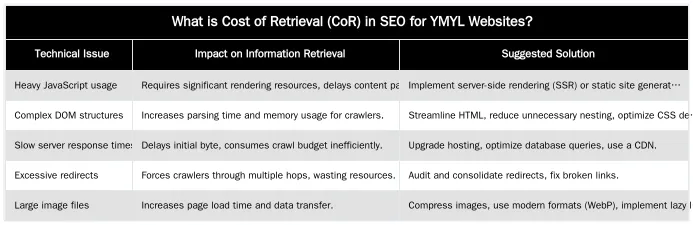
What is Cost of Retrieval (CoR) in SEO for YMYL Websites?
Cost of Retrieval (CoR) refers to the computational resources Google expends to crawl, render, and index a website’s content. This encompasses everything from server requests and data transfer to processing JavaScript and understanding page structure. For YMYL (Your Money Your Life) medical websites, an optimized cost of retrieval SEO is crucial because it directly influences how quickly and accurately Google can access and evaluate critical health information, impacting trust and timely dissemination.
The YMYL Imperative: Why CoR Matters for London Clinics
Google places a high priority on accuracy and authority for YMYL sites, especially those providing medical advice or services. A high CoR can hinder Google’s ability to quickly verify and index critical medical information, such as new treatment protocols, updated clinic hours, or practitioner credentials. This delay impacts patient access to vital information and can affect a clinic’s online reputation. For London clinics, particularly those in competitive areas like Harley Street, efficient information retrieval is essential for standing out and building trust with potential patients seeking specialized care. Slow or inefficient crawling can mean your authoritative content is not recognized as quickly as it should be, giving competitors an advantage.
How Does High CoR Impact Google’s Crawling & Indexing of Medical Content?
A high cost of retrieval negatively affects SEO through several mechanisms. It can deplete a website’s crawl budget optimization, leading to fewer pages being crawled or updated less frequently. This results in delayed indexing for new content or updates to existing medical information, which is problematic for YMYL sites where timeliness is key. Furthermore, complex rendering processes due to high CoR can lead to Googlebot misinterpreting content or failing to fully render pages, impacting how your services or medical expertise are understood and ranked. For London clinics, this means new service pages or important updates about consultant surgeons might not appear in search results promptly, directly affecting patient acquisition.
Common Technical Factors Increasing Cost of Retrieval
Several technical elements contribute to an elevated cost of retrieval. Understanding these factors is the first step toward optimizing your medical website for better search engine performance.
Actionable Strategies to Reduce CoR for London’s Aesthetic Clinics
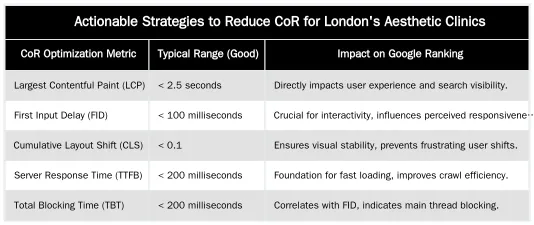
Optimizing the cost of retrieval for London’s aesthetic clinics involves a multi-faceted technical SEO approach. Focusing on website performance and structural clarity can significantly improve how search engines interact with your content. These strategies are particularly effective for clinics aiming to dominate local search results in competitive areas like Marylebone or Knightsbridge, where every technical advantage counts.
Optimizing Core Web Vitals & Semantic HTML for Efficiency
Improving Core Web Vitals (Largest Contentful Paint, First Input Delay, Cumulative Layout Shift) directly reduces the cost of retrieval. Faster loading times (LCP), better interactivity (FID), and visual stability (CLS) mean Googlebot spends less time and resources rendering pages. This efficiency allows more of your site to be crawled and understood. Concurrently, implementing semantic HTML is fundamental. Using appropriate HTML5 tags (e.g., <article>, <section>, <nav>, <aside>) makes content structure explicitly clear to search engines, reducing the effort required for parsing and understanding. A clean, semantic web structure for medical content ensures that important information, such as treatment descriptions or surgeon bios, is easily identifiable and prioritized by crawlers.
Leveraging Semantic Engineering & E-E-A-T to Minimize Retrieval Costs
Advanced semantic SEO, a specialty of Abdurrahman Şimşek, plays a pivotal role in minimizing retrieval costs. By employing entity-attribute-value (EAV) modeling and robust structured data, medical content becomes explicitly understandable to search engines. This precision reduces ambiguity and the computational effort Google expends to interpret complex medical information. For YMYL sites, this semantic clarity is directly linked to building E-E-A-T (Experience, Expertise, Authoritativeness, Trustworthiness) signals, as Google can more readily verify the accuracy and credibility of information provided by London’s top medical practitioners.
Ruxi Data & JSON-LD: Streamlining Information Retrieval for Medical Entities
Integrating a powerful semantic infrastructure like Ruxi Data and implementing comprehensive JSON-LD schema markup is transformative for medical websites. By explicitly defining entities such as MedicalClinic, Physician, Service, and their relationships, Google gains a machine-readable understanding of your clinic’s offerings and expertise. This structured approach drastically lowers the ‘cost’ of understanding complex medical information, ensuring that details about specialist surgeons, specific treatments, or clinic locations in London are accurately indexed. This semantic clarity is a cornerstone for enhancing E-E-A-T for YMYL websites, allowing Google to confidently present your content as a trusted source.
Measuring Your CoR & The Impact on London Local Search Rankings
Understanding and measuring factors related to the cost of retrieval is essential for any London clinic aiming for digital dominance. Optimizing these elements provides a significant competitive advantage, especially in dense markets like Harley Street, Mayfair, or Chelsea. By reducing the resources Google needs to process your site, you improve your chances of ranking higher and more consistently for local search queries, attracting high-value patients.
Tools & Metrics: Identifying CoR Bottlenecks and Tracking Progress
Several tools and metrics are available to monitor and diagnose issues impacting your site’s information retrieval efficiency. Google Search Console provides valuable crawl stats, including crawl requests and average response time. PageSpeed Insights and Lighthouse offer detailed reports on Core Web Vitals, server response time, and JavaScript execution time. Tools like Screaming Frog can help analyze DOM size, identify excessive redirects, and map internal linking structures. Interpreting these metrics for a London clinic’s website involves looking for trends: consistent slow server responses, a high number of unindexed pages despite being important, or significant JavaScript blocking issues. Addressing these bottlenecks systematically improves your site’s overall efficiency and search engine visibility.
Ready to Optimize Your London Clinic’s Digital Footprint?
Optimizing the cost of retrieval is a fundamental step towards achieving superior online visibility and authority for London’s medical and aesthetic clinics. By streamlining your website’s technical foundation, you ensure that your vital health information is efficiently crawled, accurately understood, and prominently ranked by Google. This technical precision, combined with advanced semantic strategies, builds a robust digital presence that attracts and converts high-value patients. If your London clinic is ready to enhance its information retrieval efficiency and dominate local organic search, explore how expert semantic SEO can transform your digital strategy. Partner with a specialist who understands the unique demands of the private healthcare sector to unlock your full online potential.
Frequently Asked Questions
What is the primary goal of optimizing for Cost of Retrieval (CoR)?
The primary goal is to make it as easy and resource-efficient as possible for search engines like Google to crawl, render, and understand your website’s content. Effective cost of retrieval SEO ensures your critical medical information is indexed quickly and accurately, which is vital for YMYL domains.
How does Abdurrahman Şimşek’s approach specifically address the challenges of cost of retrieval SEO for medical clinics?
Our methodology focuses on building technically superior websites with clean, semantic HTML and optimized rendering paths. By leveraging Ruxi Data, we create structured, machine-readable content networks that significantly lower the processing costs for search engines, giving our clients a competitive advantage in cost of retrieval SEO.
Can a slow website negatively impact its cost of retrieval SEO?
Absolutely. Slow page load times, large DOM sizes, and inefficient code directly increase the resources Google must expend to process a page. This high cost of retrieval can lead to reduced crawl frequency and potential indexing issues for your clinic’s website, directly affecting your overall cost of retrieval SEO efforts.
Is optimizing for Cost of Retrieval a one-time fix or an ongoing process for YMYL sites?
It is an ongoing process. As you add new medical content, procedures, and features to your website, it’s crucial to continuously monitor and optimize for technical efficiency to maintain a low Cost of Retrieval and ensure sustained organic performance, which is key for effective cost of retrieval SEO.
Does using advanced schema markup help reduce the overall Cost of Retrieval?
Yes, in a way. While not directly reducing rendering costs, well-structured JSON-LD schema helps search engines understand the entities and relationships on a page more efficiently. This reduces ambiguity and processing time on the semantic analysis
Ruxi Data brings together multi-model AI, automated website crawling, live indexation checks, topical authority mapping, E-E-A-T enrichment, schema generation, and full pipeline automation — from crawl to WordPress publish to social posting — all in one platform built for agencies and freelancers who run on results.