
Citing Medical Content: Building Trust and SEO Authority
Effective citing medical content is crucial for establishing medical accuracy and building trust in health information. This guide outlines a step-by-step process for rigorous fact-checking, emphasizing the importance of peer-reviewed studies and authoritative sources like PubMed. Implementing robust external citations and an editorial policy directly enhances E-E-A-T signals, which are vital for YMYL compliance and achieving top organic rankings. Readers will learn to identify credible sources and integrate them strategically to improve content authority and search engine visibility.
Abdurrahman Şimşek, a Semantic SEO Strategist, provides insights into optimizing medical content for search engines. This article demonstrates how meticulous fact-checking and strategic citation practices align with advanced SEO strategies, enhancing both user trust and algorithmic relevance for medical websites.
To explore your options, contact us to schedule your consultation. You can also reach us via: Book a Semantic SEO Audit, Direct WhatsApp Strategy Line: +90 506 206 86 86
Accurate and trustworthy online medical information is paramount. This guide covers fact-checking and citing medical content to build trust and authority with patients and search engines. Meticulous source attribution is non-negotiable for medical clinics aiming for top organic rankings. These practices are fundamental for YMYL compliance and establishing E-E-A-T, crucial for Google rankings in 2026.
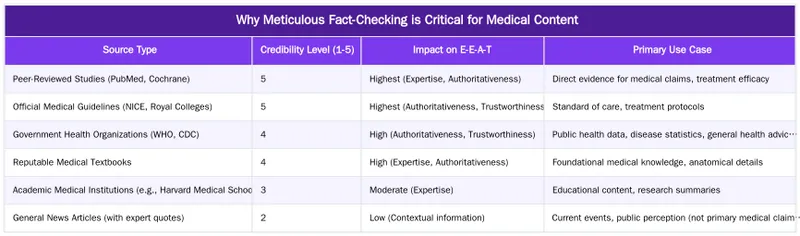
Why Meticulous Fact-Checking is Critical for Medical Content
Medical fact-checking involves verifying health-related claims, statistics, and treatment information against authoritative sources. This process is critical for “Your Money Your Life” (YMYL) topics, where inaccurate information can impact a person’s health, safety, or financial well-being. Fact-checking directly contributes to a website’s E-E-A-T (Experience, Expertise, Authoritativeness, Trustworthiness) signals, which are crucial for ranking in Google’s search results.
- Patient Safety: Ensures information provided is safe and medically sound.
- Builds Trust: Establishes credibility with patients and healthcare professionals.
- Enhances E-E-A-T: Signals to search engines that content is reliable and expert-vetted.
- YMYL Compliance: Meets Google’s stringent quality guidelines for health content.
- Reduces Misinformation: Combats the spread of inaccurate or harmful health advice.
The Gold Standard for Citing Medical Content
The most credible sources for medical information undergo peer review and are published by recognized scientific or governmental bodies. Prioritizing these sources ensures medical accuracy and strengthens your content’s authority. General news articles or platforms like Wikipedia, while useful for initial understanding, should not be primary sources for medical claims.
For a comprehensive approach to YMYL compliance, refer to our YMYL SEO Compliance: A Practical Checklist for Medical Websites.
A Step-by-Step Process for Fact-Checking Medical Information
To verify medical information, first identify specific claims like statistics, treatment recommendations, or disease prevalence statements. Next, find primary sources that support or refute these claims. Cross-reference information across multiple independent, credible sources to confirm consistency and identify biases or outdated data. Prioritize sources that demonstrate scientific consensus over isolated studies, especially for established medical knowledge.
Essential Databases and Tools for Verification
- PubMed: A free resource supporting the search and retrieval of biomedical and life sciences literature. It is maintained by the National Center for Biotechnology Information (NCBI) at the U.S. National Library of Medicine (NLM). Visit PubMed
- Cochrane Library: A collection of databases that contain different types of high-quality, independent evidence to inform healthcare decision-making. It is considered a gold standard for systematic reviews. Explore Cochrane Library
- ClinicalTrials.gov: A database of privately and publicly funded clinical studies conducted around the world. It provides information on trial design, recruitment, and results.
- World Health Organization (WHO): Provides global health statistics, guidelines, and public health information.
- Centers for Disease Control and Prevention (CDC): Offers health and safety information, disease data, and public health recommendations for the United States.
- GMC Register (General Medical Council): For UK-based medical clinics, this register allows verification of a doctor’s registration status and credentials, crucial for establishing E-E-A-T.
How to Effectively Cite Medical Content for SEO & Trust
Properly referencing sources on a medical website builds trust and improves SEO. While academic papers use complex citation styles, web content requires a balance between rigor and readability. Simplified versions of styles like Vancouver or APA are common for web content. Linking directly to scientific studies, especially peer-reviewed articles, provides strong external citations. These links signal research depth and claim authority to search engines, contributing to site credibility and topical authority.
Displaying References on Your Webpage for Clarity and E-E-A-T
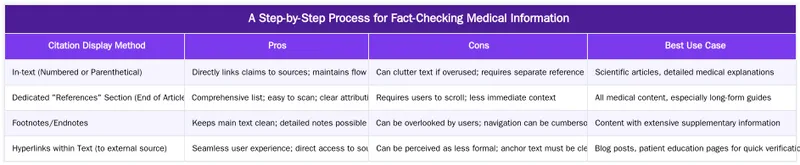
Reference presentation impacts user experience and E-E-A-T. Clear citation displays allow users and search engines to verify information. In-text citations provide immediate context, while a dedicated “References” section offers a comprehensive list. These should include clickable links to the original sources. This practice aids user verification and helps search engines understand the content’s factual basis, improving eligibility for rich snippets and AI Overviews.
Building E-E-A-T: The Role of Editorial Policy & Content Review
For medical clinics, a transparent editorial policy and content review process are critical E-E-A-T signals for YMYL content. Abdurrahman Şimşek states these elements are essential for a high-authority semantic content network. An editorial policy should outline content creation standards, source verification requirements, and the qualifications of creators and reviewers. This transparency shows medical accuracy and patient trust, which search engines reward.
An editorial policy integrated into your E-E-A-T infrastructure elevates your website’s standing. It signals to Google that your content is produced and maintained with medical expertise and trustworthiness. This is vital for London’s private healthcare clinics aiming to dominate local organic search and attract high-value patients.
Implementing a Content Review Process with Medical Experts
A structured content review process with qualified medical professionals is essential. The process includes initial authoring, medical review by a licensed physician, editing for clarity and style, publication, and regular updates. Displaying “Last Reviewed By” dates and the reviewing physician’s credentials, such as their GMC register status for UK practitioners, provides clear signals of expertise and trustworthiness. This practice aligns with Google’s Quality Rater Guidelines, which scrutinize YMYL content for verifiable E-E-A-T. For more details on compliance, see our resource on YMYL SEO Compliance: A Practical Checklist for Medical Websites.
SEO Benefits: Beyond Compliance with Citing Medical Content
Fact-checking and source attribution offer SEO advantages. These practices are fundamental to building topical authority, part of Abdurrahman Şimşek’s Semantic SEO framework. Referencing high-quality, relevant sources signals to search engines that your site is an authoritative resource. This reduces Google’s Cost of Retrieval (CoR) by providing clear, verifiable information, making your content easier for algorithms to process and rank.
Accurately referenced content improves eligibility for rich snippets and AI Overviews. Search engines are more likely to feature pages from which they can confidently extract factual information. This approach to referencing medical information becomes a tool for organic growth and visibility in competitive medical niches.
How Citations Fuel Google’s Knowledge Graph and Generative AI
Cited, factual content provides clear entities and attributes that feed Google’s Knowledge Graph. Each citation acts as a verifiable link, strengthening semantic relationships between medical concepts, procedures, and conditions. This understanding improves the accuracy and trustworthiness of information in search results. For Generative Engine Optimization (GEO), content with source attribution is more likely to be selected by AI models generating answers. AI systems prioritize verifiable information, making referenced articles candidates for inclusion in AI Overviews and other generative search features. This positions your clinic’s content as a trusted authority.
Ensuring Ongoing Medical Accuracy and Trust for Your Clinic
Maintaining medical content accuracy is an ongoing process. The medical field evolves with new research, guidelines, and treatment protocols. Regular content audits are essential to identify and update outdated information. This reinforces your clinic’s E-E-A-T, signaling to patients and search engines that your content is current and trustworthy. Neglecting content freshness can diminish authority and impact search rankings, especially for YMYL topics.
Integrating new scientific consensus into your content strategy provides the most accurate medical advice and solidifies your clinic’s reputation and search visibility. For more on establishing E-E-A-T, explore E-E-A-T for YMYL in 2026.
Auditing Your Medical Content for Continued Accuracy and Relevance
A periodic content audit is a standard practice for medical websites. This involves reviewing existing articles, procedure pages, and blog posts to identify outdated statistics, superseded medical guidelines, or new research that alters current recommendations. Content requiring updates should be prioritized, revised by medical professionals, and marked with a “Last Updated” or “Last Reviewed” date. This freshness signal is important for YMYL content, as search engines favor information reflecting the most current medical understanding. Regular audits ensure your content remains an authoritative resource for patients.
Conclusion
The integrity of medical information online is paramount. By fact-checking and referencing medical content, clinics establish trust and expertise with patients and search engines. These practices are essential for YMYL compliance, building E-E-A-T, and achieving top organic rankings. A systematic approach to source attribution and content review makes your website an authoritative resource. This commitment to accuracy is an investment in your clinic’s long-term success.
Frequently Asked Questions
What are the best sources for citing medical content to ensure accuracy?
The gold standard involves high-quality, peer-reviewed scientific literature from reputable databases like PubMed, Cochrane Library, and Google Scholar. Additionally, official guidelines from recognized medical bodies (e.g., NICE, Royal College of Surgeons) are highly authoritative for citing medical content.
How should I present sources when citing medical content on my website for SEO and user trust?
For optimal user experience and SEO, provide in-line links directly to the source material within your content. Supplement this with a numbered reference list at the bottom of the page, mirroring scientific papers, to maximize transparency and authoritativeness when citing medical content.
Does a ‘Medically Reviewed By’ tag enhance SEO for medical content?
Yes, clearly indicating that content has been written or reviewed by a qualified medical professional is a powerful E-E-A-T signal. This tag should link to the reviewer’s detailed author biography, demonstrating a commitment to responsible medical content creation.
What is a medical editorial policy and how does it relate to citing medical content?
A medical editorial policy is a public document outlining your process for creating, fact-checking, and updating content, including guidelines for proper source attribution. It demonstrates a commitment to accuracy and trustworthiness to both users and search engines, which is a key component of advanced YMYL SEO.
How frequently should medical information on a website be reviewed and updated?
Medical information evolves, so content should be reviewed for accuracy at least annually or whenever significant new research or guidelines emerge. Displaying a “last reviewed” or “last updated” date is a best practice for demonstrating content freshness and accuracy to users and search engines.
How can I improve my clinic’s medical content strategy and SEO?
To elevate your medical website’s authority and ensure robust content strategies, consider a specialized Semantic SEO Audit. Abdurrahman Şimşek offers expert guidance in Medical & Plastic Surgery SEO, focusing on entity architecture and topical authority. You can book a Semantic SEO Audit to get started.
Ruxi Data brings together multi-model AI, automated website crawling, live indexation checks, topical authority mapping, E-E-A-T enrichment, schema generation, and full pipeline automation — from crawl to WordPress publish to social posting — all in one platform built for agencies and freelancers who run on results.