Semantic Content Network: Building Authority for Plastic Surgeons
A semantic content network organizes medical information around entities and their relationships, moving beyond keyword-centric SEO for plastic surgeons. This advanced architecture builds deep topical authority, crucial for YMYL sites, by demonstrating comprehensive expertise to search engines. Implementing a robust content silo architecture and internal linking optimization improves E-E-A-T signals and reduces Google’s “Cost of Retrieval.” Such a network enhances online visibility, attracts high-value patients, and future-proofs practices by aligning content with evolving knowledge graph SEO principles and patient journey content.
This article, informed by the expertise of a Semantic SEO Strategist, details practical frameworks for designing and implementing entity-centric content strategies. It emphasizes achieving clinical accuracy and robust online authority through structured content configuration, vital for medical practices.
To explore your options, contact us to schedule your consultation. You can also reach us via: Book a Semantic SEO Audit, Direct WhatsApp Strategy Line: +90 506 206 86 86
In the highly competitive digital landscape for plastic surgeons, merely ranking for keywords is no longer enough. This article explores how designing a robust semantic content network can transform your online visibility, attract high-value patients, and future-proof your practice against evolving search algorithms by establishing deep topical authority. By structuring content around entities and their relationships, medical practices can achieve superior search engine understanding and patient trust.
What is a Semantic Content Network and Why it Matters for Surgeons
A semantic content network is an advanced content architecture that organizes information around entities and their relationships, rather than solely relying on keywords. For plastic surgeons, this means building a comprehensive, interconnected web of content that demonstrates deep expertise and authority on specific procedures, conditions, and related topics. This approach is critical for YMYL (Your Money Your Life) medical websites, where E-E-A-T (Experience, Expertise, Authoritativeness, and Trustworthiness) signals are paramount for ranking and patient confidence.
Beyond Keywords: Understanding Entity Relationships in Medical SEO
Search engines no longer simply match keywords; they strive to understand the underlying meaning and relationships between concepts, known as entities. For a plastic surgeon, entities include specific procedures like ‘Rhinoplasty,’ medical conditions, the surgeon themselves (‘Dr. Smith’), and the clinic (‘Harley Street Clinic’). A knowledge graph represents these entities and their connections, allowing search engines to grasp the full context of your content. By explicitly defining these relationships, a medical website can communicate its authority more effectively than through keyword repetition alone. This entity-centric approach is a cornerstone of modern information retrieval.
The ‘Cost of Retrieval’ Advantage for High-Authority Medical Sites
Google’s “Cost of Retrieval” (CoR) refers to the computational resources required to crawl, index, and understand a website’s content. A well-structured content architecture, such as a robust semantic network, significantly reduces this cost. When content is logically organized around clear entity relationships, search engines can process it more efficiently. This efficiency can lead to improved crawl rates, better indexing, and ultimately, enhanced ranking potential, especially for complex medical sites with extensive information on various procedures and patient journeys. Optimizing CoR is a key technical SEO advantage for high-authority medical domains.
Designing Your Semantic Content Network: A Practical Framework
Designing a content architecture for a plastic surgery practice involves a strategic shift from a keyword-focused approach to an entity-centric one. The goal is to create a logical, interconnected structure that mirrors a search engine’s understanding of medical knowledge. This process begins with identifying the core procedures and specializations of the surgeon, which will serve as the central entities around which all other content revolves. For a deeper dive into this process, consider exploring designing a semantic content network for a plastic surgery practice.
From Keywords to Entities: A Shift in SEO Mindset for Doctors
The transition to an entity-centric SEO mindset for medical professionals involves identifying core ‘procedure’ entities, such as ‘Breast Augmentation,’ ‘Facelift,’ or ‘Liposuction,’ as the foundational elements of your content strategy. These procedures become your ‘pillar pages’ – comprehensive guides that cover all aspects of the topic. Supporting content, often referred to as ‘cluster content,’ then delves into specific sub-topics, patient questions, or related conditions, all linking back to the central pillar. This structure ensures that search engines recognize your site as a definitive authority on each core procedure.
Mapping Your Topical Landscape: Tools and Techniques for Plastic Surgery
Visualizing your topical landscape is crucial for effective content configuration. This involves creating a topical map that illustrates the relationships between your core procedures and all related sub-topics. Techniques range from manual brainstorming and competitive analysis to leveraging advanced SEO tools that identify semantic gaps and opportunities. For plastic surgeons, this means mapping not just procedure names, but also patient concerns, recovery processes, associated risks, and complementary treatments. This comprehensive mapping helps identify content opportunities and informs a strategic topic cluster strategy.
Leveraging EAV Modeling for Clinical Accuracy and Authority
Entity-Attribute-Value (EAV) modeling is a powerful method for structuring medical content, ensuring both clinical accuracy and granular detail for search engines. By explicitly defining entities (e.g., a specific surgical procedure), their attributes (e.g., recovery time, anesthesia type), and the corresponding values, plastic surgeons can create highly precise and semantically rich content. This structured approach reinforces E-E-A-T by presenting information in a clear, verifiable format that search engines can easily process and trust.
Structuring Procedure Pages with EAV: A Deep Dive
When applying EAV modeling to surgical procedure pages, each procedure becomes an entity. For example, ‘Blepharoplasty’ is an entity. Its attributes might include ‘Recovery Time,’ ‘Anesthesia Type,’ ‘Ideal Candidate,’ ‘Potential Risks,’ ‘Cost Range,’ and ‘Pre-operative Instructions.’ The values assigned to these attributes would be specific details (e.g., ‘1-2 weeks,’ ‘Local with sedation,’ ‘Patients with excess eyelid skin’). This granular structuring allows for comprehensive, factual content that addresses specific patient queries and provides rich data for search engines to build their knowledge graphs. This approach is a key component of an effective EAV model for surgical procedures.
EAV vs. Traditional Content Structure: A Comparison for Medical SEO
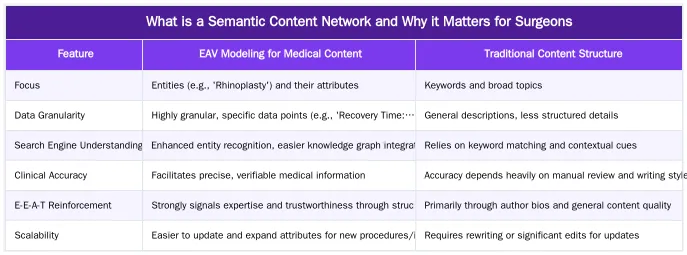
The following table compares the characteristics and benefits of EAV modeling against traditional content structuring for medical websites, highlighting the advantages of an entity-centric approach.
The Automation Advantage: Ruxi Data and Semantic Network Scaling
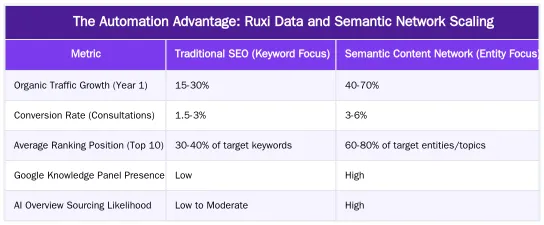
Building and maintaining a sophisticated content architecture can be resource-intensive. Abdurrahman Şimşek, a London-based Semantic SEO Strategist with over 10 years of experience, leverages Ruxi Data as a core infrastructure to automate this complex process. Ruxi Data’s capabilities allow for the efficient scaling of topical authority for medical clinics, skin clinics, and plastic surgeons without compromising on clinical accuracy or E-E-A-T principles. This automation reduces the ‘Cost of Retrieval’ for search engines, making the content more discoverable and authoritative.
Automating Topical Map Creation and Content Briefs with Ruxi Data
Ruxi Data streamlines the content production workflow by analyzing search engine results pages (SERPs) at scale. It identifies topical gaps, emerging patient queries, and competitor content strategies. Based on this data, Ruxi Data generates highly detailed, data-driven content briefs. These briefs provide medical writers with a clear roadmap, including entities to cover, key questions to answer, and optimal content structure, significantly accelerating the creation of high-quality, semantically optimized content for plastic surgery practices.
Intelligent Internal Linking: Reinforcing Semantic Relationships at Scale
Effective internal linking is crucial for distributing link equity and strengthening topical hubs within a content architecture. Automated systems, guided by the semantic relationships identified through Ruxi Data, can optimize internal linking at scale. These systems ensure that relevant supporting articles consistently link back to their pillar pages, and related topics are interconnected logically. This intelligent linking strategy reinforces the overall topical authority of the website, making it easier for search engines to understand the depth of expertise offered. For more on this, refer to automated internal linking workflow.
Future-Proofing Your Practice: Semantic Networks and Generative AI
As search evolves with generative AI, the importance of a robust content architecture becomes even more pronounced. Semantic content networks, with their emphasis on structured, entity-rich content, are inherently favored by generative AI models. Optimizing for Generative Engine Optimization (GEO) means ensuring your content is not only discoverable by traditional search algorithms but also readily digestible and trustworthy for AI Overviews and other AI-powered search experiences. This proactive approach ensures long-term visibility for plastic surgeons.
Optimizing for AI Overviews: Content That Generative Engines Trust
Generative AI models prioritize clear, factual, and well-attributed information. Content structured with EAV modeling and organized within a semantic framework provides the precise data points that AI systems need to synthesize accurate answers. By focusing on clinical accuracy, transparent sourcing, and comprehensive coverage of medical entities, plastic surgeons can increase the likelihood of their content being sourced and presented in AI Overviews, enhancing their clinic’s visibility in these new search interfaces. This requires a commitment to high-quality, verifiable information, akin to academic publishing standards.
Monitoring Your Brand in the Age of Generative Search
The rise of generative search necessitates new strategies for brand monitoring. Plastic surgeons must actively track how their procedures, their names, and their clinics are represented in AI-generated search results. This involves monitoring AI Overviews and other generative outputs for accuracy, tone, and completeness. Proactive content configuration, ensuring that your website is the most authoritative and factually correct source for information related to your practice, is the best defense against misrepresentation and ensures your brand maintains its integrity in the evolving search landscape.
Achieving Unrivaled Online Authority for Your Plastic Surgery Practice
Implementing a comprehensive content architecture offers plastic surgeons a distinct advantage in the digital realm. This strategic approach moves beyond short-term keyword gains to build a foundational online presence characterized by deep topical authority and patient trust. Abdurrahman Şimşek’s methodology, integrating semantic engineering with automation via Ruxi Data, provides a unique pathway to achieving this dominant online position, particularly within the competitive London private healthcare market.
Long-Term Organic Growth and High-Value Patient Acquisition
A well-designed content architecture leads to sustainable ranking improvements across a wide range of relevant queries. By establishing your website as the definitive source for information on specific procedures, you attract highly qualified traffic – patients actively researching treatments. This increased visibility for specialized procedures translates directly into more patient consultations and, ultimately, higher-value patient acquisition, driving the growth of your practice.
Building an Algorithm-Proof Foundation for Your Digital Future
The core strength of a semantic approach lies in its resilience. By focusing on entities, relationships, and genuine topical authority, your website becomes less susceptible to fluctuating algorithm updates. This creates a robust, algorithm-proof digital asset that consistently signals expertise and trustworthiness to search engines. Such a foundation ensures enduring visibility and authority, safeguarding your practice’s online presence for years to come.
Partner with a Semantic SEO Expert for Your Clinic’s Success
For plastic surgeons and clinic directors seeking to establish a dominant online presence and attract high-value patients, a sophisticated content architecture is essential. Abdurrahman Şimşek specializes in building these high-authority structures for medical clinics in London, leveraging a unique methodology and Ruxi Data infrastructure. Elevate your digital strategy and secure your clinic’s future in the evolving search landscape. Book a Semantic SEO Audit or connect directly via WhatsApp Strategy Line: +90 506 206 86 86.
Conclusion
The strategic design of a semantic content network is no longer an option but a necessity for plastic surgeons aiming for sustained online success. By shifting focus from mere keywords to a comprehensive understanding of entities and their relationships, medical practices can build unparalleled topical authority, enhance clinical accuracy, and significantly reduce Google’s ‘Cost of Retrieval’. This advanced approach, coupled with automation tools like Ruxi Data, future-proofs your practice against algorithmic changes and positions your clinic for optimal visibility in both traditional and generative AI search results. To explore how this methodology can transform your practice’s digital footprint, contact us today. Book a Semantic SEO Audit, Direct WhatsApp Strategy Line: +90 506 206 86 86.
Frequently Asked Questions
What is the first step in designing a semantic content network for a surgeon?
The initial step involves defining the core ‘procedure’ entities that the surgeon specializes in, such as Facelift or Breast Augmentation. These entities become the central hubs or ‘pillar pages’ around which the entire semantic content network of supporting content is meticulously built. This foundational mapping ensures a clear structure for topical authority.
How do you ensure clinical accuracy within the content network?
Clinical accuracy is ensured through our ‘Content Configuration’ process, where the surgeon provides the essential medical expertise and facts. Our team, leveraging Ruxi Data’s semantic blueprint, then structures this information into an interconnected network of articles, guides, and FAQs that is both clinically accurate and optimized for search engines. This collaborative approach maintains medical integrity while enhancing visibility.
What role does internal linking play in a semantic content network?
Internal linking serves as the crucial connective tissue of a semantic content network. It establishes clear semantic relationships between related entities, such as linking from a ‘Facelift’ pillar page to a ‘Recovery Process’ supporting article. This strategic linking funnels authority to the most important pillar pages, signaling deep expertise and comprehensive coverage to search engines like Google.
How does a semantic content network help in ranking for competitive terms?
Instead of attempting to rank a single page for a highly competitive term, the semantic content network approach builds overwhelming topical authority across the entire subject matter. This collective authority makes it significantly easier for all pages within the network, including the main pillar pages, to rank for high-value keywords. It demonstrates comprehensive understanding and relevance to search engines.
Can Ruxi Data automate the entire content network design process?
Ruxi Data generates the strategic blueprint for the network, including the topical map, entity relationships, and optimal content structure. While it automates the most complex part of the process by providing a clear, data-driven plan, human expertise is still required for content creation and final implementation. This ensures both efficiency and quality in building your content architecture.
How can a plastic surgeon get started with designing a semantic content network for their practice?
Plastic surgeons can begin by booking a Semantic SEO Audit with Abdurrahman Şimşek to assess their current online presence and identify key opportunities. Alternatively, for direct strategic advice, you can reach out via the WhatsApp Strategy Line at +90 506 206 86 86. This initial consultation will outline a tailored approach for building your practice’s topical authority.
Ruxi Data brings together multi-model AI, automated website crawling, live indexation checks, topical authority mapping, E-E-A-T enrichment, schema generation, and full pipeline automation — from crawl to WordPress publish to social posting — all in one platform built for agencies and freelancers who run on results.