
Plastic Surgery SEO: Attracting High-value Patients
This guide outlines a strategic blueprint for plastic surgery seo, focusing on increasing online visibility and attracting high-value patients. It details leveraging E-E-A-T principles and semantic search strategies to establish topical authority and dominate local organic search, particularly in competitive markets like London’s Harley Street. The content covers essential components from technical SEO and Google Business Profile optimization to advanced content strategies and conversion rate optimization, ensuring qualified patient inquiries and sustainable growth for aesthetic clinics.
Abdurrahman Şimşek, a Semantic SEO Strategist, provides insights into optimizing digital presence for medical practices. This content emphasizes E-E-A-T principles and advanced semantic strategies to secure sustainable organic growth and patient trust.
To explore your options, contact us to schedule your consultation. You can also reach us via: Book a Semantic SEO Audit, Direct WhatsApp Strategy Line: +90 506 206 86 86
This blueprint for plastic surgery seo is designed to increase a clinic’s online visibility, attract high-value patients, and establish topical authority in the London market. It covers leveraging semantic strategies and E-E-A-T principles for sustainable growth, providing a roadmap for surgeons to dominate local organic search across Harley Street and premium London postcodes and ensure qualified patient inquiries.
What is the Cornerstone of Plastic Surgery SEO Success?
The cornerstone of successful plastic surgery SEO is E-E-A-T: Experience, Expertise, Authoritativeness, and Trustworthiness. For medical practices in the “Your Money or Your Life” (YMYL) category, Google prioritizes content demonstrating verifiable credentials and a patient-centric approach. Without a strong E-E-A-T foundation, other SEO efforts will yield limited results.
Why E-E-A-T is Non-Negotiable for YMYL Medical Practices
Google’s YMYL guidelines require high standards for content that can impact a user’s health, financial stability, or safety. Plastic surgery is in this category. Search engines scrutinize medical websites for a surgeon’s experience, expertise in specific procedures, clinic authority, and information trustworthiness. This includes verifiable qualifications, professional memberships, peer-reviewed publications, and transparent patient safety protocols. Strong E-E-A-T is fundamental for medical practices seeking organic visibility, as it directly influences ranking potential and patient confidence. For a broader understanding of medical SEO, refer to The Definitive Guide to SEO for Private Healthcare Clinics in London.
Building Your Digital Foundation: Technical & Local SEO for Surgeons
A digital presence for plastic surgeons requires technical and local search optimization. This ensures your website is accessible to search engines and visible to potential patients in your target geographical areas, especially London’s private healthcare market. Ignoring these aspects can hinder patient acquisition.
Mastering Google Business Profile for London Clinics
Optimizing your Google Business Profile (GBP) is essential for local patient acquisition. For London-based plastic surgeons, select primary and secondary categories that reflect your services, such as “Plastic Surgeon” and “Cosmetic Surgery Clinic.” Ensure service areas cover specific London postcodes and Harley Street. Manage and respond to patient reviews, as they influence local search rankings and patient trust. Positive reviews signal E-E-A-T and patient satisfaction. For a complete guide, see Google Business Profile Optimization for Private Surgeons and Clinics.
Optimizing Core Web Vitals for Procedure Pages
Core Web Vitals (CWV) are user experience metrics that impact search rankings. For plastic surgery websites, this is important for image-heavy ‘before and after’ galleries and procedure pages. Improve Largest Contentful Paint (LCP) by optimizing image sizes and server response times. Minimize Cumulative Layout Shift (CLS) by ensuring visual elements load stably. Good CWV scores improve user experience, reducing bounce rates and increasing content engagement. This also reduces Google’s Cost of Retrieval (CoR) for your site.
Beyond Keywords: The Semantic SEO Advantage for Plastic Surgeons
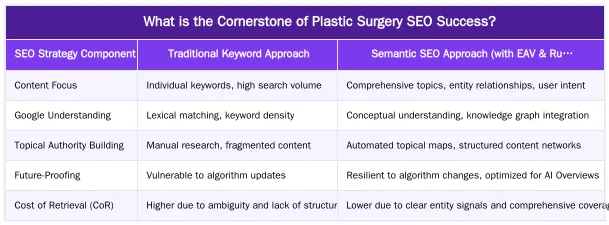
SEO for plastic surgeons extends beyond keyword targeting. Semantic SEO focuses on the meaning and relationships between entities to build topical authority. Using Entity-Attribute-Value (EAV) modeling and automation positions your practice as a resource, reducing Google’s Cost of Retrieval (CoR) and future-proofing your digital presence.
Crafting Entity-Rich Content with EAV Modeling
Entity-Attribute-Value (EAV) modeling structures information about medical procedures and surgeon expertise. Defining entities (e.g., “Rhinoplasty”) and their attributes (e.g., “recovery time,” “anesthesia type,” “surgeon qualifications”) helps search engines understand your content. This data modeling enhances relevance for patient queries and strengthens topical authority. For example, a “Rhinoplasty” entity might have attributes like “procedure duration,” “ideal candidate,” and “potential risks,” defined on the page. This structured approach is vital for medical SEO. Learn more about the EAV model for surgical procedures.
Automating Topical Authority with Ruxi Data
Building topical authority is resource-intensive. Ruxi Data, an LLM-driven semantic engine, automates the creation of topical maps and content briefs. It identifies relevant entities and sub-topics surrounding a medical procedure, enabling plastic surgeons to develop content efficiently. Covering a topic completely makes your website the definitive resource, reducing Google’s Cost of Retrieval (CoR) and improving ranking potential. This automation allows for scaling content production without compromising E-E-A-T. To understand CoR, consider a Cost of Retrieval Audit for your website.
Attracting High-Value Patients: Content & Conversion Strategies
A content strategy for plastic surgery practices should attract organic traffic and convert visitors into consultations. This requires patient-centric content that addresses concerns, builds trust, and guides their decision-making process. Content marketing is critical for patient acquisition.
Structuring High-Converting Medical Procedure Pages
Medical procedure pages are key to patient acquisition. They should address patient questions, showcase surgeon expertise, and include clear calls-to-action. Include sections for FAQs, transparent pricing information (where appropriate), and realistic recovery timelines. Visuals, such as diagrams and ethically sourced ‘before and after’ images, enhance understanding and build trust. All content must be medically accurate and easy to digest. For detailed guidance, review how to structure all medical procedure pages effectively.
Leveraging Patient Testimonials and Visuals Ethically
Patient testimonials and ‘before and after’ galleries are trust signals. Ensure GDPR compliance and obtain explicit patient consent. Optimize images for web performance without sacrificing quality. Contextual descriptions for each image, explaining the procedure and outcome, add SEO value. Ethical guidelines from bodies like the General Medical Council (GMC) must be followed when presenting patient results. For ethical medical marketing, consult the GMC’s guidance on marketing and advertising.
Measuring Impact: ROI and Sustainable Growth for Your Practice
Plastic surgery SEO requires tracking and measuring performance. Clinics must focus on business outcomes to assess ROI and ensure sustainable growth. This involves analyzing patient acquisition, lead quality, and revenue from organic channels.
Key Performance Indicators Beyond Rankings
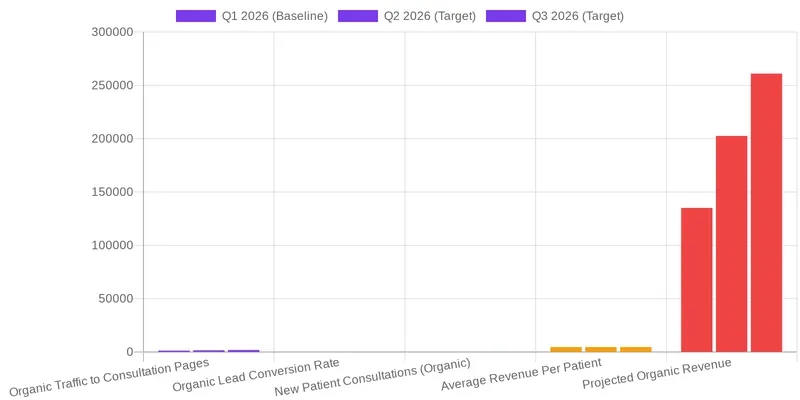
KPIs for plastic surgery practices beyond rankings include organic traffic to consultation forms, lead quality, conversion rates from organic visitors to booked appointments, and patient acquisition cost from organic channels. Monitoring these metrics shows SEO’s impact on revenue. Understanding the patient journey from search to consultation is paramount. For more on medical marketing analytics, explore resources from industry bodies like the American Marketing Association.
Forecasting Patient Leads and Revenue from SEO
Forecasting SEO’s impact on patient bookings and clinic revenue is essential for strategic planning. By analyzing historical data, conversion rates, and average procedure values, clinics can project new patients and revenue from organic search. This framework informs decision-making and demonstrates the value of a plastic surgery SEO strategy.
Ready to Transform Your Online Presence? Partner with a Specialist
Growing a plastic surgery practice online requires a specialized approach to medical E-E-A-T, local market dynamics, and semantic strategies. A medical SEO expert helps your clinic rank, attract, and convert high-value patients. Abdurrahman Şimşek specializes in building high-authority Semantic Content Networks for medical clinics, including plastic surgeons, focusing on the London private healthcare market.
Conclusion
A plastic surgery SEO strategy integrates E-E-A-T principles, technical foundations, local strategies, and semantic content architecture. Focusing on patient acquisition with authoritative, entity-rich content and optimizing for Google’s algorithms helps plastic surgeons achieve organic growth and attract high-value patients. Implementing these strategies requires understanding both medical practice and search engineering. To discuss a tailored strategy for your clinic, contact us. You can also Book a Semantic SEO Audit or reach out directly via WhatsApp Strategy Line: +90 506 206 86 86.
Frequently Asked Questions
What is the most critical element of a plastic surgery seo strategy?
The most critical element for plastic surgery seo is building E-E-A-T (Experience, Expertise, Authoritativeness, Trustworthiness). This involves showcasing the surgeon’s verifiable credentials, publishing peer-reviewed quality content, and ensuring all medical information is accurate and patient-centric. Adhering to Google’s stringent YMYL (Your Money or Your Life) standards is paramount for establishing credibility and trust with both patients and search engines.
How does semantic SEO benefit a plastic surgery practice?
Semantic SEO helps Google understand the deep relationships between a surgeon, the specific procedures they offer (e.g., rhinoplasty, facelift), and their geographic location (e.g., London). This advanced understanding leads to higher rankings for specific, high-intent patient queries, positioning the practice as a definitive topical authority in its specialized niche. It moves beyond simple keyword matching to capture the true intent behind patient searches.
Should my plastic surgery seo strategy prioritize specific procedures or the clinic’s brand?
A successful plastic surgery seo strategy effectively balances both. It targets high-value procedural keywords (e.g., ‘deep plane facelift London’) to attract patients with immediate needs and specific search intent. Simultaneously, it focuses on building the surgeon’s and clinic’s brand authority, which fosters long-term patient trust, encourages direct traffic, and strengthens overall online presence.
How important are patient reviews and testimonials for plastic surgery seo?
Patient reviews and testimonials are extremely important for improving search rankings and building trust within plastic surgery seo. Positive feedback on platforms like Google Business Profile and Doctify serves as powerful social proof, directly influencing local ranking factors. They provide authentic validation of a surgeon’s expertise and patient satisfaction, which is crucial for both potential patients and search engine algorithms.
What kind of content is most effective for attracting surgical patients through SEO?
Highly-detailed, educational content about specific procedures is most effective for attracting surgical patients. This includes comprehensive guides covering the surgery process, recovery expectations, typical costs, and ideal candidacy criteria. Integrating video testimonials, extensive before-and-after galleries, and patient stories further enhances engagement and trust, all while being optimized for relevant search terms.
How can I begin implementing a strategic blueprint for my clinic’s online presence?
To start transforming your clinic’s online presence, you can book a Semantic SEO Audit with Abdurrahman Şimşek to assess your current strategy and identify growth opportunities. Alternatively, for direct consultation, you can reach out via the WhatsApp Strategy Line at +90 506 206 86 86. This initial step helps tailor a blueprint specifically for your practice’s unique needs and market.
Ruxi Data brings together multi-model AI, automated website crawling, live indexation checks, topical authority mapping, E-E-A-T enrichment, schema generation, and full pipeline automation — from crawl to WordPress publish to social posting — all in one platform built for agencies and freelancers who run on results.