
Keyword Research Cosmetic Procedures: Attracting High-value Patients
Effective keyword research cosmetic procedures enables private healthcare clinics to attract high-value patients by moving beyond generic terms to uncover precise, high-intent queries. This strategy focuses on long-tail medical keywords and patient intent analysis, connecting specialist practices with individuals actively seeking specific aesthetic treatments. By leveraging semantic search queries and procedure-specific keywords, clinics can tailor content to patient needs, leading to higher conversion rates and more qualified patient leads. Understanding the patient journey is crucial for developing a robust medical keyword strategy.
Abdurrahman Şimşek, a Semantic SEO Strategist, provides expert guidance on developing precise medical keyword strategies. This approach optimizes content for patient intent, enhancing online visibility and patient acquisition for specialist practices.
To explore your options, contact us to schedule your consultation. You can also reach us via: Book a Semantic SEO Audit, Direct WhatsApp Strategy Line: +90 506 206 86 86
Effective keyword research cosmetic procedures helps London’s private healthcare clinics attract high-value patients by moving beyond generic terms to uncover precise, high-intent queries. This connects specialist practices with individuals actively seeking specific aesthetic treatments. Understanding patient intent and leveraging semantic techniques are central to patient acquisition.
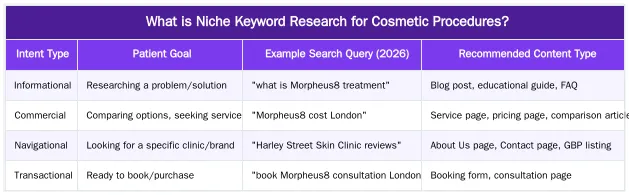
What is Niche Keyword Research for Cosmetic Procedures?
Niche keyword research for cosmetic procedures identifies specific search terms reflecting a patient’s needs and intent, moving beyond broad phrases. This approach targets individuals seeking particular treatments, leading to higher conversion rates and more qualified patient leads. It differentiates a clinic by focusing on services like “Morpheus8 London cost” instead of “skin treatment.”
Cosmetic practices should focus on procedure-specific keywords and long-tail phrases capturing patient questions. These high-intent keywords connect with individuals further in their decision-making process. Understanding these queries allows clinics to tailor content to patient needs, establishing relevance and authority.
Beyond Broad Terms: Identifying High-Intent Patient Queries
Generic terms like “plastic surgery” attract unfocused traffic that is difficult to convert. Focus on specific procedures and patient problem-solving queries. A patient searching for “sagging eyelids treatment” is seeking solutions like blepharoplasty or non-surgical eye lifts. Identifying these needs allows clinics to create targeted content that addresses the patient’s problem with relevant solutions.
This strategic shift is a core component of a plastic surgery SEO blueprint for attracting high-value patients by understanding patient intent.
Analyzing Patient Intent: The Core of Medical Keyword Strategy
Patient intent is foundational to medical keyword strategy. Patients progress through awareness, consideration, and decision stages, each with different search queries reflecting their knowledge and readiness to book. Patient intent analysis maps these queries to the patient’s journey to align content with their needs.
For example, a patient in the awareness stage might search for “how to reduce wrinkles.” In the consideration phase, they might search for “Botox vs. fillers for forehead lines.” A decision-stage query could be “best Botox clinic Harley Street,” signaling readiness to book.
Mapping Search Queries to the Patient Journey
Keywords evolve through the patient journey. Initial research involves problem-based queries like “sagging eyelids” or “uneven skin tone.” As patients learn about solutions, queries become more specific, like “blepharoplasty London cost” or “Morpheus8 benefits.” When ready to choose a provider, they use high-commercial intent terms like “best blepharoplasty surgeon Harley Street” or “Morpheus8 clinic near me.”
A clinic’s website should offer educational articles for early-stage queries and detailed service pages with clear calls to action for later-stage searches. This provides patients with relevant information at every point of their journey. More insights are in resources on deconstructing SERP intent.
Uncovering Long-Tail Keywords for Niche Treatments
Long-tail medical keywords are specific phrases of three or more words. They have lower search volumes but indicate higher intent, leading to better conversion rates. Examples include “Morpheus8 treatment near me,” “recovery time after rhinoplasty UK,” or “non-surgical facelift options for jowls.”
These queries capture patients who know what they want, making them qualified leads. These terms attract patients closer to booking. Incorporate these phrases into procedure pages, FAQs, and blog posts for visibility.
Practical Steps to Discover High-Value Cosmetic Keywords
Keyword research for cosmetic procedures involves analyzing competitors, brainstorming terms, and using tools to find high-value queries. The goal is to identify terms with sufficient search volume that align with services and patient intent.
Competitor Analysis and SERP Deconstruction
Analyzing competitor keyword strategies reveals successful approaches and potential gaps. Identify top-ranking clinics for target procedures and examine their content with tools like Semrush or Ahrefs to find their ranking keywords, top pages, and content structure. SERP analysis deconstructs search results to understand dominant intent (informational, commercial, navigational) and the content types Google favors, helping craft content that meets user and search engine expectations.
For example, a search for “lip fillers London” showing service pages with pricing indicates commercial intent. A search for “what are dermal fillers” yielding educational articles indicates informational intent.
Keyword Discovery Tools and Techniques for Medical SEO
Tools for medical SEO include Google Keyword Planner for volume estimates and Semrush or Ahrefs for in-depth data like competitor insights and keyword difficulty. Google’s “People Also Ask” (PAA) and “Related Searches” are sources for long-tail, question-based keywords that reflect patient questions.
Evaluate keywords by search volume and commercial intent. High-volume terms can be competitive, while lower-volume, high-intent phrases often yield better conversion rates. Non-surgical treatment keywords, for example, often have strong commercial intent.
Leveraging Semantic SEO and EAV for Procedure-Specific Keywords
Keyword research for cosmetic procedures now uses semantic SEO and Entity-Attribute-Value (EAV) modeling, an approach from experts like Abdurrahman Şimşek. It helps search engines understand the context and relationships between medical entities. Building topical authority with a semantic content network reduces the ‘Cost of Retrieval’ for search engines, improving visibility for complex medical queries.
This methodology makes content conceptually comprehensive, covering all facets of a procedure. It aligns with Google’s prioritization of expertise, authoritativeness, and trustworthiness (E-E-A-T) for Your Money Your Life (YMYL) topics like healthcare.
From Keywords to Entities: Building Topical Authority
Entity-based SEO recognizes that search engines understand concepts, not just words. Medical practices should define procedures (entities) like “rhinoplasty” and their attributes (e.g., “recovery time,” “anesthesia type,” “surgeon qualifications,” “potential risks”). Structuring content around these entities and their relationships helps Google grasp your expertise.
This approach builds topical authority, signaling to search engines that your clinic is a definitive source for specific procedures. It moves beyond individual keyword rankings to establish your website as an authoritative hub for a topic. Understanding the Entity-Attribute-Value (EAV) SEO model is key.
Automating Keyword Discovery with Ruxi Data and AI
Medical content networks require advanced tools for keyword discovery and topical map creation. Ruxi Data, a semantic engine, automates identifying semantic gaps and high-potential keywords by analyzing search data and competitor content. This AI approach uncovers procedure-specific keywords and related semantic queries that might otherwise be missed.
Using Ruxi Data, clinics can generate topical maps covering all relevant entities and attributes. This enhances content relevance and reduces the ‘Cost of Retrieval’ for search engines because information is structured logically. This automation allows clinics to scale content efforts while maintaining precision and E-E-A-T standards. Learn more about automating medical topical maps.
Implementing and Refining Your Cosmetic Keyword Strategy
Integrate keywords into content, monitor performance, and adapt your strategy based on data and algorithm changes to maintain visibility and attract patients.
Map keyword types to content formats to serve specific patient intents. Regularly review performance to identify what works and what needs adjustment.
Mapping Keywords to Content: Procedure Pages, Blogs, and FAQs
Align content with patient intent through strategic keyword placement. Commercial intent keywords like “breast augmentation London price” belong on service pages with calls to action, pricing, and booking options. Informational keywords like “how long does Botox last” are best for blog posts or educational guides.
Question-based keywords, often long-tail phrases, belong in FAQ sections on service pages or in dedicated FAQ articles. This approach meets each search query with relevant content.
Monitoring Performance and Adapting to Algorithm Changes
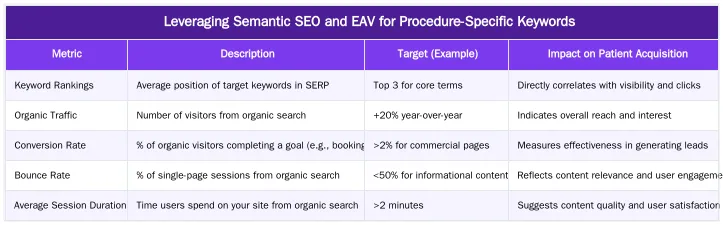
Assess your keyword strategy by tracking metrics like keyword rankings, organic traffic, conversion rates, and patient inquiries. Use tools like Google Search Console and Google Analytics for this analysis. Regularly review these metrics to identify underperforming keywords or content gaps.
The search landscape is dynamic with frequent algorithm updates. Stay informed about changes impacting medical SEO. Adapt your keyword strategy, content, and technical SEO in response to shifts in SERP behavior or Google’s ranking factors.
Partner with a Semantic SEO Expert for Niche Medical Growth
Keyword research for niche cosmetic procedures and building topical authority requires specialized expertise. Abdurrahman Şimşek, a London-based Semantic SEO Strategist, specializes in crafting high-authority Semantic Content Networks for medical clinics and plastic surgeons. His methodology uses Ruxi Data to optimize a clinic’s digital presence for patient acquisition.
Partnering with a semantic SEO expert helps private practices in London dominate local organic search and attract high-value patients. Book a Semantic SEO Audit or connect via WhatsApp Strategy Line: +90 506 206 86 86.
Frequently Asked Questions
What is the first step in keyword research cosmetic procedures?
The initial step involves moving beyond generic terms to pinpoint specific, long-tail phrases that high-value patients use. This requires analyzing patient intent to understand if they are researching a problem, comparing solutions, or ready to book a consultation for a specific treatment.
Why is semantic keyword research important for niche cosmetic procedures?
Semantic research prioritizes topics and entities over mere strings of words. For niche cosmetic procedures, this means identifying all related concepts, questions, and attributes a patient might search for, enabling the creation of comprehensive content that establishes true topical authority. This approach significantly enhances the effectiveness of your overall content strategy.
How do you find keywords with high commercial intent when performing keyword research cosmetic procedures?
To identify high commercial intent, look for queries that include modifiers such as “cost,” “price,” “in London,” “best surgeon for,” or specific procedure names combined with a location. This type of keyword research cosmetic procedures is crucial for attracting patients who are close to making a decision and actively seeking a provider.
Should a comprehensive strategy for keyword research cosmetic procedures target both surgical and non-surgical treatments?
Yes, if your clinic offers both types of treatments, a comprehensive keyword strategy should map out all services. Creating dedicated topic clusters for each ensures you capture the widest possible range of relevant patient searches, addressing diverse needs and preferences.
What tools are recommended for effective keyword analysis in cosmetic procedures?
While standard tools like Ahrefs and Semrush are useful, a specialist approach for cosmetic procedures involves deeper SERP analysis, leveraging People Also Ask data, and utilizing semantic tools like Ruxi Data. These tools help understand underlying entities and build a data-driven topical map for superior targeting.
How can I get expert help with my clinic’s semantic SEO strategy?
Abdurrahman Şimşek, a Semantic SEO Strategist, offers specialized expertise in medical and plastic surgery SEO. You can book a Semantic SEO Audit through his website or contact his direct WhatsApp Strategy Line at +90 506 206 86 86 for tailored guidance. This ensures your clinic benefits from a holistic and data-driven approach.
Ruxi Data brings together multi-model AI, automated website crawling, live indexation checks, topical authority mapping, E-E-A-T enrichment, schema generation, and full pipeline automation — from crawl to WordPress publish to social posting — all in one platform built for agencies and freelancers who run on results.