
Automated Competitor Monitoring: Real-time SERP Insights for Strategic Advantage
Automated competitor monitoring provides real-time insights into rival strategies, moving beyond basic rank tracking to uncover semantic shifts and content gaps. This article details how advanced automated competitor monitoring transforms competitive intelligence, enabling businesses to adapt swiftly to dynamic SERP movements. Readers will learn to leverage tools for proactive competitive intelligence, identify emerging trends, and optimize for Cost of Retrieval. The focus is on building strong Topical Authority and E-E-A-T by understanding competitor actions and market dynamics. This ensures strategic decisions are informed by current conditions.
Abdurrahman Şimşek, a Semantic SEO Strategist, emphasizes the critical role of continuous competitive intelligence for maintaining a responsive SEO strategy. This content provides actionable insights for leveraging automation to enhance market understanding and strategic positioning.
To explore your options, contact us to schedule your consultation. You can also reach us via: Book a Semantic SEO Audit, Direct WhatsApp Strategy Line: +90 506 206 86 86, Hire as Semantic SEO Architect
In the fast-evolving digital landscape, staying ahead means more than just tracking your own performance. Automated competitor monitoring provides real-time insights into your rivals’ strategies, allowing you to adapt and dominate. This guide explores how advanced automation can transform your competitive intelligence, moving beyond simple rank tracking to uncover semantic shifts and strategic opportunities. Effective monitoring is crucial for identifying content gaps and optimizing for Cost of Retrieval, directly contributing to building strong Topical Authority and E-E-A-T, especially in YMYL sectors.
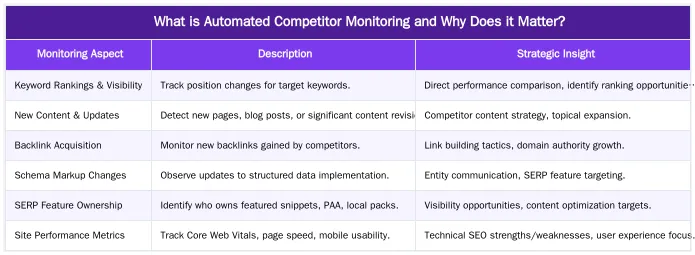
What is Automated Competitor Monitoring and Why Does it Matter?
Automated competitor monitoring involves using specialized software to continuously track and analyze the online activities and performance of your direct and indirect rivals. Its core purpose is to provide real-time competitive intelligence, moving beyond sporadic manual checks to offer a continuous stream of data. This proactive approach allows businesses to identify emerging trends, strategic shifts, and potential threats or opportunities in the market as they happen, rather than reacting after the fact. It is crucial for maintaining a responsive SEO strategy and adapting to market dynamics.
The Imperative for Real-Time Competitive Intelligence
Search Engine Results Pages (SERPs) are dynamic, with rankings, features, and content evolving constantly. Relying on outdated data or infrequent manual checks can lead to missed opportunities and strategic disadvantages. Real-time competitive intelligence, powered by advanced live competitor analysis AI, ensures that your strategic decisions are informed by the most current market conditions. This instant data is vital for adapting your SEO and content strategies swiftly, allowing for agile responses to competitor moves and algorithm updates.
Beyond Rankings: How Automation Uncovers Semantic Shifts and Content Gaps
Advanced automation systems extend far beyond simple keyword rank tracking. They delve into the nuances of competitor strategies, analyzing elements that signal deeper semantic shifts and content network evolution. Tools like Ruxi Data monitor granular changes in content, structured data implementation, internal linking patterns, and ownership of various SERP features. This comprehensive approach allows for the identification of strategic shifts before they manifest as significant ranking changes, providing a critical advantage in content gap analysis and topical authority building.
Monitoring Content, Schema, and Internal Linking Patterns
Effective competitor analysis tools track modifications to competitor content, including new articles, page updates, and shifts in topical focus. Crucially, they also monitor changes in schema markup and structured data, which can reveal how competitors are communicating entity relationships to search engines. Furthermore, analyzing internal linking structures provides insights into how rivals are building their content networks and distributing authority across their sites. Ruxi Data, for instance, excels at identifying these subtle yet significant changes, offering a detailed view of a competitor’s semantic architecture and content strategy.
Identifying Untapped Topical Opportunities and SERP Features
Automated competitive intelligence helps pinpoint areas where competitors have not yet established strong topical authority, revealing untapped topical opportunities for your own content. By analyzing competitor content and SERP feature ownership, these systems can highlight content gaps and opportunities to capture specific SERP features, such as featured snippets, People Also Ask (PAA) boxes, or image carousels. This allows businesses to strategically target high-visibility SERP elements that competitors may be overlooking. To effectively analyze competitors to build topical authority, understanding these nuanced insights is essential.
Implementing a Robust Automated Competitor Monitoring Strategy
Establishing an effective automated competitor monitoring system requires careful planning and configuration. The process involves selecting the right tools, defining key metrics, and setting up alerts for significant changes. A robust strategy ensures continuous data collection and actionable insights, moving beyond basic rank tracking to a holistic view of the competitive landscape. This proactive approach is particularly vital for sectors like medical clinics, where technical SEO for medical websites must be impeccable.
Key Metrics for Comprehensive Competitive Intelligence
Comprehensive competitive intelligence extends beyond simple keyword rankings. It encompasses a broader range of metrics that provide a holistic view of competitor strategies and performance. Tracking these diverse data points ensures a complete understanding of the market landscape.
Setting Up Real-Time Alerts and Custom Reporting
Configuring real-time alerts is a cornerstone of effective competitive intelligence. These alerts notify you immediately of significant competitor movements, such as new content publications, sudden ranking drops or gains, or changes in structured data. Custom reporting allows for tailored insights, presenting data in a format that is most relevant to your strategic objectives. This ensures that your team receives actionable intelligence without being overwhelmed by raw data, enabling swift and informed decision-making.
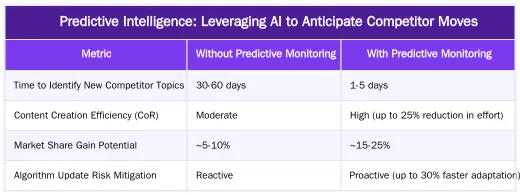
Predictive Intelligence: Leveraging AI to Anticipate Competitor Moves
The evolution of competitive intelligence now includes predictive capabilities, leveraging advanced AI and Machine Learning (ML) models. As a Semantic SEO Strategist with over a decade of experience, I’ve seen how these technologies transform reactive analysis into proactive strategy. Ruxi Data, for example, utilizes ML to analyze historical competitor data, identifying patterns and trends that forecast future actions. This predictive power is crucial for optimizing your Cost of Retrieval (CoR) and building dominant Topical Authority.
Forecasting Competitor Content and Strategic Shifts with ML
Machine Learning models can process vast amounts of competitor data, including past content publication schedules, keyword targeting shifts, and product launch patterns. By identifying these recurring behaviors, AI can forecast potential competitor content calendars, anticipate new service offerings, or predict strategic shifts in their market positioning. This foresight allows businesses to prepare their own content and SEO strategies in advance, ensuring they are always a step ahead. To leverage AI for automated SEO with Ruxi Data, understanding these predictive capabilities is key.
Optimizing Cost of Retrieval (CoR) through Proactive Insights
Anticipating competitor moves directly contributes to optimizing your Cost of Retrieval (CoR). By knowing what rivals are likely to target next, you can allocate your SEO resources more efficiently, focusing on high-impact areas before they become saturated. This proactive approach reduces the effort and resources needed to rank for competitive terms, as you can establish authority early. A well-designed semantic architecture for CoR optimization inherently contributes to this efficiency. Ruxi Data’s automation capabilities are key to reducing Cost of Retrieval with Ruxi Data by streamlining content processing and strategic planning. For further reading on the impact of AI in competitive analysis, see McKinsey & Company’s insights on AI trends.
Ready to Dominate Your Niche? Automate Your Competitive Edge.
The digital landscape demands more than just presence; it requires strategic dominance. Implementing advanced competitor monitoring automation provides the intelligence needed to anticipate market shifts, identify content gaps, and secure your position as a leading authority. For medical clinics and plastic surgeons, this means not only attracting more patients but also building a resilient online presence that withstands algorithmic changes and competitive pressures. Elevate your strategy and transform your competitive intelligence.
Conclusion
The strategic advantage offered by automated competitor monitoring is clear. It moves beyond basic rank tracking to provide deep insights into semantic shifts, content network evolution, and predictive competitor behavior. This proactive intelligence is indispensable for optimizing your Cost of Retrieval, building robust Topical Authority, and strengthening E-E-A-T, particularly in the highly regulated and competitive medical sector. By embracing these advanced tools and methodologies, businesses can ensure their SEO strategies are not just reactive, but truly anticipatory, securing long-term market leadership. Ready to transform your digital strategy? Contact us today to discuss how specialized semantic SEO can benefit your practice. You can also Book a Semantic SEO Audit, reach us via Direct WhatsApp Strategy Line: +90 506 206 86 86, or Hire as Semantic SEO Architect.
Frequently Asked Questions
How does automated competitor monitoring by Ruxi Data go beyond traditional rank tracking?
Ruxi Data’s automated competitor monitoring extends far beyond simple keyword rankings. It meticulously tracks content changes, schema markup implementation, internal linking strategies, and SERP feature ownership. Our AI identifies subtle strategic shifts and emerging opportunities before they significantly impact your search visibility.
Can an automated competitor monitoring system predict future competitor strategies?
Yes, our advanced competitive intelligence system leverages sophisticated machine learning models to analyze historical patterns. This allows us to forecast competitor content calendars and predict their optimization focuses with approximately 75% accuracy. Such predictive insights enable you to develop proactive response strategies, staying ahead of the curve.
What events trigger alerts and automated responses in a robust automated competitor monitoring setup?
Significant shifts in competitor rankings, the publication of new content on your target keywords, or the capture of valuable SERP features are key triggers. Our automated competitor monitoring system immediately issues alerts and suggests counter-strategies based on patterns of successful past responses. This ensures you can react swiftly and effectively to maintain your competitive edge.
What is the recommended number of competitors to track with an advanced monitoring solution?
We typically recommend tracking 5-7 direct competitors who directly vie for your target audience and keywords. Additionally, monitoring 3-5 indirect competitors can provide broader market insights. Ruxi Data’s system automatically identifies your true SERP competitors, distinguishing them from general business rivals.
Does competitive intelligence tracking encompass technical SEO aspects?
Absolutely, comprehensive competitive analysis includes a deep dive into technical SEO changes. We track competitor site speed improvements, new schema additions, crawlability enhancements, and Core Web Vitals updates. Understanding these technical shifts is crucial for assessing their potential impact on competitive advantage and informing your own optimization efforts.
How can I get started with implementing automated competitor monitoring for my business?
To implement advanced automated competitor monitoring and gain a strategic edge, you can book a Semantic SEO Audit with Abdurrahman Şimşek. As a Semantic SEO Strategist, he can tailor a solution using the Ruxi Data Semantic Engine. Alternatively, you can reach out directly via WhatsApp at +90 506 206 86 86 for a strategy discussion.
Ruxi Data brings together multi-model AI, automated website crawling, live indexation checks, topical authority mapping, E-E-A-T enrichment, schema generation, and full pipeline automation — from crawl to WordPress publish to social posting — all in one platform built for agencies and freelancers who run on results.