AI Content Workflow for WordPress: Automating Content Production
An **ai content workflow for WordPress** streamlines content creation from SERP analysis to automated publishing. This guide details building an end-to-end content pipeline, integrating advanced AI models like GPT-4o API and Claude 3 Opus with the WordPress REST API. It covers prompt engineering, natural language generation, and topic cluster models to ensure high-quality, SEO-optimized content. Implementing this content automation strategy enhances efficiency, improves SEO performance, and scales content velocity for WordPress sites. Readers will gain a systemic approach to transforming their content marketing.
This content provides a detailed, practical framework for implementing advanced content automation strategies on WordPress platforms. It emphasizes leveraging modern AI capabilities to achieve scalable, SEO-driven content outcomes.
To explore your options, contact us to schedule your consultation.
Implementing an effective AI content workflow for WordPress offers a transformative solution for scaling content production. This guide details how to build an end-to-end content pipeline, from initial SERP data analysis to automated publishing, ensuring high-quality, SEO-optimized posts. By integrating advanced AI models and leveraging the WordPress REST API, organizations can achieve unprecedented efficiency and maintain a competitive edge in 2026. Understanding this systemic approach is key to unlocking significant content marketing advantages.
What is an AI Content Workflow for WordPress?
An AI content workflow for WordPress is a structured, automated system that manages the entire content creation lifecycle, from initial topic identification to final publication on a WordPress site. It integrates artificial intelligence models with content management processes to streamline tasks traditionally performed manually. This comprehensive pipeline ensures content is not only generated efficiently but also optimized for search engines and user intent, leveraging data-driven insights from the outset.
The End-to-End Content Pipeline Explained
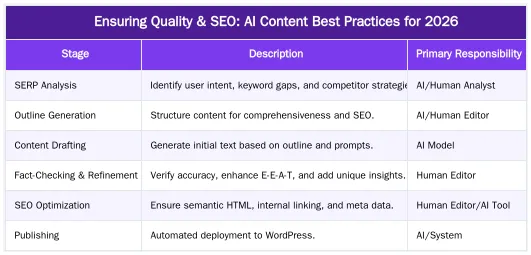
A comprehensive AI content pipeline encompasses several critical stages. It begins with in-depth SERP analysis to identify relevant topics, user intent, and competitive gaps. Next, AI models generate detailed outlines and draft content, often incorporating natural language generation techniques. This draft then undergoes optimization for SEO, readability, and semantic HTML structuring. Finally, the content is automatically published to WordPress, often via the WordPress REST API, completing the end-to-end process. This systematic approach transforms content automation from a fragmented task into a cohesive, efficient operation.
Why Your WordPress Site Needs an AI Content Workflow
Implementing a full AI content workflow offers significant strategic advantages over traditional content creation or basic AI writing tools. This approach enables businesses to achieve substantial increases in content velocity, producing more high-quality, relevant articles consistently. Improved SEO performance is a direct result of integrating SERP-driven insights from the initial research phase, ensuring content aligns with current search trends and user intent. Furthermore, the automation inherent in a robust content pipeline leads to considerable cost efficiency by reducing manual labor and accelerating time-to-market for new content.
Beyond Basic AI: The Strategic Advantage of a Full Workflow
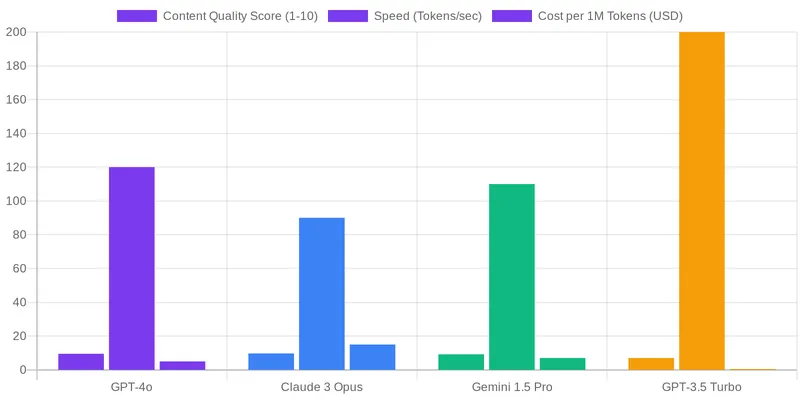
A comprehensive content automation workflow, incorporating live SERP analysis and a multi-model AI approach, surpasses simple AI writers. Tools like Ruxi Data leverage real-time search engine results to inform content strategy, identifying precise keyword opportunities and semantic gaps. By utilizing advanced models such as GPT-4o, Claude 3 Opus, and Gemini 1.5 Pro, the workflow can generate nuanced, high-quality content tailored to specific intents. This multi-model strategy allows for specialized AI capabilities at different stages, from ideation to drafting, ensuring content is not only unique but also optimized for ranking and user engagement through proper semantic HTML structuring.
Crafting Your AI Content Workflow: A Step-by-Step Guide
Building an effective AI content workflow requires a structured approach. The process begins with thorough SERP analysis to identify topic clusters and content gaps, ensuring every piece of content serves a specific purpose and targets relevant keywords. Advanced prompt engineering is crucial for guiding AI models to generate high-quality, contextually relevant, and brand-aligned content. Selecting and integrating the right AI models, such as GPT-4o API, Claude 3 Opus, or Gemini 1.5 Pro, allows for specialized tasks like research, drafting, and refinement. Finally, automating publishing via the WordPress REST API ensures seamless integration with your existing website infrastructure.
Integrating Advanced AI Models with WordPress for Seamless Publishing
Connecting AI model APIs to your content pipeline is a core step. This involves setting up secure API keys and developing scripts or using integration platforms to send prompts and receive generated content. For instance, a SEO data pipeline can feed SERP insights directly to the AI models. Effective prompt engineering best practices are vital for instructing these models to produce structured, semantically rich output. The WordPress REST API documentation provides the necessary endpoints for automated content creation, updates, and publishing. This allows for programmatic control over posts, pages, categories, and tags, ensuring content is correctly formatted and categorized upon publication. This integration streamlines the entire content pipeline, from generation to live post.
AI Model Performance Comparison (2026)
Ensuring Quality & SEO: AI Content Best Practices for 2026
The quality and SEO effectiveness of AI-generated content in 2026 hinge on adherence to Google’s guidelines and a focus on user helpfulness. Google emphasizes E-E-A-T (Experience, Expertise, Authoritativeness, Trustworthiness) for all content, regardless of its generation method. This necessitates human oversight, rigorous fact-checking, and the integration of unique insights that AI alone cannot provide. While AI can generate vast amounts of text, human editors are crucial for refining tone, ensuring accuracy, and injecting the distinct voice and perspective that builds trust and authority.
Human Oversight and E-E-A-T in an AI-Driven World
Integrating human expertise into the AI workflow is paramount for maintaining high standards. Human editors review AI-generated drafts, fact-check information, and refine language to align with brand voice and E-E-A-T principles. This ensures content is not only accurate but also demonstrates genuine experience and authority. For instance, a scaling content production AI workflow should always include a human review stage. Google’s helpful content guidelines explicitly state that content should be created for people, not search engines. This means AI-generated content must provide unique value, answer user queries comprehensively, and be free from factual errors or misleading information. The combination of AI efficiency and human discernment creates content that ranks well and genuinely serves its audience.
Key Stages for Quality Assurance in AI Content
What Outcomes Can You Expect from an Automated Content Pipeline?
Implementing a robust automated content pipeline yields several tangible benefits for businesses. Expect a significant increase in content output, often allowing for the publication of multiple articles daily or weekly, far exceeding manual capabilities. This increased content velocity directly contributes to higher organic traffic as more indexed pages attract a wider audience. Consequently, improved SERP rankings for target keywords become achievable, enhancing overall organic visibility. Operational costs are reduced by minimizing the need for extensive manual labor in research, drafting, and publishing. Furthermore, a well-defined content automation workflow ensures consistent brand messaging and quality across all generated content.
Measuring Your Success: Key Metrics for AI Content
Tracking specific Key Performance Indicators (KPIs) is essential to evaluate the effectiveness of your AI content strategy. Monitor content velocity by measuring the number of published articles per week or month. Keyword ranking improvements can be tracked using SEO tools, noting positions for target keywords and overall organic visibility. Organic traffic, measured through analytics platforms, indicates the volume of visitors arriving from search engines. Engagement rates, such as bounce rate, time on page, and social shares, provide insights into content quality and user satisfaction. By consistently analyzing these metrics, businesses can refine their AI content workflow and maximize ROI.
Ready to Scale Your WordPress Content with AI?
Transforming your content strategy with an advanced AI content workflow for WordPress is within reach. This integrated approach, from SERP data to published post, offers unparalleled efficiency and quality. If you are looking to significantly boost your content output, improve SEO performance, and streamline your publishing process, exploring specialized AI content solutions is the next step. Discover how a tailored SEO workflow automation can revolutionize your WordPress content production.
Conclusion
An AI content workflow for WordPress is no longer a futuristic concept but a vital strategy for scaling content production in 2026. By integrating advanced AI models, leveraging SERP data, and automating publishing via the WordPress REST API, businesses can create a highly efficient, quality-driven content pipeline. This approach ensures content is not only generated rapidly but also optimized for SEO and human readers, adhering to E-E-A-T principles. Embracing this end-to-end automation allows organizations to achieve increased organic traffic, improved rankings, and significant operational efficiencies. To explore how to implement such a workflow for your WordPress site, visit abdurrahmansimsek.com.
Frequently Asked Questions
What is an AI content workflow for WordPress and how does it differ from a standard AI writer?
An AI content workflow for WordPress is a comprehensive, automated system that manages the entire content lifecycle, from initial SERP analysis to direct publishing. Unlike a standard AI writer that only generates text, this workflow integrates live data, uses multiple AI models for nuanced content, and structures posts semantically. It ensures content is not only written but also optimized and published efficiently to your WordPress site.
How does an AI content workflow for WordPress ensure high E-E-A-T?
An effective ai content workflow wordpress builds E-E-A-T by leveraging real-time data from top-ranking, authoritative sources. The AI synthesizes this fresh information to ensure accuracy and relevance. Additionally, the system programmatically adds Author Schema and other trust signals, demonstrating expertise and trustworthiness for your WordPress content.
Can I integrate my own API keys into the AI content workflow for WordPress?
Yes, the platform is designed for maximum flexibility, allowing you to integrate your own API keys from providers like OpenAI and Anthropic. This gives you full control over your usage and costs within the automated content creation process. Integrating your keys ensures your ai content workflow wordpress operates exactly as you intend.
Is the content publishing process to WordPress fully automated?
Yes, the entire process from content generation to publication on your WordPress site is fully automated. The system utilizes the WordPress REST API to create posts, assign categories, add tags, set featured images, and inject generated Schema markup. This eliminates manual intervention, streamlining your content pipeline.
What quality control measures are in place for AI-generated content?
The workflow incorporates several quality control checkpoints to ensure high-quality output. You can define strict prompt engineering guidelines and set content for manual review before publishing. Built-in plagiarism and AI detection checkers also help ensure originality and adherence to your brand standards.
What outcomes can I expect from implementing an automated content pipeline?
Implementing an automated content pipeline can lead to significant improvements in efficiency and content scale. You can expect faster content production, consistent SEO optimization, and a reduction in manual labor. This allows your team to focus on strategy and higher-value tasks, ultimately driving more traffic and engagement to your WordPress site.
Ruxi Data brings together multi-model AI, automated website crawling, live indexation checks, topical authority mapping, E-E-A-T enrichment, schema generation, and full pipeline automation — from crawl to WordPress publish to social posting — all in one platform built for agencies and freelancers who run on results.