
301 Redirect Strategy: Preserving SEO During Clinic Mergers
A 301 redirect strategy is crucial for medical clinics merging websites, ensuring the preservation of search engine rankings and link equity. This permanent redirection method informs search engines of URL changes, transferring domain authority and preventing organic traffic loss. Implementing a precise 301 redirect strategy is vital for maintaining E-E-A-T signals and a positive user experience during domain consolidation. Proper URL mapping and technical SEO execution are key to avoiding redirect chains and preserving valuable search visibility for YMYL content.
Abdurrahman Şimşek, a Semantic SEO Strategist specializing in medical clinics, emphasizes that precise technical SEO, including a robust 301 redirect strategy, is fundamental for maintaining E-E-A-T and topical authority during website mergers. His expertise ensures seamless domain consolidation and sustained organic growth.
To explore your options, contact us to schedule your consultation.
A 301 redirect strategy is essential when merging clinic websites to preserve search engine rankings and link equity. For medical practices with Your Money Your Life (YMYL) content, correct execution maintains authority, patient trust, and uninterrupted access to information.
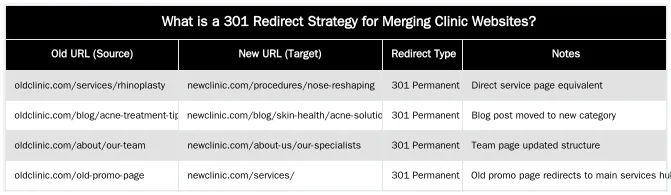
What is a 301 Redirect Strategy for Merging Clinic Websites?
A 301 redirect strategy uses the HTTP status code 301 to permanently move a web page or an entire domain to a new URL. For medical clinics merging websites, this informs search engines of the permanent location change. This signal instructs search engines to pass nearly all of the original page’s link equity and ranking power to the new destination, preventing loss of authority and visibility.
Understanding the ‘Permanent Move’ for SEO
A 301 redirect signifies a permanent move. This is distinct from a 302 redirect, which indicates a temporary relocation and does not pass the same level of link equity. When consolidating domains, using 301s ensures that the trust, authority, and relevance from old URLs are transferred to the new site, maintaining organic search performance.
Why a 301 Redirect Strategy is Critical for Medical SEO
For medical websites with Your Money Your Life (YMYL) content, a correct redirection strategy is essential. Incorrectly implemented redirects can cause significant drops in organic traffic, erode E-E-A-T (Experience, Expertise, Authoritativeness, Trustworthiness) signals, and diminish domain authority.
Preserving E-E-A-T and Link Equity in Healthcare
Any disruption signaling uncertainty to search engines can impact E-E-A-T. A proper 301 redirect strategy transfers link equity from the old site’s backlinks and internal links to the new domain. This consolidation of domain authority maintains topical relevance and trust signals. Learn more about Managing Website Migrations and Redesigns for Medical Clinics.
Avoiding Ranking Drops and User Experience Disruptions
Broken links or incorrect redirects create frustrating patient experiences and signal poor site management to search engines, which can cause ranking drops and loss of organic visibility. A correct redirect implementation ensures users arriving from search results or old bookmarks are directed to relevant content on the new site, minimizing negative impacts on SEO and patient satisfaction.
Implementing Your 301 Redirect Plan for Domain Consolidation
A website merge requires creating a map of all old URLs to their new counterparts and configuring server-side rules for redirection.
Comprehensive URL Mapping
Before technical changes, create a spreadsheet mapping every old URL to its new destination. Prioritize pages with high traffic, backlinks, or critical patient information. Redirect pages without a direct equivalent to the most relevant category page, service page, or the homepage. This prevents lost link equity and ensures users land on a functional, relevant page.
Technical Implementation: .htaccess, Nginx, and Wildcard Redirects
Redirects are implemented at the server level. For Apache servers, edit the `.htaccess` file. Nginx servers require modifications to their configuration files. Wildcard redirects (`RedirectMatch` in Apache, `rewrite` rules in Nginx) are useful for consolidating entire sections or subdomains, such as redirecting `oldclinic.com/blog/*` to `newclinic.com/insights/*`. This method streamlines large-scale merges and is a component of automated redirect management, improving scalability and reducing manual errors.
Avoiding Redirect Pitfalls & Optimizing for Google’s Understanding
Technical SEO challenges can arise during a website merge. Abdurrahman Şimşek, a semantic SEO and web development expert for medical clinics, emphasizes mitigating common redirect pitfalls. Understanding how Google processes redirects and canonicalization is key to a successful migration.
Diagnosing and Preventing Redirect Chains
A redirect chain occurs when a URL redirects multiple times before reaching the final destination. These chains harm SEO because they consume crawl budget, dilute link equity, and slow page load times; search engines may stop following long chains. The goal is a direct, single-hop 301 redirect from the old URL to the final new URL. Audits using tools like Screaming Frog or Sitebulb can identify and fix these issues.
Canonicalization and Entity Reconciliation Post-Merge
Redirects and canonical tags work together to signal the preferred version of a page. After a merge, ensure all new pages have self-referencing canonical tags. This tells Google the new URL is the definitive source and aids in entity reconciliation for semantic SEO. Correct redirects and canonicalization help Google consolidate information about entities (like a medical procedure or surgeon), preventing fragmentation and strengthening the new site’s authority. Learn more about entity reconciliation SEO.
Post-Merge Monitoring: Ensuring SEO Health and Preserving Link Equity
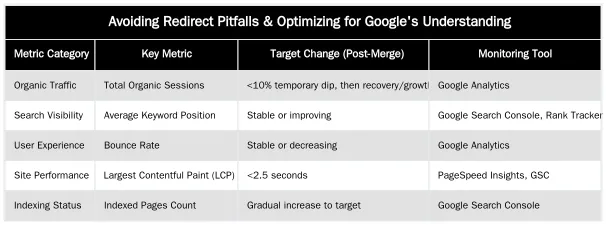
Post-merge monitoring validates the redirection strategy and ensures the new website performs as expected. It helps identify and fix issues quickly, safeguarding organic visibility and patient acquisition channels.
Leveraging Google Search Console for Redirect Validation
Google Search Console (GSC) is essential for post-merge validation. Check the ‘Crawl Stats’ report to see if Googlebot is crawling new URLs and discovering redirects. The ‘Coverage’ report highlights indexing issues. The ‘Removals’ tool can expedite the removal of old URLs, though 301s handle this over time. Submit new sitemaps for the merged domain to inform Google of the new site structure.
Key Metrics to Watch: Traffic, Rankings, and Core Web Vitals
Monitor key performance indicators (KPIs) after the merge. Track organic traffic with Google Analytics and observe keyword rankings. Monitor user experience metrics like bounce rate and Core Web Vitals (Largest Contentful Paint, Cumulative Layout Shift, First Input Delay) to ensure the new site is fast and stable. Significant dips in these metrics warrant investigation.
Secure Your Clinic’s Future: Partner with a Semantic SEO Expert
Merging clinic websites is a complex technical task with significant SEO implications for YMYL healthcare content, demanding specialized expertise. Abdurrahman Şimşek offers semantic SEO strategies and web development services to help medical practices navigate these challenges. Partner with an expert who understands the London private healthcare market to preserve your digital assets and enhance your online authority.
Conclusion
A correct 301 redirect strategy is essential for medical clinics merging websites. It safeguards SEO value, preserves E-E-A-T signals, and ensures a good patient experience. Neglecting any step, from URL mapping to post-merge monitoring, can lead to ranking losses and diminished trust. For guidance on technical SEO and building a semantic content network for your medical practice, visit AbdurrahmanSimsek.com.
Frequently Asked Questions
Is a comprehensive 301 redirect strategy necessary when merging two clinic websites?
Yes, a thorough 301 redirect strategy is crucial for preserving your search engine rankings and user experience. Every valuable page from the old site should be 301 redirected to the most relevant page on the new primary site. This ensures that search engines understand the permanent move and pass on link equity, preventing broken links for patients.
What is the primary benefit of a proper 301 redirect strategy during a clinic website merger?
The main benefit is the consolidation of authority and preservation of SEO value. A correct 301 redirect strategy passes the link equity from the old domain’s backlinks to the new domain, often resulting in a significant ranking boost for the primary website. This is vital for maintaining visibility and patient trust in the highly competitive medical sector.
Can I simply redirect the old homepage to the new one and neglect other pages in my 301 redirect strategy?
No, this is a critical SEO error that can severely harm your rankings. Failing to redirect individual pages means you will lose all the ranking value and backlinks associated with those specific pages. A page-by-page mapping is essential for a successful 301 redirect strategy to ensure no valuable content or authority is lost.
Where are 301 redirects typically implemented for optimal performance?
They are most commonly implemented at the server level, often within the `.htaccess` file on Apache servers or in the server config for Nginx. Using server-level redirects is more efficient for search engine crawlers than using plugin-based or script-based redirects. This ensures a smoother transition for your merged clinic websites.
How should Google Business Profiles be managed after a clinic website merger?
You should mark the old clinic’s Google Business Profile as “Permanently Closed” and, if possible, work with Google Support to merge any reviews into the primary clinic’s profile. Crucially, ensure the website field on the old profile is updated to the new primary domain to guide patients correctly. This helps consolidate your online presence.
How can Abdurrahman Şimşek assist with my clinic’s website merger and redirect plan?
Abdurrahman Şimşek specializes in holistic SEO strategies for medical clinics, including meticulous planning and execution of complex site migrations and redirect projects. As a Semantic SEO Strategist, he ensures your new site maintains and enhances its topical authority, preserving patient trust and organic visibility. You can contact him via the website to discuss your specific needs for a seamless transition.
Ruxi Data brings together multi-model AI, automated website crawling, live indexation checks, topical authority mapping, E-E-A-T enrichment, schema generation, and full pipeline automation — from crawl to WordPress publish to social posting — all in one platform built for agencies and freelancers who run on results.