
Topical Gap Analysis: Enhancing Clinic Visibility and Authority
A topical gap analysis identifies missing content areas on a website, crucial for medical clinics to uncover underserved patient-relevant topics compared to competitors. This process moves beyond individual keywords to build comprehensive topical authority, demonstrating E-E-A-T in YMYL sectors. By mapping content to the patient journey and addressing diverse search intent, clinics enhance online visibility, attract qualified patients, and establish themselves as reliable experts. This strategic content audit ensures a complete resource for patient queries, improving organic performance.
Abdurrahman Şimşek, a Semantic SEO Strategist specializing in medical clinics, leverages this approach to build high-authority content networks. His expertise focuses on semantic engineering and E-E-A-T optimization, crucial for London’s competitive private healthcare market.
To explore your options, contact us to schedule your consultation.
For medical clinics in London’s competitive private healthcare sector, a topical gap analysis identifies underserved patient-relevant topics on your website compared to competitors. Uncovering these content opportunities enhances online visibility, builds topical authority, and attracts qualified patients. This guide outlines the methodology for this analysis, tailored to the E-E-A-T requirements of the medical industry.
What is a Topical Gap Analysis for Medical Clinics?
A topical gap analysis for medical clinics identifies relevant subject areas and related entities your website lacks compared to competitors. The process moves beyond individual keywords to encompass clusters of related information, establishing topical authority. For YMYL (Your Money Your Life) industries like healthcare, this depth demonstrates E-E-A-T (Experience, Expertise, Authoritativeness, and Trustworthiness) to search engines and patients.
Topical Gap vs. Keyword Gap: Understanding the Nuance
A keyword gap analysis focuses on specific search terms where competitors rank and your site does not. This approach can be narrow. A topical gap analysis examines broader subject matter, identifying missing clusters of related concepts, questions, and entities. For a plastic surgery clinic, a keyword gap might be “rhinoplasty cost London.” A topical gap would be an entire missing section on “nasal surgery recovery,” including related terms, patient concerns, and procedural details. This broader view is more critical for building medical authority and serving patient search intent.
The Strategic Advantage: How Topical Gaps Impact Patient Acquisition
Addressing content gaps makes your website a more complete resource, impacting patient acquisition. Increased visibility for more patient queries leads to higher organic traffic. Content that answers patient questions builds trust. In medical SEO, demonstrating comprehensive knowledge signals to search engines that your clinic is a reliable expert, which is critical for ranking and converting inquiries into appointments.
Mapping Content to the Patient Journey
Topical gaps often correspond to unmet needs at different stages of the patient journey. A patient considering a cosmetic procedure moves from awareness (“what is liposuction?”) to research (“liposuction recovery time”) to decision-making (“best liposuction clinic London”). If your content has gaps at these stages, patients may use competitor sites. A topical strategy must align content with all search intents, from informational queries to booking. This captures patients at every touchpoint, guiding them toward conversion. The National Library of Medicine highlights the importance of patient education throughout their healthcare journey.
Step-by-Step: How to Conduct a Topical Gap Analysis for Medical Clinics
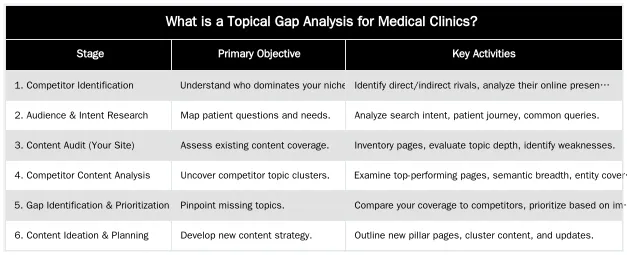
A topical gap analysis is a systematic process to identify content opportunities for your clinic, from research to data interpretation. The goal is a content strategy that addresses patient needs and outperforms competitors.
Identifying Competitors and Their Content Footprint
Identify direct and indirect competitors. Direct competitors are other private clinics in London offering similar services, like those on Harley Street. Indirect competitors include health information portals or NHS resources ranking for your informational queries. Analyze their websites to understand their content architecture, topics, and depth of explanation. Look for recurring themes, common questions, and semantic breadth. For instance, a competitor’s guide on “post-operative care for breast augmentation” might reveal a topic your clinic has only superficially addressed. Semrush provides a guide on conducting competitive analysis that can be adapted for the medical sector.
Leveraging SEO Tools for Comprehensive Data Collection
SEO tools are indispensable. Platforms like Ahrefs and Semrush analyze competitor keyword rankings, top pages, and related search queries. Google Search Console reveals queries where your site appears but may lack comprehensive content. Focus on tools that identify topic clusters and semantic relationships. Tools like Surfer SEO or Clearscope analyze content for entity coverage, suggesting related terms and concepts for a comprehensive page. This moves beyond keyword research to understand topical relevance. A live SERP analysis case study shows how these tools produce results.
Measuring Success: What to Expect After Filling Your Topical Gaps
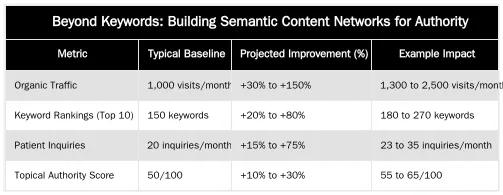
A content strategy based on a topical gap analysis yields measurable results. Expect increased organic traffic as your site ranks for more relevant topics and long-tail keywords. Higher rankings for medical procedures and conditions signal enhanced topical authority. Improved patient engagement, shown by longer time on page and lower bounce rates, indicates content is meeting search intent. This leads to more qualified inquiries and patient acquisitions. The long-term impact includes a stronger brand reputation and sustained E-E-A-T, positioning your clinic as a leader.
Continuous Improvement: The Iterative Nature of Topical Authority
Building topical authority is an ongoing process. The digital landscape, patient needs, and search algorithms evolve. Regular content audits maintain relevance and identify new opportunities. Periodically revisit your topical gap analysis to assess new competitor content, emerging patient questions, and shifts in search intent. This iterative approach keeps your content strategy effective, reinforcing expertise and trustworthiness for patients and search engines. Staying current with medical advancements and patient concerns is vital for sustained online success.
Ready to Dominate Your Niche? Partner with a Semantic SEO Expert
For London’s medical clinics, plastic surgeons, and aesthetic practices, mastering organic search requires understanding semantic content and topical authority. If your clinic is ready to implement a content strategy driven by a topical gap analysis, Abdurrahman Şimşek offers specialized expertise. As a London-based Semantic SEO Strategist with a decade of experience in the private healthcare market, he builds Semantic Content Networks to attract high-value patients. Elevate your online presence and secure your position as a leader in your medical niche.
Conclusion
A topical gap analysis is a foundational strategy for medical clinics to achieve organic growth and establish online authority. By addressing content voids, clinics create a semantic content network that meets patient search intent at every stage. This approach boosts search visibility and cultivates patient trust, a critical factor in the YMYL healthcare sector. This methodology makes your clinic’s website a definitive resource, driving traffic and conversions in London’s private healthcare market.
To discuss a tailored semantic SEO strategy for your clinic, visit AbdurrahmanSimsek.com.
Frequently Asked Questions
What is a topical gap analysis for medical clinics?
A topical gap analysis for medical clinics identifies relevant subject areas and related entities your website lacks compared to competitors. This process moves beyond individual keywords to encompass clusters of related information, establishing topical authority and attracting qualified patients.
What is the primary goal of conducting a topical gap analysis?
The goal is to develop a data-driven content plan that systematically addresses patient needs and builds your clinic’s online authority. By identifying and prioritizing these content opportunities, you can capture organic traffic currently going to competitors.
How do I begin a topical gap analysis for my clinic’s website?
Start by identifying your top 3-5 direct competitors in the SERPs. Then, utilize an SEO tool (like Ahrefs or Semrush) to compare the keywords their domains rank for against your own, generating a list of potential content gaps for your website.
Should I create content for every single content gap identified?
No, prioritization is crucial. Group identified keywords into semantic topics and evaluate them based on search volume, relevance to your core procedures, and the searcher’s intent. Focus on developing comprehensive content for the highest-value topics first to maximize impact and E-E-A-T.
How does advanced semantic infrastructure like Ruxi Data enhance this type of analysis?
Advanced SEO infrastructure, such as Ruxi Data, automates this analysis at a deeper, semantic level. It identifies not just keyword gaps, but entire conceptual or entity-level gaps in your topical map, providing a more sophisticated and effective content strategy for medical clinics.
How can Abdurrahman Şimşek help my clinic with a content gap analysis?
Abdurrahman Şimşek specializes in building high-authority Semantic Content Networks specifically for medical clinics in London. He can leverage his expertise and tools like Ruxi Data to conduct a comprehensive content gap analysis, developing a tailored strategy to enhance your online visibility and patient acquisition.
Ruxi Data brings together multi-model AI, automated website crawling, live indexation checks, topical authority mapping, E-E-A-T enrichment, schema generation, and full pipeline automation — from crawl to WordPress publish to social posting — all in one platform built for agencies and freelancers who run on results.