
Topical Gap Analysis: Uncovering Content Opportunities for Authority
This article introduces topical gap analysis, a critical process for identifying underserved subject areas on a website. It details how to conduct a comprehensive content audit to pinpoint missing entities, sub-topics, and user intent coverage. By addressing these semantic gaps, websites can build robust topical authority, enhance E-E-A-T signals, and improve organic visibility. The process involves leveraging SERP analysis, keyword clustering, and competitor content strategy to create a definitive resource that satisfies patient information needs and drives organic growth.
Abdurrahman Şimşek, a Semantic SEO Strategist, emphasizes that complete topical coverage is essential for demonstrating expertise and trustworthiness, especially for YMYL content. Filling these gaps signals deep subject understanding to both users and search engines, crucial for establishing authority.
To explore your options, contact us to schedule your consultation. You can also reach us via: Book a Semantic SEO Audit, Direct WhatsApp Strategy Line: +90 506 206 86 86
To attract high-value patients in London’s private healthcare sector, medical practices must establish topical authority. This article explains topical gap analysis: how to identify and fill content gaps to build expertise and become a trusted authority. Addressing these content voids is essential for organic growth and patient acquisition in 2026.
What is a Topical Gap Analysis in Medical SEO?
A topical gap analysis in medical SEO identifies relevant subject areas a medical practice’s website fails to cover. These gaps are missed opportunities to establish authority and meet patient information needs. For YMYL (Your Money Your Life) medical sites, addressing these gaps is crucial for demonstrating expertise and building trust with users and search engines.
For a plastic surgery or aesthetic clinic, a topical gap could be a specific recovery phase, non-surgical alternatives, or information on a less common condition. Every facet of a core topic like “rhinoplasty” must be addressed, from consultation to long-term results and complications. This signals to search engines that your site is a definitive resource.
Beyond Keywords: Understanding Semantic Gaps
Topical gaps extend beyond keyword omissions, focusing on broader semantic themes and entities. For example, a keyword analysis might reveal a missing keyword like “breast augmentation cost.” A semantic content audit would identify a gap in the broader topic of “breast augmentation financial considerations,” which encompasses cost, insurance, financing options, and payment plans. This entity-based SEO approach ensures exhaustive coverage by addressing all related concepts and patient questions, moving beyond a keyword checklist to a holistic understanding of information needs.
How to Conduct a Comprehensive Topical Gap Analysis for Your Clinic
A structured content gap analysis identifies missing content and opportunities, ensuring a clinic’s website covers its specialty to meet patient and search engine needs. This approach moves beyond keyword research to a holistic understanding of the content landscape.
Step-by-Step Methodology & Key Tools
A content gap analysis follows this methodology:
- Content Inventory & Audit: Catalog all existing content on your site. Evaluate its quality, depth, and relevance. Identify outdated or underperforming pages.
- Competitor Content Strategy Analysis: Examine top-ranking competitors’ content. Identify topics they cover that you do not, or where their content is more comprehensive, including their information architecture and content types.
- Keyword Clustering & Semantic Mapping: Group related keywords into topics and sub-topics. Use tools like SEMrush, Ahrefs, and Google Search Console to find search queries and their intent, visualizing topical coverage and weaknesses.
- User Intent Modeling: Understand patient journey stages and their questions. Map these intents to existing content to identify information gaps.
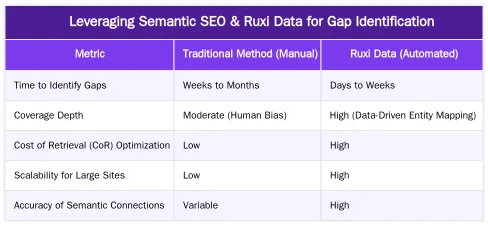
Tools like SEMrush, Ahrefs, and Google Search Console are used for data collection. Semantic tools like Ruxi Data can automate this process, providing insights into entity relationships and content voids. The table below compares manual and automated approaches.

Mapping User Intent Across the Patient Journey
Identifying content gaps requires aligning search queries with patient acquisition stages. Patients move from initial awareness (e.g., “what is a facelift?”) to consideration (e.g., “facelift recovery time,” “best facelift surgeon London”) to decision (e.g., “book facelift consultation”). Each stage has unique information needs. An analysis ensures your website addresses patient questions at all stages, from initial curiosity to pre-booking concerns. This content guides patients through their journey, building trust and encouraging conversion.
Leveraging Semantic SEO & Ruxi Data for Gap Identification
Traditional SEO focuses on keywords; modern search engines understand topics and entities. Semantic SEO Strategist Abdurrahman Şimşek uses semantic SEO principles and Ruxi Data to identify content gaps with precision. This method analyzes semantic relationships that define topical authority, going beyond keyword analysis. This approach is effective for complex medical topics where nuanced understanding is critical for patients and search algorithms.
This methodology optimizes for “Cost of Retrieval” (CoR) by focusing on how search engines process information. CoR is the computational resources search engines use to understand and rank content. A semantically structured site with comprehensive topic coverage reduces CoR, making it more efficient for Google to crawl, index, and rank. This efficiency can improve organic visibility and rankings for medical practices in markets like London.
Entity-Based Analysis vs. Keyword-Centric Approaches
Focusing on entities (e.g., ‘Rhinoplasty’, ‘Surgeon’, ‘Recovery’) and their attributes provides a more granular understanding of topical coverage. Unlike keyword-centric approaches, entity-based SEO maps relationships between concepts. For example, an entity-based audit for ‘Rhinoplasty’ ensures coverage of related entities like ‘nasal anatomy,’ ‘surgical techniques,’ ‘anesthesia types,’ and ‘post-operative care,’ not just keywords. This reveals gaps keyword tools might overlook, ensuring every aspect of a procedure is addressed. This aligns with Google’s reliance on its Knowledge Graph and entity understanding. Explore this further in Entity-Based Content Audit.
Automating Topical Map Creation with Ruxi Data
Ruxi Data is a semantic engine that automates identifying missing topics and sub-topics. It analyzes SERP data, competitor content, and user intent signals to construct topical maps. This automation streamlines content gap analysis for medical practices, allowing rapid identification of underserved areas. For example, Ruxi Data can pinpoint that a clinic covering ‘Breast Augmentation’ lacks content on ‘Saline vs. Silicone Implants’ or ‘Capsular Contracture Prevention.’ This ensures comprehensive coverage and reduces the ‘Cost of Retrieval’ for search engines, as the content network becomes organized and semantically rich. Learn more about this automation in Automating Medical Topical Maps with Ruxi Data.
Transforming Gaps into Growth: Expected Outcomes & ROI
A topical gap analysis yields benefits for medical clinics, leading to growth. Filling content voids improves rankings for a broader range of patient queries. This increases organic traffic as patients discover the clinic’s expertise. Enhanced topical authority and E-E-A-T signals increase conversion rates, as users perceive the site as more trustworthy.
For plastic surgeons and aesthetic clinics in London, this means more qualified patient leads, bookings, and revenue. For example, a clinic filling gaps on ‘rhinoplasty recovery tips’ or ‘non-surgical facelift alternatives’ captures patients at different decision-making stages, guiding them to a consultation. This content expansion builds brand reputation and positions the clinic as a specialty leader.
Measuring Success: KPIs Beyond Rankings
Measuring the success of filling content gaps requires tracking Key Performance Indicators (KPIs) beyond rankings. These include increased organic visibility, higher click-through rates (CTR), and improved engagement metrics like time on page and reduced bounce rates. Clinics should monitor qualified patient leads from organic search, consultation bookings, and the resulting revenue. These metrics show the return on investment (ROI), demonstrating how topical authority impacts patient acquisition and growth.
Conclusion
A topical gap analysis is fundamental for medical practices to succeed in 2026. By addressing content voids, clinics build topical authority, enhance E-E-A-T signals, and improve organic visibility. This makes a website a complete resource for patients, driving higher rankings, traffic, and patient acquisitions. To discuss a tailored semantic SEO strategy for your London clinic, contact us today. You can also Book a Semantic SEO Audit or reach out directly via our WhatsApp Strategy Line: +90 506 206 86 86.
Frequently Asked Questions
What is a topical gap, and how does a topical gap analysis help medical SEO?
A topical gap is a subject area relevant to your medical practice and patient queries that your website currently doesn’t cover in sufficient depth. A professional topical gap analysis identifies these missing pieces to build comprehensive authority and meet patient search intent for YMYL topics.
How does a topical gap analysis improve rankings for surgeons?
By systematically identifying and filling content gaps, a surgeon’s website demonstrates comprehensive expertise to Google. This process of building topical authority, guided by a thorough topical gap analysis, is key to outranking competitors for high-value procedures and establishing trust with potential patients.
What is the first step in a topical gap analysis?
The initial step in a topical gap analysis involves defining the core entities and services of your medical practice, such as ‘rhinoplasty’ or ‘Harley Street dermatology’. This is followed by mapping your existing content assets and comparing them against the complete user search landscape and competitor strategies to pinpoint missing areas.
Can I use automated tools for a topical gap analysis?
While tools like Semrush and Ahrefs are useful for initial data gathering, a data-driven topical gap analysis requires semantic interpretation. It involves understanding the relationships between entities and user intent, which is critical for the nuanced medical field and goes beyond simple keyword comparisons.
How does a topical gap analysis contribute to building topical authority?
A topical gap analysis is the foundational audit for building comprehensive topical authority. It provides a strategic roadmap, showing exactly which content needs to be created, updated, or consolidated to establish your medical specialty as a complete and authoritative resource.
How can I get started with a topical gap analysis for my clinic?
To begin uncovering hidden opportunities for your website, you can book a Semantic SEO Audit with Abdurrahman Şimşek. Alternatively, for direct strategy discussions, reach out via the WhatsApp Strategy Line at +90 506 206 86 86. This initial consultation will outline how a topical gap analysis can benefit your specific medical practice.
Ruxi Data brings together multi-model AI, automated website crawling, live indexation checks, topical authority mapping, E-E-A-T enrichment, schema generation, and full pipeline automation — from crawl to WordPress publish to social posting — all in one platform built for agencies and freelancers who run on results.