
Remove Fake Google Review: Protect Your Clinic’s Reputation
This guide explains how to remove fake google review entries for UK clinics, detailing Google’s content policies and the step-by-step reporting process. It outlines how to identify fraudulent online reviews, including vague language, no patient record matches, and suspicious profile activity. Successfully removing fake Google reviews is crucial for effective reputation management and protecting your clinic’s digital standing. The article also covers UK-specific legal recourse and proactive strategies to safeguard your clinic reputation against defamation and negative reviews, ensuring your Google Business Profile accurately reflects your professional care.
Abdurrahman Şimşek, a Semantic SEO Strategist, provides expert insights into managing online presence and protecting brand reputation. This content leverages specialized knowledge in digital strategy to help medical professionals navigate complex online review challenges effectively.
To explore your options, contact us to schedule your consultation.
For UK doctors, understanding how to remove fake google review entries maintains professional integrity and patient trust. This guide explains how to navigate Google’s review policies, identify fraudulent feedback, and protect your clinic’s digital standing. It covers the reporting process, UK-specific legal considerations, and proactive strategies to ensure your online presence reflects your quality of care.
What Constitutes a Fake Google Review for UK Clinics?
A fake Google review is an online rating or comment that does not originate from a genuine patient experience or is intentionally misleading, malicious, or fabricated. For medical clinics, such reviews can damage reputation, erode patient trust, and impact business.
Identifying Red Flags in Suspicious Reviews
Several indicators can suggest an online review is not authentic.
- Vague or Generic Language: Reviews lacking specific details about the treatment, staff, or clinic experience are suspicious.
- No Patient Record Match: If a reviewer’s name does not correspond to any patient in your clinic’s records, it is a strong indicator of a fabricated review.
- New or Sparse Profile Activity: Reviews from Google accounts with no profile picture, few other reviews, or recent creation dates can be red flags.
- Sudden Surge of Negative Reviews: An abrupt influx of similar negative comments within a short period might suggest a coordinated attack from a competitor or disgruntled individual.
- Off-Topic or Irrelevant Content: Reviews discussing topics unrelated to your clinic’s services or patient care are often fake.
- Emotional or Abusive Tone Without Basis: While genuine negative feedback can be emotional, reviews that are excessively aggressive or contain personal attacks without any verifiable incident are suspicious.
Google’s Review Policies: Understanding What Can Be Removed
Google’s content policies for online reviews prohibit specific content types, which can be removed upon reporting. Google removes content that violates its principles of helpfulness, relevance, and trustworthiness. This includes reviews not based on genuine experiences or intended to manipulate a business’s rating.
Key Violations That Trigger Review Removal
When reporting a review, identifying the specific violation is critical for a successful removal request. Common policy breaches include:
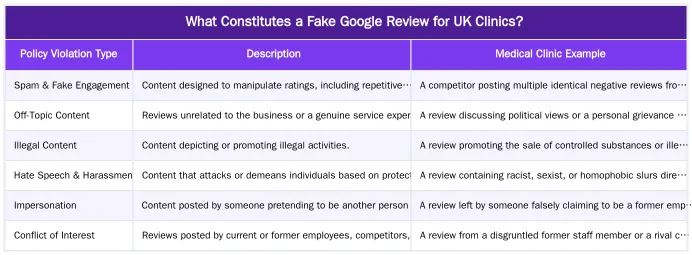
Reviews that fall into these categories are strong candidates for removal. Google’s automated systems and human moderators review flagged content against these guidelines.
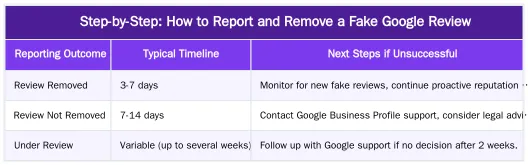
Step-by-Step: How to Report and Remove a Fake Google Review
Report fraudulent reviews through your Google Business Profile. This allows Google to investigate and remove content that violates its policies.
The Google Business Profile Reporting Process
Follow these steps to report a suspicious review:
- Access Your Google Business Profile: Log into the Google account associated with your clinic’s Google Business Profile.
- Navigate to Reviews: From your dashboard, click on the “Reviews” section.
- Locate the Review: Find the specific review you wish to report.
- Flag the Review: Click the three vertical dots (more options menu) next to the review. Select “Report review.”
- Choose a Violation Type: A pop-up will appear, asking you to select the reason for reporting. Choose the option that best describes how the review violates Google’s content policies (e.g., “Conflict of interest,” “Off-topic,” “Spam”). Be specific.
- Submit Your Report: Confirm your selection. Google will then receive your report for review.
Document the review with screenshots before reporting. This evidence can be useful if further action is required. Google’s response time varies from a few days to several weeks.
Responding to Negative Reviews: When and How
While awaiting Google’s decision, consider responding to the review. A professional response can mitigate the immediate impact on potential patients. A public response demonstrates your commitment to patient care and transparency.
- Maintain Professionalism: Avoid emotional or accusatory language.
- Keep it Concise: Acknowledge the feedback and offer to discuss the matter privately.
- Avoid Specifics: Do not disclose patient information or specific details of a potential interaction due to patient confidentiality.
- Example Response: “Thank you for your feedback. We take all patient comments seriously. We cannot find a record of your visit under this name. If you were a patient, please contact us directly at [phone number] or [email] so we can investigate your concerns.”
This approach shows other prospective patients that you are attentive and responsive.
Beyond Reporting: Legal Recourse & Proactive Reputation Management for UK Doctors
If Google does not remove a fake and harmful review, UK doctors can take further action, including legal recourse under defamation law and proactive online reputation management. A doctor can sue for a bad review in the UK if the review meets specific criteria for defamation.
UK Defamation Law and Online Reviews
In the UK, the Defamation Act 2013 governs claims of defamation. For a claim to succeed, the claimant must prove that the statement:
- Is Defamatory: It lowers the claimant’s reputation in the eyes of right-thinking members of society generally.
- Refers to the Claimant: It is clearly about the doctor or clinic.
- Has Caused or is Likely to Cause Serious Harm: For a trading body, serious harm means serious financial loss. For an individual, it means serious harm to their reputation.
- Is False: The claimant must prove the statement is untrue.
If these conditions are met, a doctor can pursue legal action against the reviewer. This often begins with a “Letter Before Action” from a solicitor, demanding removal and an apology. If unsuccessful, court proceedings may follow. Platforms like Google may be compelled to disclose the reviewer’s identity under a Norwich Pharmacal Order, though this is a complex legal process. Consult a legal professional specializing in media or defamation law for detailed guidance. The UK government provides resources on legal aid and advice. Learn more about legal aid in the UK.
Building an Online Presence with Semantic SEO
A proactive approach to online reputation management builds a strong, authoritative digital footprint that dilutes the impact of negative content. Semantic SEO is key to this strategy. By developing a semantic content network, clinics can establish topical authority around their specializations.
This strategy, used by experts like Abdurrahman Şimşek, focuses on creating interconnected content that covers all relevant entities and topics within a medical niche. For instance, a plastic surgery clinic in London would build topical authority around specific procedures, patient safety, and post-operative care. This content architecture signals to search engines like Google that your clinic is a definitive source of information. Your authoritative content ranks higher, pushing down negative online reviews and strengthening brand protection. This approach aligns with Google’s E-E-A-T (Experience, Expertise, Authoritativeness, Trustworthiness) guidelines, which are critical for Your Money Your Life (YMYL) topics like healthcare.
Protecting Your Clinic’s Digital Footprint: Long-Term Strategies
Online reputation management extends beyond addressing individual fake reviews. It is a continuous effort to cultivate a positive digital footprint by encouraging genuine patient feedback, monitoring, and integrating these efforts into your digital presence. A strong online presence demonstrates commitment to quality care and patient satisfaction. This dilutes the impact of negative reviews by surrounding them with positive, authentic content.
Encouraging Authentic Patient Feedback
The most effective way to combat negative or fake reviews is to generate a steady stream of positive, genuine patient feedback. This requires an ethical and systematic approach:
- Directly Ask Satisfied Patients: After a positive experience, ask patients to consider leaving an online review. Provide clear instructions or a direct link to your Google Business Profile.
- In-Clinic Reminders: Use signage or cards at reception to remind patients about leaving reviews.
- Post-Visit Follow-ups: Include a link to your review platforms in post-appointment emails or SMS messages.
- Diversify Review Platforms: Encourage reviews on Google and industry-specific platforms like Doctify, NHS Choices, or other relevant health review sites. This broadens your online reviews landscape.
- Educate Staff: Ensure all staff understand the importance of online reviews and how to ethically encourage them.
Proactively encouraging genuine patient feedback builds a buffer of positive sentiment, making it harder for a single negative or fake review to impact your overall rating.
Secure Your Clinic’s Reputation with Expert Semantic SEO
Protecting your clinic’s online reputation and building digital authority requires a specialized approach. Abdurrahman Şimşek, a London-based Semantic SEO Strategist, offers solutions for medical clinics, skin clinics, and plastic surgeons. With over a decade of experience and the Ruxi Data Semantic Engine, he crafts high-authority Semantic Content Networks to help your clinic dominate local organic search and attract patients. Strengthen your brand protection and establish a strong digital presence.
Conclusion
Managing online reviews is essential for UK doctors’ reputation management. A successful strategy includes understanding Google’s policies, reporting fake reviews, exploring legal options, and implementing proactive semantic SEO. Addressing misleading content and fostering an authoritative online presence safeguards professional standing and patient trust. For guidance in building a website that dominates local search, partner with a medical SEO specialist. Contact Abdurrahman Şimşek today to book a Semantic SEO Audit.
Frequently Asked Questions
What is the first step to remove a fake Google review?
The initial step to address a fraudulent review is to flag it directly from your Google Business Profile dashboard. Navigate to the specific review, click the three vertical dots, and select ‘Report review’. Choose the most appropriate reason that aligns with Google’s content policies, such as ‘Conflict of interest’ or ‘Hate speech’, to initiate the process to remove fake Google review content.
What kind of reviews will Google actually remove?
Google will only take down reviews that explicitly violate their content policies, which include spam, fake content, conflicts of interest (e.g., from a disgruntled ex-employee), hate speech, or harassment. They do not remove fake Google review entries simply because a business disagrees with a patient’s honest opinion or experience.
Should I respond to a suspected fake review publicly?
Yes, a calm, professional, and non-accusatory public response is crucial. Instead of directly accusing the reviewer of being fake, state something like: ‘We take all patient feedback seriously, but we have no record of a patient with your name or details in our system. We would be happy to discuss this matter privately if you could contact our practice manager directly.’ This demonstrates your commitment to patient care and professionalism to other potential patients.
What if Google denies my request to remove a fake Google review?
If your initial flagging attempt is unsuccessful, you have the option to appeal the decision. This involves providing more detailed context and compelling evidence to the Google Business Profile support team. Thoroughly documenting why you believe the review is fraudulent is essential for a successful appeal to get Google to reconsider and potentially remove fake Google review content.
Is it possible to take legal action over a fake review in the UK?
Taking legal action for defamation in the UK is a possible, but often complex and costly, last resort. It is strongly advisable to exhaust all of Google’s internal removal options first. Consulting with a solicitor specializing in online reputation law is recommended before pursuing this path.
How can a London Private Healthcare SEO Service help clinics remove a fake Google review?
A specialized London Private Healthcare SEO Service can assist clinics by providing expert guidance on Google’s policies, helping gather evidence, and managing the reporting and appeal processes. They can also implement proactive reputation management strategies to build a strong online presence, mitigating the impact of negative or fraudulent feedback and helping to remove fake Google review entries more effectively.
Ruxi Data brings together multi-model AI, automated website crawling, live indexation checks, topical authority mapping, E-E-A-T enrichment, schema generation, and full pipeline automation — from crawl to WordPress publish to social posting — all in one platform built for agencies and freelancers who run on results.