
Reputation Management for Doctors: Building Online Trust and Practice Growth
Reputation management for doctors is essential for safeguarding professional image and fostering patient trust in the digital age. This guide outlines strategies for medical professionals to proactively build a resilient online presence, effectively manage patient reviews, and ethically navigate negative feedback. It emphasizes optimizing digital assets like websites and Google Business Profiles, alongside leveraging semantic SEO and E-E-A-T principles to establish authority. Understanding these components ensures a doctor’s digital footprint accurately reflects their expertise and trustworthiness, directly influencing patient acquisition and retention.
Abdurrahman Şimşek, a Semantic SEO Strategist, provides expert guidance on optimizing digital visibility and managing online perception. This content delivers actionable insights for medical professionals seeking to enhance their digital footprint and maintain a strong professional reputation.
To explore your options, contact us to schedule your consultation. You can also reach us via: Book a Semantic SEO Audit, Direct WhatsApp Strategy Line: +90 506 206 86 86
Effective reputation management for doctors is crucial in 2026, directly influencing patient trust and practice growth. This guide explores essential strategies to protect and enhance your professional image online. We’ll cover everything from proactive brand building to effectively handling patient reviews, ensuring your digital footprint accurately reflects your medical authority and trustworthiness. Understanding and actively managing your online presence is no longer optional; it is a fundamental component of modern medical practice.
What is Reputation Management for Doctors & Why Does it Matter?
Online reputation management for doctors involves actively monitoring, influencing, and improving how a medical professional or practice is perceived across digital platforms. This encompasses everything from patient reviews on health directories to social media interactions and search engine results. A strong online reputation directly correlates with patient trust, acquisition, and retention, forming a critical pillar of a doctor’s professional standing and E-E-A-T (Experience, Expertise, Authoritativeness, Trustworthiness).
In the digital landscape of 2026, prospective patients frequently research doctors online before booking appointments. Search results, patient testimonials, and professional profiles shape their initial impressions. A positive digital footprint reassures patients, validates expertise, and fosters confidence. Conversely, unmanaged negative feedback or an absent online presence can deter potential patients, impacting practice growth and credibility. Therefore, strategic management of this digital narrative is essential for any medical professional.
Proactive Strategies: Building a Resilient Online Presence
Building a robust online presence requires intentional effort to control your digital narrative. This involves creating and optimizing your own digital assets to ensure accurate and positive information dominates search results. Proactive personal branding for medical professionals establishes authority before potential issues arise.
Optimizing Your Digital Footprint: Website, GBP, and Social Media
A professional website serves as your digital headquarters, offering comprehensive information about your practice, specializations, and patient resources. Optimizing your Google Business Profile (GBP) is equally vital for local search visibility, ensuring accurate contact details, services, and hours are readily available. For doctors, strategic use of professional social media platforms like LinkedIn can showcase expertise, share medical insights, and connect with peers, contributing to a well-rounded digital PR strategy. Maintaining consistent information across all platforms reinforces your professional identity and aids in building online trust.
Leveraging Your Knowledge Panel for Authority
The Google Knowledge Panel is an information box that appears in search results for prominent entities, including doctors. It aggregates key information such as your name, specialty, practice address, contact details, and sometimes reviews. Claiming and managing your Knowledge Panel allows you to ensure its accuracy and completeness. By providing structured data and consistent information across your digital properties, you can influence the content displayed, presenting an authoritative and trustworthy profile to patients. This is a key component of knowledge panel management and overall digital PR.
Mastering Patient Review Management: From Acquisition to Response
Effective patient review management is central to a doctor’s online reputation. It involves not only encouraging positive feedback but also strategically addressing negative comments. This proactive approach helps shape patient perception and reinforces your commitment to care. For a comprehensive approach to this, consider an overall SEO guide for private healthcare that includes detailed review management strategies.
Ethical Strategies for Generating Positive Patient Reviews
Encouraging satisfied patients to share their positive experiences is crucial for building online trust. Ethical strategies include making the review process convenient, such as providing direct links to review platforms via email after an appointment or placing discreet signage in your waiting room. Focus on providing exceptional care, as this naturally leads to positive feedback. Never offer incentives for reviews, as this violates platform guidelines and ethical standards. Genuine testimonials are more impactful and credible.
Responding to Negative Reviews: A Step-by-Step Approach
Responding to negative reviews requires professionalism and empathy. A prompt, courteous response can mitigate damage and demonstrate your commitment to patient satisfaction. Follow these steps:
- Acknowledge and Empathize: Express regret for the patient’s negative experience without admitting fault.
- Maintain Privacy: Never disclose protected health information (PHI) or specific details of a patient’s case in a public response.
- Offer Offline Resolution: Invite the patient to contact your office directly to discuss and resolve the issue privately.
- Keep it Concise: Short, professional responses are best. Avoid lengthy explanations or defensive language.
- Learn and Improve: Use feedback as an opportunity to identify areas for practice improvement.
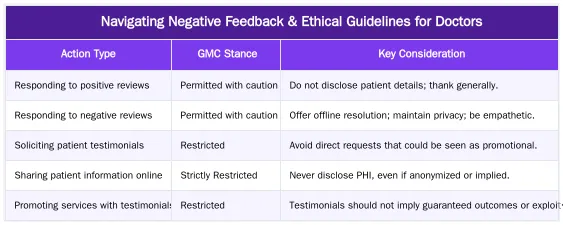
Navigating Negative Feedback & Ethical Guidelines for Doctors
Dealing with negative feedback online is a delicate process, balancing the need to protect your professional image with strict ethical and legal obligations. Understanding the nuances of negative review removal and adhering to professional body guidelines is paramount.
Can You Remove a Negative Review? Understanding the Process
Directly removing a negative review is generally not possible unless it violates the platform’s terms of service. Common grounds for removal include:
- Fake or Spam Reviews: Reviews from non-patients or bots.
- Offensive Content: Hate speech, obscenity, or personal attacks.
- Irrelevant Content: Reviews unrelated to the patient experience.
- Privacy Violations: Reviews containing sensitive personal information.
If a review meets these criteria, you can report it to the platform (e.g., Google, Yelp, Doctify) and provide evidence. The platform will then investigate and decide on removal. Attempting to suppress legitimate, albeit negative, feedback can backfire and damage credibility.
GMC Guidelines & Patient Testimonials: What Doctors Need to Know
The General Medical Council (GMC) provides clear guidance on doctors’ use of social media and engagement with patient testimonials. Doctors must ensure that any online interactions or content do not compromise patient confidentiality, exploit patient vulnerability, or make misleading claims. The GMC emphasizes that doctors should not solicit testimonials that could be seen as promotional or imply a guarantee of results. When responding to reviews, doctors must avoid disclosing patient information, even if the patient has already done so. Familiarity with these GMC guidelines is essential for compliance and maintaining professional integrity.
Semantic SEO & E-E-A-T: The Future of Doctor Reputation Management
Beyond traditional methods, advanced semantic SEO and E-E-A-T principles are shaping the future of online reputation for doctors. Abdurrahman Şimşek, a London-based Semantic SEO Strategist, emphasizes that search engines increasingly understand entities and their relationships, directly impacting how medical authority is perceived and ranked. This approach reduces the ‘Cost of Retrieval’ for search engines by presenting clear, interconnected information.
How Entity-Based SEO Reinforces Your Medical Authority
Google views doctors, clinics, and medical procedures as distinct entities. Consistent, authoritative signals across the web build a strong entity profile for a medical professional. This involves ensuring your name, specialty, affiliations, and publications are accurately represented and interlinked across your website, professional directories, and academic profiles. By implementing entity-based SEO, you help search engines confidently recognize your expertise and trustworthiness, which directly contributes to your E-E-A-T. This holistic approach ensures that positive reputation signals are easily discoverable and understood by algorithms.
Monitoring Your Brand: Beyond Basic Alerts
Effective brand monitoring extends beyond simple keyword alerts. It involves sophisticated tools that track mentions, analyze sentiment, and identify emerging reputation threats across various platforms. Advanced semantic infrastructure, like Ruxi Data, can automate the identification of positive and negative sentiment surrounding your brand, allowing for proactive intervention. This data-driven approach provides insights into public perception, competitor activity, and potential areas for reputation enhancement. Utilizing such tools helps medical practices stay ahead of the curve in managing their digital footprint. For more on advanced monitoring, see resources on brand monitoring.
Protect Your Practice: Partner with a Specialist SEO Strategist
Maintaining a stellar online presence is a continuous effort that requires specialized expertise. For doctors, effective online reputation management is not merely about damage control; it’s about strategically building and reinforcing your professional authority and trustworthiness. Partnering with a specialist SEO strategist who understands the unique challenges and ethical considerations of the medical field ensures your digital footprint accurately reflects your clinical excellence. Abdurrahman Şimşek offers tailored semantic SEO strategies for medical clinics, helping you dominate local search and attract high-value patients.
Secure your professional legacy and enhance your patient acquisition efforts. Book a Semantic SEO Audit today or connect directly via WhatsApp: +90 506 206 86 86.
Frequently Asked Questions
What is the first step in proactive reputation management for doctors?
The initial step involves ‘owning’ your digital footprint. This means establishing a professional website, optimizing your LinkedIn profile, and maintaining a complete, controlled Google Business Profile to ensure positive and accurate top search results for your name, which is crucial for effective reputation management for doctors.
How does SEO contribute to effective reputation management for doctors?
SEO is a powerful tool for managing a doctor’s online image. By creating and ranking high-quality, positive content you control—such as your professional website, articles, and profiles—you can strategically push any negative or inaccurate third-party results further down the search page, making them less visible to potential patients.
Is it better to ignore or respond to negative patient reviews?
It is almost always better to respond professionally and empathetically to negative feedback. A thoughtful response demonstrates to prospective patients that you value feedback and are committed to patient experience, which can often transform a negative situation into a net positive for your practice’s standing.
Why is reputation management for doctors so crucial in today’s digital age?
In 2026, effective online reputation management directly influences patient trust and practice growth. A strong online presence ensures your digital footprint accurately reflects your medical authority and trustworthiness, making it a fundamental component of modern medical practice.
How does Abdurrahman Şimşek handle patient testimonials while adhering to GMC guidelines?
We ensure all testimonials are genuine, obtained with explicit consent, and presented factually without making misleading claims. Our focus is on the patient’s experience rather than guaranteeing specific clinical outcomes, strictly adhering to GMC guidance and ethical standards.
How can I get started with improving my online presence or booking a semantic SEO audit?
To begin enhancing your online reputation and digital presence, you can book a Semantic SEO Audit directly through Abdurrahman Şimşek’s website. Alternatively, for immediate strategic discussions, you can reach out via the Direct WhatsApp Strategy Line at +90 506 206 86 86.
Ruxi Data brings together multi-model AI, automated website crawling, live indexation checks, topical authority mapping, E-E-A-T enrichment, schema generation, and full pipeline automation — from crawl to WordPress publish to social posting — all in one platform built for agencies and freelancers who run on results.