
Update Google Business Profile: Maintain Local SEO After Migration
To maintain local search visibility after a website migration, it is critical to update your Google Business Profile. This guide details the essential steps for medical practices to update their Google Business Profile and comprehensive local citations. Ensuring name, address, and phone (NAP) consistency across all directory listings, including Google Maps, is vital for local SEO. Inconsistent information erodes trust signals and reduces local search rankings. Proactive management of your local search ecosystem protects patient trust and search engine authority, preventing visibility loss after a domain change.
Abdurrahman Şimşek, a Semantic SEO Strategist, emphasizes the strategic importance of precise local citation management. This content provides actionable insights for safeguarding local search presence and maintaining E-E-A-T signals crucial for competitive markets.
To explore your options, contact us to schedule your consultation. You can also reach us via: Book a Semantic SEO Audit, Direct WhatsApp Strategy Line: +90 506 206 86 86
A website migration impacts local search visibility. This guide details how to update your Google Business Profile and local citations to protect local search presence for medical clinics in competitive markets like London. These updates maintain patient trust and search engine authority after a domain change.
Why Updating Your Google Business Profile is Critical After a Website Migration
The most critical local profile update after a website migration is changing the website URL on your Google Business Profile (GBP), a primary trust signal for Google’s local algorithm. Failing to update it confuses users and search engines, causing a drop in local search visibility and potential patient loss.
The Immediate Impact on Local Search Visibility
An un-updated Google Business Profile after a website migration disrupts your local search presence. Google’s algorithms rely on accurate, consistent information for local pack results and Google Maps. A GBP pointing to an old or redirected domain creates a broken user experience. This inconsistency signals unreliability to Google, reducing visibility, rankings, and patient inquiries.
Google’s Trust Signals and Your New Domain
The website URL on your GBP is a key trust signal for Google. For medical practices in Your Money Your Life (YMYL) sectors like plastic surgery or aesthetic clinics, E-E-A-T (Experience, Expertise, Authoritativeness, Trustworthiness) is paramount. An outdated or incorrect website link erodes this trust. An incorrect link makes it harder for Google to verify your practice’s legitimacy, negatively impacting perceived authority and trustworthiness in local search.
How to Update Your Google Business Profile and Core Local Citations
Updating your Google Business Profile and core local citations requires a methodical process and is a component of a website migration SEO checklist for medical practices.
Step-by-Step: Updating Your GBP Website URL and Information
- Access Your GBP Dashboard: Log in to the Google account associated with your Google Business Profile.
- Navigate to Info Section: From the main dashboard, click on “Info” in the left-hand menu.
- Edit Website URL: Locate the “Website” field (globe icon). Click the pencil icon to edit. Replace the old URL with your new, canonical domain (e.g.,
https://www.yournewdomain.com). - Review All Fields: While there, review other fields like business description, services, hours, and photos to ensure they are current.
- Apply Changes: Click “Apply” or “Save”. Google may require re-verification for significant changes. This process helps Google confirm the update’s legitimacy.
Ensuring NAP Consistency Across Key Directories
NAP (Name, Address, Phone) consistency is the uniformity of your business’s name, address, and phone number across online directories. This consistency helps search engines identify and rank your business. Inconsistencies confuse search engines, diluting local authority and harming search performance. After a migration, audit and update these details across all platforms.
Here’s a comparison table for old versus new NAP details, illustrating the necessary updates:
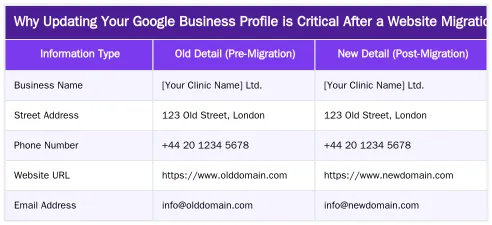
Key general directories to prioritize include Yelp, Facebook, Apple Maps, and local business listings. Each platform requires manual login and update, or can be managed via a citation management service.
Beyond Google: Comprehensive Local Citation Management for Medical Practices
For medical practices, local citation management extends beyond general business directories. Specialized healthcare listings help establish E-E-A-T and attract patients. A comprehensive approach is essential for clinics in competitive areas like London.
Identifying and Prioritizing Medical-Specific Directories
Medical practices must update profiles on authoritative healthcare directories. These platforms are trust signals for patients and search engines, reinforcing E-E-A-T. For UK-based clinics, key directories include Doctify, I Want Great Care, NHS Choices (if applicable), and the General Medical Council (GMC) register. Consistent details across these platforms are vital for patient acquisition and professional presence. Refer to our guide on Medical Directory SEO: How Entity Optimization Drives Patient Bookings.
Auditing Your Existing Local Citation Ecosystem
Before updating, audit your existing local citations. Methods include:
- Manual Search: Google your business name, phone number, and old website URL.
- Backlink Analysis: Use SEO tools to check backlinks from directories.
- Citation Management Tools: Platforms like BrightLocal or Yext scan for existing citations and inconsistencies.
- Competitor Analysis: Examine where competitors are listed to find more directories.
This audit ensures no listing is overlooked during the post-migration update.
Streamlining Your Citation Update Process: Tools and Best Practices
Updating many local citations is time-consuming, especially for practices with multiple listings. Specialized tools and a structured approach streamline this process for efficiency and accuracy.
Leveraging Citation Management Platforms (Yext, BrightLocal)
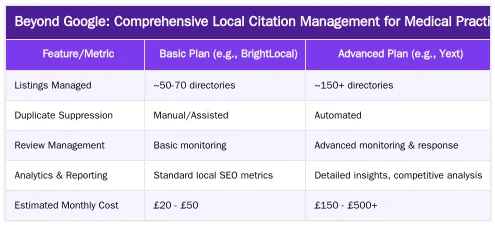
Citation management platforms like Yext and BrightLocal automate updating and monitoring listings across many directories.
- Yext: Known for direct API integrations with publishers for real-time updates and duplicate suppression. Effective for large or multi-location clinics.
- BrightLocal: A budget-friendly option with citation building, auditing, and monitoring. Favored by small to medium practices for its reporting and local SEO tools.
These subscription services save time and improve consistency. The investment is justified for medical practices by the need for accurate information and strong E-E-A-T signals. More information is on their websites, like BrightLocal.
Here’s a comparison of typical features and costs for citation management tools:
Developing a Post-Migration Citation Update Checklist
A checklist ensures no citation is missed when updating your GBP and other listings.
- Google Business Profile: Update website URL, description, services, and photos.
- Core General Directories: Yelp, Facebook, Apple Maps, Yellow Pages, Foursquare.
- Medical Directories: Doctify, I Want Great Care, NHS Choices, GMC, Healthgrades (if applicable).
- Social Media Profiles: LinkedIn, Instagram, X (formerly Twitter), etc.
- Industry-Specific Listings: Local chamber of commerce, professional associations.
- Partnership Websites: Any sites where your practice is listed as a partner or affiliate.
- Local Business Schema: Ensure your Local Business Schema on your website reflects the new URL and consistent NAP.
- Monitor for Duplicates: Regularly check for new or old duplicate listings.
Allow 2-4 weeks for changes to propagate across all directories; some platforms update faster than others.
Protecting Your Local SEO: What to Expect Post-Update
Updating your Google Business Profile and local citations is an investment in long-term local SEO. Monitoring results validates these efforts and helps sustain local search presence.
Monitoring Local Pack Rankings and Google Maps Visibility
After updating local citations, monitor key performance indicators. Track local pack rankings for relevant keywords for fluctuations as Google processes the updates. Monitor Google Maps visibility, noting impressions and actions from your GBP listing like calls, direction requests, and website clicks. Google Analytics and Google Business Profile Insights provide data for this. Initial visibility dips are possible, but consistent data should lead to recovery within weeks.
The Long-Term Benefits for Medical Practice Authority
Consistent and accurate local data contributes to your medical practice’s long-term E-E-A-T. A unified, verifiable digital footprint builds trust with search engines and potential patients. For London clinics, this leads to sustained local search presence, higher patient acquisition, and a stronger reputation in competitive postcodes. A maintained local search presence ensures patients find, trust, and choose your practice.
Secure Your Local Search Presence After Migration
Maintaining local search presence during a website migration is paramount for medical practices. Proactive management of your Google Business Profile and local citations is necessary to maintain patient trust and organic visibility. If your practice is navigating a migration or has local SEO challenges, expert guidance can help. Contact us to discuss a strategy for your clinic. You can also Book a Semantic SEO Audit or reach out via our Direct WhatsApp Strategy Line: +90 506 206 86 86.
Frequently Asked Questions
What is the most critical step to update your Google Business Profile after a website migration?
The most critical action is to update your Google Business Profile by changing the website URL. This immediately signals to Google and potential patients that your business information is current and accurate. Failing to update it can confuse search engines and users, negatively impacting your local search visibility.
Why is it important to update local citations on other directories beyond Google?
Google cross-references information across various online directories to verify your business data’s accuracy. Inconsistent NAP (Name, Address, Phone) and website information across platforms like Yelp, Doximity, or other industry-specific listings can erode trust. This inconsistency can significantly harm your local search rankings and overall online authority.
How does a prompt update Google Business Profile impact local SEO after a migration?
A prompt update Google Business Profile ensures continuity in your local search presence and maintains patient trust. It prevents search engines from displaying outdated information, which could lead to lost traffic and confused customers. This immediate action helps preserve your hard-earned local search rankings and authority.
If only my website domain changed, do I still need to update Google Business Profile and all other citations?
Yes, absolutely. Even if your physical address and phone number remain the same, the website domain change requires you to update Google Business Profile and all other local citations. Consistency across all online profiles is paramount for local SEO, and an outdated URL is considered a significant inconsistency that can negatively impact your rankings.
How long does it typically take for updated citations to affect my local rankings?
The impact timeline varies; updates to your Google Business Profile can reflect in search results within a few days. However, changes on third-party directories may take several weeks or even months for Google to re-crawl and acknowledge. This emphasizes the importance of initiating the update process immediately after your website migration.
Where can I find expert help for managing local SEO and website migrations for my clinic?
Abdurrahman Şimşek, a Semantic SEO Strategist specializing in medical and plastic surgery SEO, offers expert guidance. You can book a Semantic SEO Audit to ensure your local search presence is optimized post-migration. Alternatively, reach out directly via WhatsApp for a strategy discussion at +90 506 206 86 86.
Ruxi Data brings together multi-model AI, automated website crawling, live indexation checks, topical authority mapping, E-E-A-T enrichment, schema generation, and full pipeline automation — from crawl to WordPress publish to social posting — all in one platform built for agencies and freelancers who run on results.