
Navigational Vs Contextual Links: Optimizing Medical Site E-e-a-t
Understanding navigational vs contextual links is crucial for effective medical SEO. This article details how these distinct internal linking strategies guide user journeys and search engine crawlers, enhancing E-E-A-T signals and topical authority for healthcare websites. Navigational links establish site hierarchy and user experience, while contextual links build semantic relationships within content, distributing link equity and improving information retrieval. Mastering both types is essential for a robust internal linking strategy that supports complex medical content networks.
Abdurrahman Şimşek, a Semantic SEO Strategist, specializes in building high-authority semantic content networks for medical clinics. His expertise in information architecture and E-E-A-T optimization ensures robust digital strategies for healthcare providers.
To explore your options, contact us to schedule your consultation.
Internal linking is critical for SEO on complex medical websites. This article explains the differences between navigational vs contextual links and their roles in user experience, guiding search engine crawlers, and building E-E-A-T signals for plastic surgeons and aesthetic clinics in 2026. An effective internal linking strategy supports both user journeys and search engine comprehension of medical expertise.
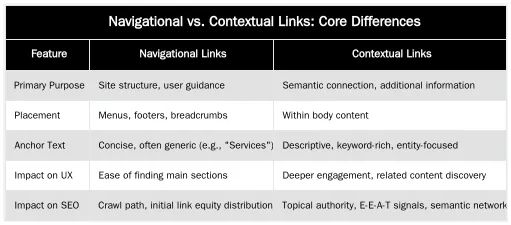
Navigational vs. Contextual Links: Core Differences
Navigational and contextual links serve distinct but complementary purposes. Navigational links guide users through the site’s structure, while contextual links are embedded within content to connect related topics and enhance semantic understanding.
What Are Navigational Links?
Navigational links are structural elements that help users navigate a website, including main menu items, sub-menus, breadcrumbs, and footer links. They provide a clear path for users to find key sections and services, such as “About Us,” “Services,” “Contact,” or medical procedures like “Rhinoplasty” or “Breast Augmentation.” They establish the site’s hierarchy and improve usability.
What Are Contextual Links?
Contextual links are embedded within a page’s body content. They point to other relevant pages on the site, offering more information on related topics. For a medical website, a contextual link might connect a paragraph about “dermal fillers” to a page on “lip augmentation” or a surgeon’s profile. These links build semantic relationships between content and demonstrate topical authority.
Why Both Link Types Matter for Medical SEO?
A balanced internal linking approach is essential for medical websites, especially for plastic surgeons and aesthetic clinics. Both navigational and contextual links contribute to user experience, search engine crawlability, and link equity distribution. Ignoring either type can hinder ranking for competitive medical terms.
Enhancing User Experience and Site Navigation
Clear navigational links are critical for medical websites where patients seek specific information on conditions, treatments, or surgeon credentials. Intuitive menus and breadcrumbs reduce bounce rates and improve the patient journey by helping users find procedure pages, before-and-after galleries, or contact information. This accessibility builds trust. For instance, a well-organized menu helps a user find the “Breast Augmentation” section, while breadcrumbs like “Home > Services > Breast Procedures > Breast Augmentation” clarify their location within the site.
Optimizing Crawl Budget and Link Equity Flow
Search engines like Googlebot use internal links to discover and index pages. Navigational links provide a map for crawlers, ensuring primary sections of a medical website are accessible. Contextual links guide crawlers to semantically related content, helping them understand the depth of a clinic’s expertise. On large medical sites, an optimized internal linking strategy is crucial for efficient crawl budget use. It passes “link equity” (or “link juice”) from high-authority pages to more specific content, improving their ranking potential. This is a core component of an E-E-A-T-driven internal linking architecture.
Crafting an E-E-A-T-Driven Internal Linking Strategy
An effective internal linking strategy for medical websites integrates navigational and contextual links within a cohesive information architecture. Abdurrahman Şimşek, a London-based Semantic SEO Strategist, notes this strategy must reinforce E-E-A-T and topical authority, especially for competitive markets like Harley Street.
Designing a Cohesive Information Architecture
A planned information architecture is the foundation for an E-E-A-T-driven internal linking strategy. This involves structuring a medical website into content silos or topic clusters of related pages. For example, all content related to “breast procedures” (augmentation, lift, reduction, reconstruction) would reside within a dedicated silo, with a pillar page linking to all supporting articles. This structure supports both navigational links (e.g., main menu item for “Breast Procedures”) and contextual links (e.g., a “Breast Augmentation” page linking to “Choosing the Right Implant”). This organization helps search engines understand topic relationships and the depth of expertise. Learn more in Building an E-E-A-T-Driven Internal Linking Architecture.
Advanced Anchor Text Optimization for Medical Terms
Anchor text is the visible, clickable text in a hyperlink. For medical SEO, optimized anchor text conveys relevance and passes link equity. Use descriptive, entity-rich anchor text that reflects the linked page’s content, not generic phrases like “click here.” For example, linking to a page about “liposuction techniques” with the anchor text “advanced VASER liposuction methods” provides clear semantic signals to search engines. Avoid over-optimization; anchor text should be natural within the surrounding content. This precision helps Google understand the medical entities discussed, contributing to topical authority. Find more insights in Google’s SEO Starter Guide on Anchor Text.
Measuring Link Impact on Medical Site Performance
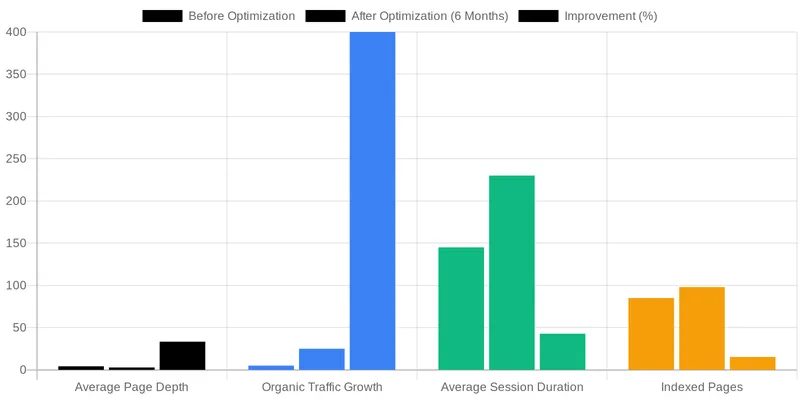
Measuring an internal linking strategy’s effectiveness is crucial for optimizing medical site performance. Tracking key metrics shows how links influence user behavior, crawl efficiency, organic rankings, and patient acquisition.
Key Metrics for Internal Link Performance
Key metrics indicate the effectiveness of internal linking. Monitoring page depth (clicks from the homepage) helps identify orphaned or deeply buried pages. Google Search Console’s “Links” report shows which pages have the most internal links. Analyzing internal link click-through rates (CTR) reveals which anchor texts and placements are most engaging. Crawl stats in Google Search Console show how efficiently Googlebot discovers and indexes pages, reflecting the impact of your link structure. Google Analytics can track user flow and engagement across linked pages, providing user experience data.
Auditing and Refining Your Linking Strategy
Regular internal link audits maintain an effective linking architecture. Audits should identify broken links, which harm user experience and SEO, and find orphaned pages (pages with no internal links), which are hard for crawlers to discover. Identifying pages with too many internal links or weak anchor text provides refinement opportunities. For medical websites, this refinement strengthens the semantic network, reinforces E-E-A-T signals, and optimizes link equity flow. Data from tools like Ruxi Data can provide automated insights for optimizing internal linking, as discussed in Leveraging Ruxi Data for Automated Topical Map Creation.
Elevate Your Medical Site’s Semantic SEO
A strategic blend of navigational and contextual links is foundational for a high-performing medical website. This approach ensures an intuitive user experience and a semantic network that signals expertise and trustworthiness to search engines. For plastic surgeons and aesthetic clinics in London, mastering internal linking is a critical component of their medical SEO services for surgeons. Expert guidance helps build a content architecture that drives patient acquisition and establishes authority.
A specialist in semantic SEO and web development can enhance your topical authority and E-E-A-T signals. Connect with Abdurrahman Şimşek today to discuss your clinic’s needs.
Frequently Asked Questions
Which link type is more important for a plastic surgeon’s SEO: navigational vs contextual links?
Both types are critical for a robust medical SEO strategy, but they serve different functions. Navigational links ensure user experience and site crawlability, while contextual links are more powerful for demonstrating expertise and building topical authority. An effective strategy balances both, recognizing that contextual links create a semantic network crucial for proving deep subject matter understanding to search engines.
How do contextual links help establish E-E-A-T for a medical practice?
Contextual links within well-researched content point to other relevant, authoritative pages on your site, forming a comprehensive knowledge base. This demonstrates a deep understanding of the subject matter, reinforcing the Expertise and Authoritativeness signals vital for YMYL topics like medical procedures. By connecting related concepts, these links show Google your practice is a reliable source of information.
What are the primary differences between navigational vs contextual links in a medical website’s structure?
Navigational links are structural elements like menus and footers, designed to help users easily move through the site’s main sections and find specific information. In contrast, contextual links are embedded within the body of content, connecting related topics and providing deeper semantic relevance. Understanding the distinct roles of navigational vs contextual links is key for optimizing both user experience and search engine comprehension.
Can automated tools help manage the balance between navigational vs contextual links?
Yes, advanced semantic SEO platforms like Ruxi Data can analyze your content network to suggest and automate the placement of relevant contextual links. This ensures you build topical authority efficiently while maintaining a clear navigational structure for users. Such tools are invaluable for optimizing the interplay between navigational vs contextual links on large medical websites.
What is the ideal anchor text for a contextual link on a clinic’s blog?
The ideal anchor text is a natural, descriptive phrase that accurately reflects the content of the linked page, providing clear context for both users and search engines. Avoid generic terms like “click here” or “read more.” Instead, use specific phrases such as “advanced rhinoplasty techniques” or “benefits of dermal fillers” to enhance relevance and user understanding.
How many contextual links should be in a 1,500-word article about a medical procedure?
There isn’t a strict rule for the exact number, but a good guideline is to include 5-10 highly relevant contextual links within a 1,500-word article. The focus should always be on quality and user value, linking to supporting articles, surgeon bios, or related procedure pages that genuinely enhance the reader’s understanding and journey. Over-linking or irrelevant links can detract from user experience and SEO value.
Ruxi Data brings together multi-model AI, automated website crawling, live indexation checks, topical authority mapping, E-E-A-T enrichment, schema generation, and full pipeline automation — from crawl to WordPress publish to social posting — all in one platform built for agencies and freelancers who run on results.