E-e-a-t Signals Medical Website: Building Trust and Authority Online
Integrating e-e-a-t signals medical website is crucial for establishing online credibility and patient trust. This article outlines a framework for embedding Experience, Expertise, Authoritativeness, and Trust into every page, vital for Your Money or Your Life (YMYL) content. Readers will learn how to satisfy Google Quality Rater Guidelines and enhance search visibility through a semantic SEO approach. Demonstrating robust E-E-A-T ensures medical websites provide accurate, reliable information, directly impacting patient acquisition and online presence.
Abdurrahman Şimşek, a Semantic SEO Strategist, specializes in building high-authority content networks for medical clinics. His expertise in semantic engineering and YMYL SEO ensures medical websites meet stringent quality standards, driving organic growth and patient engagement.
To explore your options, contact us to schedule your consultation. You can also reach us via: Book a Semantic SEO Audit, Direct WhatsApp Strategy Line: +90 506 206 86 86
A high-trust medical website is critical for plastic surgeons and aesthetic clinics in the competitive London market. Integrating e-e-a-t signals medical website is foundational. This guide explains Google’s E-E-A-T framework, its importance for Your Money or Your Life (YMYL) medical content, and provides a framework for demonstrating expertise, experience, authoritativeness, and trust to search engines and patients. A semantic SEO approach elevates a clinic’s online presence and patient acquisition.
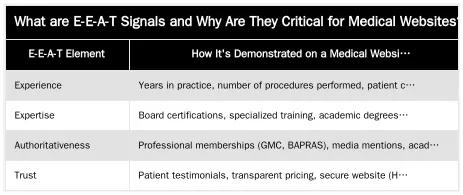
What are E-E-A-T Signals and Why Are They Critical for Medical Websites?
E-E-A-T (Experience, Expertise, Authoritativeness, and Trust) is a framework Google uses to evaluate content and website quality. It originated from Google’s Search Quality Rater Guidelines, which instruct human reviewers on assessing web pages. For medical websites, E-E-A-T is vital because it impacts patient safety and confidence, making it a primary ranking factor for health-related queries. Google prioritizes credible healthcare sources to provide users with accurate, reliable information.
Understanding YMYL: The High Stakes of Medical Content
YMYL (“Your Money or Your Life”) topics can impact a person’s health, financial stability, or safety. Medical content is a YMYL category, including advice on treatments, health information, and related financial transactions. Google applies stringent E-E-A-T standards to YMYL content to prevent misinformation. A website’s demonstrated E-E-A-T directly correlates with Google’s quality assessment for these topics, influencing search visibility.
Deconstructing E-E-A-T: Experience, Expertise, Authority, and Trust in Practice
Each E-E-A-T component establishes a medical website’s credibility: Experience is firsthand knowledge, expertise is specialized skill, authoritativeness is reputation, and trust is reliability and transparency.
Showcasing Verifiable Experience and Expertise
Experience is demonstrated by a surgeon’s years in practice, volume of procedures performed, and patient interactions. Expertise is conveyed through specialized training, board certifications, and knowledge in a medical field. ‘About Us’ pages and surgeon bios are essential for detailing these qualifications. These pages should detail educational backgrounds, fellowships, and specializations, providing evidence of a practitioner’s capabilities.
Building Authoritativeness and Undeniable Trust Signals
Authoritativeness is established by a clinic’s or practitioner’s reputation within the medical community. This includes published research, memberships in professional organizations like the General Medical Council (GMC) or British Association of Plastic, Reconstructive and Aesthetic Surgeons (BAPRAS), academic affiliations, and media mentions. Trust signals build patient confidence. These include patient testimonials, transparent pricing, GDPR compliance, and a secure website (HTTPS). Clear contact information and accessible disclaimers reinforce reliability.
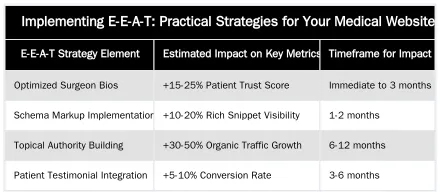
Implementing E-E-A-T: Practical Strategies for Your Medical Website
Integrating E-E-A-T signals across a medical website requires a systematic approach. These actions satisfy search engine algorithms and build confidence with patients.
Optimizing Surgeon Bios and ‘About Us’ Pages for E-E-A-T
Surgeon bios are central to demonstrating expertise and experience. Essential elements include verifiable qualifications, board certifications, specializations, and a patient philosophy. These pages should also detail professional affiliations, awards, and contributions to the medical field. ‘About Us’ pages should convey the clinic’s values, history, and team expertise. This establishes a narrative of competence and care, reinforcing the E-E-A-T signals visitors expect.
Leveraging Patient Testimonials, Reviews, and Schema Markup
Displaying patient testimonials and reviews is a powerful trust signal. These accounts provide social proof of positive patient experiences. Structured data is also critical. Implementing `Physician`, `MedicalClinic`, and `Review` schema markup communicates E-E-A-T signals to search engines. This data helps search engines understand your site’s entities, qualifications, and patient feedback, potentially leading to rich results.
Beyond the Basics: Advanced E-E-A-T with Semantic Engineering & Ruxi Data
Abdurrahman Şimşek’s approach uses Semantic SEO and advanced data methodologies to elevate E-E-A-T. This involves creating a content architecture that integrates the E-E-A-T signals a medical website needs. Entity-Attribute-Value (EAV) modeling structures information for search engines, linking medical entities (e.g., ‘Rhinoplasty’) with attributes (e.g., ‘recovery time’, ‘anesthesia type’, ‘surgeon qualifications’). This structuring reduces the ‘Cost of Retrieval’ for search engines, helping them process and rank medical content. This framework ensures all content contributes to the clinic’s authority and trust.
Building Topical Authority with Semantic Content Networks
A semantic content network using EAV modeling helps search engines understand a clinic’s expertise on medical topics. Content is interconnected by entity relationships, demonstrating comprehensive coverage. This reinforces E-E-A-T at scale, signaling to Google that the clinic is an authoritative source for its specialties. Explore a semantic content network blueprint.
Leveraging Ruxi Data for Automated E-E-A-T Signal Enhancement
Ruxi Data analyzes SERPs and entity relationships to find E-E-A-T gaps and opportunities in a medical niche. It automates content brief creation, ensuring new content contributes to the clinic’s authority. The process focuses on ‘Information Gain,’ ensuring new content provides unique insights. Structuring content around an EAV model for surgical procedures with Ruxi Data builds an online presence resilient to algorithmic shifts and prepared for Generative Engine Optimization (GEO). Information retrieval is the science of searching for information within documents and for documents themselves, as well as searching for metadata about documents and databases.
The Impact of Strong E-E-A-T: What to Expect for Your Clinic
A strong E-E-A-T strategy improves online performance and patient acquisition for medical websites. Benefits include a stronger brand reputation and preparation for search changes like Generative Engine Optimization (GEO).
Improved Organic Visibility and Patient Acquisition
Higher E-E-A-T scores correlate with better rankings in competitive queries, especially for location-specific searches like London or Harley Street. Increased visibility leads to more qualified organic traffic, as patients click on trusted sources. This generates more patient leads and consultation bookings, driving clinic growth.
Enhanced Trust and Conversion Rates
Demonstrated E-E-A-T builds patient confidence. When a website shows verifiable E-E-A-T, visitors engage more, spend more time on pages, and are more likely to book a consultation. This trust leads to lower bounce rates and higher conversion rates. A strong E-E-A-T foundation prepares a clinic for future search innovations where AI answers will rely on verifiable authority.
Secure Your Clinic’s Future: Partner with an E-E-A-T Specialist
For plastic surgeons and aesthetic clinics in the competitive London market, a specialized E-E-A-T and Semantic SEO strategy is essential. Partnering with a medical SEO expert ensures your online presence reflects your practice’s standards. Abdurrahman Şimşek offers strategies to build authority and trust. Explore Medical SEO Services for Surgeons.
Conclusion
Integrating E-E-A-T signals into a medical website is a requirement for online success. Demonstrating E-E-A-T across every page improves a clinic’s search visibility, attracts qualified patients, and builds credibility. A semantic SEO approach using EAV modeling and Ruxi Data provides a framework for maintaining online authority. Book a Semantic SEO Audit or connect via WhatsApp: +90 506 206 86 86.
Frequently Asked Questions
What are the most crucial e-e-a-t signals medical website should prioritize for a plastic surgeon?
For a plastic surgeon, the most critical signal is Expertise, demonstrated through a comprehensive ‘About the Surgeon’ page. This page must clearly list qualifications, board certifications, published research, and professional memberships, establishing the surgeon as a verifiable authority in their field. Integrating these elements effectively strengthens the overall E-E-A-T profile of a medical website.
How does the ‘Experience’ component of E-E-A-T apply to a medical website’s content?
‘Experience’ refers to demonstrating first-hand, real-world involvement, which is vital for a medical website. This can be shown through detailed case studies, patient testimonials, and content that speaks from the surgeon’s direct experience performing procedures. Showcasing practical experience builds patient trust and reinforces the site’s credibility.
Can a new clinic effectively build strong e-e-a-t signals medical website to compete in London?
Yes, a new clinic can establish strong e-e-a-t signals medical website by focusing on the surgeon’s individual credentials and investing in medically reviewed content. Showcasing early patient reviews and ensuring the website’s technical foundation is secure and professional are also key. This strategic approach helps new clinics gain trust and visibility.
How does technical SEO contribute to the overall E-E-A-T framework for a medical website?
Technical SEO directly builds Trustworthiness, a core component of E-E-A-T. A secure site (HTTPS), fast page load speeds, a clear site architecture, and the use of structured data all signal to Google that the website is professional and reliable. These technical foundations are essential for any medical website aiming for high E-E-A-T.
Why are external links and citations crucial for enhancing e-e-a-t signals medical website?
External links from reputable medical journals, hospital websites, and professional organizations are extremely important. They serve as powerful external validations of your expertise and authority, which are core E-E-A-T signals that Google’s algorithms are designed to evaluate. These citations significantly boost the credibility of a medical website.
How can I begin integrating E-E-A-T strategies for my London medical clinic?
To start enhancing your clinic’s online presence with E-E-A-T, consider a specialized Semantic SEO Audit. This audit identifies specific areas for improvement and outlines a tailored strategy for your medical website. You can book a Semantic SEO Audit directly or contact Abdurrahman Şimşek via WhatsApp at +90 506 206 86 86 for immediate guidance.
Ruxi Data brings together multi-model AI, automated website crawling, live indexation checks, topical authority mapping, E-E-A-T enrichment, schema generation, and full pipeline automation — from crawl to WordPress publish to social posting — all in one platform built for agencies and freelancers who run on results.