
Entity-attribute-value SEO: Enhancing Medical Procedure Visibility
Entity-attribute-value seo leverages the EAV data model to significantly improve semantic understanding for complex surgical procedures, particularly within the London private healthcare market. This structured data approach organizes medical content into clear Entities, Attributes, and Values, enabling search engines to interpret specialized information more effectively. By implementing EAV, medical practices enhance their topical authority and search relevance, aligning with Google’s E-E-A-T guidelines for YMYL content. This method moves beyond basic keyword matching, building a robust semantic foundation for procedure markup and knowledge graph integration.
Abdurrahman Şimşek, a Semantic SEO Strategist specializing in medical clinics, applies EAV modeling to build high-authority semantic content networks. His expertise in information architecture and medical schema ensures precise data organization, crucial for YMYL content in competitive healthcare markets.
To explore your options, contact us to schedule your consultation.
Entity-attribute-value seo uses the Entity-Attribute-Value (EAV) data model to enhance semantic understanding for complex surgical procedures. EAV improves a clinic’s online authority and search presence, particularly in the London private healthcare market. This structured data approach helps search engines interpret and present specialized medical information to prospective patients.
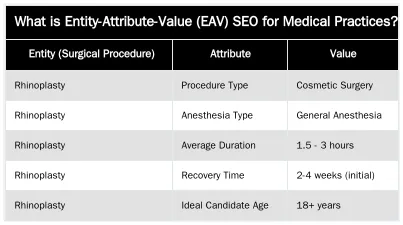
What is Entity-Attribute-Value (EAV) SEO for Medical Practices?
The entity-attribute-value seo model is a structured data approach that organizes complex information into Entities, Attributes, and Values, allowing search engines to process detailed medical content more effectively. For a medical practice, an ‘Entity’ is a concept like a surgical procedure. ‘Attributes’ are its properties, and ‘Values’ are the data for those attributes.
For example, ‘Rhinoplasty’ is the Entity. Its Attributes include ‘Recovery Time’, ‘Anesthesia Type’, ‘Procedure Duration’, and ‘Ideal Candidate’. The corresponding Values are ‘2-4 weeks’, ‘General Anesthesia’, ‘1-3 hours’, and ‘Individuals seeking nasal reshaping’. This granular structure helps search engines move beyond keyword matching to semantic comprehension of medical services.
Why is EAV Modeling Crucial for Surgical Procedure SEO?
EAV modeling is advantageous for medical SEO, especially for YMYL (Your Money Your Life) topics like surgical procedures. Google’s Knowledge Graph uses structured data to interpret and rank medical information. By organizing content with EAV, clinics give search engines explicit signals about their services. This improves topical authority, search relevance, and the user experience for patients researching procedures.
In the London private healthcare market, EAV helps clinics stand out. It ensures Google can match a query like “facelift recovery time Harley Street” with accurate, authoritative information. This approach builds a semantic foundation beyond keyword optimization.
Navigating YMYL & E-E-A-T with Structured Data
Google’s E-E-A-T (Experience, Expertise, Authoritativeness, Trustworthiness) guidelines are critical for YMYL content, including medical information. EAV modeling supports E-E-A-T by providing verifiable, structured data about procedures, their characteristics, and the professionals performing them. When a clinic defines an entity like ‘Breast Augmentation’ with attributes like ‘Surgeon Qualifications’ and provides specific values, it signals expertise and trustworthiness. This helps Google confirm the information’s accuracy, which is essential for ranking in medical search results. For details on medical schema, see medical schema for surgeons.
Implementing EAV: Defining Entities, Attributes, and Values for Procedures
To implement EAV, first identify core entities. For a plastic surgery clinic, entities are procedures like ‘Breast Augmentation’, ‘Facelift’, or ‘Liposuction’. Next, determine attributes for each entity, such as ‘Anesthesia Type’, ‘Procedure Duration’, ‘Ideal Candidate’, ‘Recovery Time’, ‘Potential Risks’, or ‘Cost Range’. Finally, assign specific values. For example, ‘Breast Augmentation’ (Entity) has ‘Anesthesia Type’ (Attribute) with the value ‘General Anesthesia’.
This structured data can be translated into Schema Markup using types like MedicalProcedure or Service. Schema.org provides a vocabulary to describe entities and their properties in a machine-readable format. This markup helps search engines understand your services, display rich results, and answer direct user queries.
Mapping Surgical Procedures to Schema Markup
Translating EAV to Schema.org involves selecting appropriate types and properties. For surgical procedures, `MedicalProcedure` is a primary type, with properties like `procedureType`, `bodyLocation`, `preparation`, `recoveryTime`, and `outcome`. The `Service` schema can also describe the offering. For example, the ‘Liposuction’ entity can be marked up as a `MedicalProcedure`, mapping its ‘Anesthesia Type’ attribute to the `anesthesia` property and its ‘Procedure Duration’ attribute to `expectedDuration`. This mapping gives search engines clear data, strengthening the semantic understanding of your content. For a comprehensive guide, see Medical Schema for Surgeons.
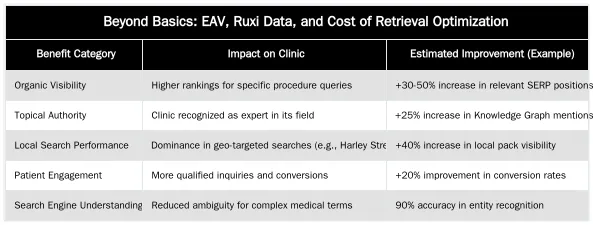
Beyond Basics: EAV, Ruxi Data, and Cost of Retrieval Optimization
Advanced EAV applications form the backbone of semantic content networks. With over 10 years of experience in semantic engineering, Abdurrahman Şimşek uses EAV modeling to optimize for ‘Cost of Retrieval’ (CoR). CoR is the efficiency with which search engines can process, understand, and present information. Precise EAV modeling reduces ambiguity for search algorithms, making it more efficient for them to retrieve and rank a clinic’s content. This is vital for medical clinics in London, where search engines prioritize clear, authoritative data.
Integrating EAV with systems like Ruxi Data enhances this process. Ruxi Data, a semantic infrastructure, uses EAV principles to create an interconnected, contextually rich knowledge base. This integration allows for dynamic content generation and ensures information about a surgical procedure is consistently understood and linked across your digital ecosystem. This semantic precision is a feature of high-authority medical SEO strategies.
The Role of Entity Reconciliation in EAV Precision
Entity reconciliation is a refinement process in EAV modeling that identifies and merges different representations of the same entity across data sources. For a medical clinic, this means ensuring ‘Rhinoplasty’ is recognized as the same entity on your website, in patient management systems, and in external directories. This process prevents ambiguity, resolves data discrepancies, and strengthens the EAV model’s effectiveness for SEO. By unifying the understanding of each entity, entity reconciliation enhances accuracy and trustworthiness signals sent to search engines, solidifying your clinic’s topical authority. Learn more in our guide to entity reconciliation for SEO.
The Impact of EAV SEO: Elevating Your Clinic’s Digital Presence
An EAV strategy improves organic visibility and rankings for procedure-related queries for plastic surgeons and aesthetic clinics. This structured approach helps search engines understand your services, resulting in more relevant search results and increased qualified patient inquiries. For clinics in competitive areas like Harley Street, EAV enhances local search performance by providing precise, location-specific data.
EAV modeling establishes your clinic as an authority. By defining and interlinking medical entities, you build a knowledge base that Google recognizes as trustworthy and expert. This semantic work fosters long-term digital growth and positions your practice in medical search.
Conclusion
The Entity-Attribute-Value (EAV) model is a framework for structuring complex medical information, offering advantages for surgical procedure SEO. By defining entities, attributes, and values, medical practices can enhance search engine understanding, improve topical authority, and meet E-E-A-T requirements. This approach is effective for clinics in competitive markets like London. Implementing EAV, especially when integrated with strategies like Ruxi Data and Cost of Retrieval optimization, improves organic visibility, rankings, and qualified patient inquiries. EAV modeling is an investment in a clinic’s long-term digital success and semantic authority. For more on EAV modeling, explore our Entity-Attribute-Value (EAV) Modeling for Surgical Procedures: A Practical Guide.
Frequently Asked Questions
What is entity-attribute-value seo for medical practices?
The entity-attribute-value seo model organizes complex medical information into Entities, Attributes, and Values. This structured approach allows search engines to process detailed content more effectively, enhancing their understanding of surgical procedures and improving visibility. It helps position your clinic as a trusted source for specific medical queries.
How does using an EAV model benefit my clinic’s website’s search performance?
This data model translates your complex medical services into a structured language Google’s AI can easily understand and trust. It significantly improves your chances of appearing in rich results, AI Overviews, and establishing your site as a leading authority in the London private healthcare market. This leads to increased organic traffic from highly relevant patient searches.
Can you give a simple example of EAV for a ‘Facelift’ procedure?
Certainly. The Entity would be ‘Facelift’. Attributes could include ‘Procedure Time’, ‘Ideal Candidate Age’, and ‘Incision Locations’. The Values would be the specific details for each attribute, such as ‘3-4 hours’, ’45-65 years’, and ‘Around the ear’, providing granular detail for search engines.
Is entity-attribute-value seo the same as just having an FAQ section on my page?
No, while FAQs are helpful for human users, entity-attribute-value seo is implemented in the website’s code using schema markup. It’s a machine-readable format designed specifically for search engines to enhance semantic understanding. This allows search engines to interpret the relationships between medical concepts more deeply than plain text.
Do I need to be a data scientist to implement entity-attribute-value seo?
While the concept is rooted in data science, a specialist Semantic SEO consultant like Abdurrahman Şimşek can handle the technical implementation of entity-attribute-value seo. Your crucial role as a surgeon is to provide accurate medical facts (the ‘Values’), which the SEO expert then structures into the EAV model for optimal search engine interpretation.
How can I get started with implementing this strategy for my clinic?
To begin leveraging this advanced SEO strategy for your medical clinic, you can contact Abdurrahman Şimşek for a consultation. As a London-based Semantic SEO Strategist, he specializes in building high-authority Semantic Content Networks for medical clinics. You can reach out via the contact form on his website to discuss your specific needs and how this model can benefit your practice.
Ruxi Data brings together multi-model AI, automated website crawling, live indexation checks, topical authority mapping, E-E-A-T enrichment, schema generation, and full pipeline automation — from crawl to WordPress publish to social posting — all in one platform built for agencies and freelancers who run on results.