
EAV SEO Model: Semantic Data Architecture for Medical SEO
The eav seo model provides a robust data architecture for organizing complex medical information, particularly surgical procedures. This framework breaks down content into entities, attributes, and values, enabling precise semantic understanding for search engines. Implementing an Entity-Attribute-Value approach transforms how medical procedure data is structured, enhancing information retrieval and building definitive topical authority. This method is crucial for medical practices aiming to establish a strong knowledge graph and improve search visibility for intricate healthcare topics.
Abdurrahman Şimşek, a Semantic SEO Strategist, specializes in leveraging EAV modeling to construct high-authority semantic content networks for medical clinics. His expertise in semantic engineering and information retrieval optimizes complex medical datasets for superior search performance.
To explore your options, contact us to schedule your consultation.
In the complex digital landscape of private healthcare, establishing robust topical authority is paramount. This article delves into the eav seo model, a powerful data architecture that enables precise organization and semantic understanding of intricate medical information. Discover how Entity-Attribute-Value (EAV) can transform your content strategy, enhance search engine visibility, and build an unassailable knowledge graph for surgical procedures. This approach is critical for medical practices aiming to be definitive sources of truth online.
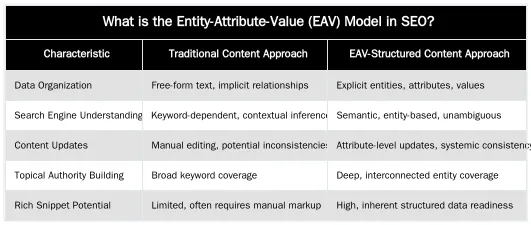
What is the Entity-Attribute-Value (EAV) Model in SEO?
The Entity-Attribute-Value (EAV) model is a data structure that organizes information by breaking it down into three fundamental components: entities, their attributes, and the corresponding values. This flexible framework is particularly effective for managing complex, sparse, or evolving datasets, such as those found in medical procedure data. For search engines, EAV provides a clear, unambiguous way to understand the characteristics and relationships of specific topics, moving beyond simple keyword matching to deep semantic comprehension.
EAV Explained: Entity, Attribute, Value Components
In the context of semantic SEO, an Entity represents a distinct concept or object, such as a specific surgical procedure, a medical condition, or a clinic location. An Attribute describes a characteristic or property of that entity. For instance, a surgical procedure entity might have attributes like “Anesthesia Type,” “Recovery Time,” or “Potential Risks.” The Value is the specific data point associated with an attribute for a given entity. This granular breakdown allows for precise content configuration and information retrieval.
A Practical EAV Example: Rhinoplasty Procedure Data
Consider the medical procedure ‘Rhinoplasty’. Using an EAV approach, ‘Rhinoplasty’ is the Entity. Its attributes could include ‘Anesthesia Type’, ‘Average Procedure Duration’, ‘Typical Recovery Time’, ‘Ideal Candidate Profile’, ‘Associated Risks’, and ‘Post-Operative Care Instructions’. The values for these attributes would be specific details: ‘General Anesthesia’ or ‘Local with Sedation’ for ‘Anesthesia Type’; ‘2-4 hours’ for ‘Average Procedure Duration’; ‘1-2 weeks for initial swelling’ for ‘Typical Recovery Time’; and so forth. This structured data makes the procedure’s characteristics immediately clear to search engines.
How Does EAV Elevate Semantic SEO for Medical Procedures?
The EAV framework fundamentally transforms semantic SEO by enabling search engines to move beyond superficial keyword matching. For medical content, where precision and accuracy are paramount, this data model allows for the disambiguation of terms and the establishment of definitive information. Medical SEO faces unique challenges, including the need for clinical accuracy, the complexity of medical terminology, and the critical importance of Your Money Your Life (YMYL) guidelines. EAV addresses these by providing a structured foundation for content.
Structuring Clinical Accuracy and Detail
EAV ensures that every piece of medical information, from the type of incision to post-operative care, is precisely defined and linked to its relevant entity. This meticulous structuring is crucial for YMYL content, where misinformation can have serious consequences. By explicitly stating attributes and values, medical websites can present facts in a way that minimizes ambiguity, enhancing trust and demonstrating expertise. This level of detail supports comprehensive coverage, which is a key signal for search engines evaluating content quality.
Beyond Keywords: Building Topical Authority with EAV
An EAV-driven approach facilitates the creation of a robust semantic content network. Instead of merely repeating keywords, content built on an entity attribute value model systematically covers all relevant facets of a medical topic. This holistic understanding signals to search engines that a website is a comprehensive and authoritative source. For example, a plastic surgery clinic detailing every attribute of a ‘Facelift’ procedure, including variations, recovery, and candidacy, builds deep topical authority around cosmetic facial surgery. This structured depth improves information retrieval and positions the site as a knowledge graph optimization leader.
Implementing EAV: Structured Data, Knowledge Graphs & Ruxi Data
The conceptual framework of EAV finds its practical application in structured data, particularly through Schema.org markup. By translating entities, attributes, and values into standardized vocabularies, websites can directly communicate their underlying data model to search engines. This structured information then contributes to the search engine’s Knowledge Graph, enhancing visibility in rich results and improving overall understanding of the site’s content. For medical clinics, this implementation is a cornerstone of advanced semantic strategy.
Mapping EAV to Schema.org for Medical Entities
EAV components translate directly into Schema.org types and properties. For a ‘SurgicalProcedure’ entity, attributes like ‘procedureType’, ‘medicalSpecialty’, ‘bodyLocation’, ‘recoveryTime’, and ‘risks’ can be marked up using specific Schema.org properties. For example, ‘Rhinoplasty’ (Entity) would be marked as `MedicalProcedure`, with ‘Anesthesia Type’ (Attribute) as `drug` or `procedureType` with a specific value. This precise mapping ensures that search engines interpret medical content accurately. For a deeper dive into specific implementations, explore medical schema for surgeons.
Leveraging Ruxi Data for Advanced Semantic Infrastructure
Managing complex EAV models for extensive medical content requires specialized tools. Ruxi Data provides a robust platform for building and maintaining this advanced semantic infrastructure. It facilitates the systematic extraction, organization, and deployment of entity-attribute-value data, ensuring consistency and scalability across a medical website. By integrating Ruxi Data, clinics can automate the generation of structured content, maintain clinical accuracy, and significantly enhance their content configuration capabilities, leading to superior data retrieval and semantic performance.
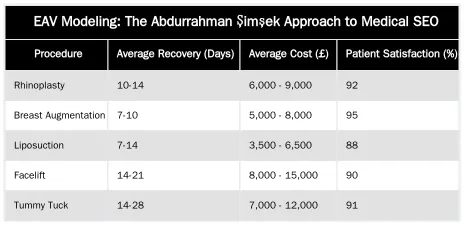
EAV Modeling: The Abdurrahman Şimşek Approach to Medical SEO
Abdurrahman Şimşek specializes in applying sophisticated EAV modeling to create high-authority semantic content networks for medical clinics, particularly plastic surgeons and aesthetic practices in London and Harley Street. This approach integrates advanced methodologies, ensuring that medical websites not only rank but also serve as definitive sources of truth. With over a decade of experience in semantic engineering, Abdurrahman Şimşek leverages a deep understanding of information retrieval to optimize digital presence for complex medical niches.
Optimizing Cost of Retrieval (CoR) with EAV
Efficient EAV structures significantly reduce the ‘Cost of Retrieval’ (CoR) for search engines. CoR refers to the computational effort required for a search engine to understand, process, and retrieve relevant information from a webpage. By presenting medical data in a clear, structured, entity-attribute-value format, websites make it easier and faster for algorithms to parse content. This efficiency can lead to improved indexing, better ranking signals, and ultimately, enhanced visibility for critical medical procedures. This strategic optimization is a hallmark of advanced medical SEO.
Python for SEO: Automating EAV Content Configuration
Leveraging Python for SEO is central to automating the generation and management of EAV-driven content. Python scripts can extract data from various sources, structure it into EAV models, and then generate Schema.org markup or even entire content sections. This automation ensures scalability, accuracy, and consistency across vast amounts of medical information, which is vital for large clinics or those offering numerous procedures. This programmatic approach to content configuration, detailed further in Content Configuration for Clinical Accuracy, allows for rapid deployment and updates of clinically accurate content.
The Impact of EAV on AI Overviews and Future Search
The evolving search landscape, characterized by the rise of AI Overviews and generative AI, places an even greater premium on structured, entity-rich data. EAV modeling positions medical content favorably for these advanced information retrieval systems. Generative AI models, which synthesize information to answer complex queries, rely heavily on clearly defined entities and their relationships. Websites that meticulously structure their medical data using an entity attribute value approach are more likely to be recognized as authoritative sources by these intelligent systems.
Becoming a Definitive Source for Generative AI
Well-structured EAV data makes content highly consumable for AI models. When a website presents information about a surgical procedure with clear entities, attributes, and values, it provides the precise data points that generative AI needs to formulate accurate and comprehensive answers. This makes the content more likely to be cited, summarized, or directly used in AI Overviews, establishing the medical practice as a definitive source of truth in a YMYL niche. This is crucial for maintaining visibility as search evolves.
Future-Proofing Medical SEO with Semantic Engineering
Implementing an EAV-based semantic engineering strategy is a proactive measure for future-proofing medical SEO. As search algorithms become more sophisticated and rely less on keywords and more on semantic understanding, websites with robust entity graphs will maintain their authority. This approach ensures adaptability to future changes in how search engines process and present information, securing long-term visibility and trust for medical practices. Building a semantic content network with EAV is an investment in enduring digital relevance.
Conclusion
The Entity-Attribute-Value (EAV) model represents a fundamental shift in how medical content can be organized and optimized for search engines. By providing a clear, structured framework for complex information, the eav seo model enhances semantic understanding, builds robust topical authority, and positions medical practices as trusted sources of truth. Implementing this data architecture through structured data and specialized tools like Ruxi Data is essential for navigating the evolving landscape of AI-driven search. For plastic surgeons and aesthetic clinics seeking to establish a dominant online presence, embracing EAV is a strategic imperative. To explore how this advanced semantic engineering can transform your practice’s digital footprint, consult with Abdurrahman Şimşek today.
Frequently Asked Questions
Can you give a simple EAV example for ‘Rhinoplasty’?
For ‘Rhinoplasty’, the Entity is the procedure itself. Attributes could include ‘Anesthesia Type’, ‘Recovery Time’, ‘Procedure Cost’, and ‘Ideal Candidate’. The corresponding Values for ‘Anesthesia Type’ might be ‘General’ or ‘Local with Sedation’, providing precise data points for each characteristic. This structured approach helps search engines categorize and understand the procedure comprehensively.
How is the eav seo model physically implemented on a webpage?
It’s implemented through a combination of structured content and structured data. The content is organized using clear headings (Attributes) and concise text (Values), often presented in tables or lists for readability. This approach, central to the eav seo model, is then reinforced with MedicalProcedure JSON-LD schema that explicitly defines these relationships for search engines, enhancing machine understanding.
What is the primary benefit of using an EAV data structure for a surgeon’s website?
The primary benefit is unparalleled clarity and precision in data representation. This data structure transforms ambiguous prose into a machine-readable format, leaving no room for misinterpretation by search engines. Such precision is vital for high-stakes YMYL (Your Money Your Life) topics and for effectively feeding Google’s Knowledge Graph with accurate information about medical procedures.
Is the eav seo model difficult to scale across many procedures?
Manually, scaling the eav seo model across many procedures can be challenging due to the volume of data. However, automation platforms like Ruxi Data are specifically designed to streamline this process. By defining a template for a procedure entity, the system can programmatically generate EAV structures for numerous different treatments, ensuring consistency and efficient scalability across your entire service offering.
Does using an eav seo model guarantee better rankings?
No single tactic guarantees specific rankings, as SEO involves many factors. However, implementing an eav seo model provides a superior data structure that helps search engines understand your content more deeply and accurately. This significantly increases your chances of ranking for specific, long-tail queries and being featured prominently in rich results and AI Overviews.
How can medical practices begin implementing this data modeling approach?
Medical practices interested in leveraging this advanced data modeling approach should consult with a specialized semantic SEO strategist. Abdurrahman Şimşek offers strategic consulting to integrate EAV principles and Ruxi Data infrastructure, tailored specifically for medical clinics. You can learn more and schedule a consultation via his website to discuss a bespoke strategy for your practice.
Ruxi Data brings together multi-model AI, automated website crawling, live indexation checks, topical authority mapping, E-E-A-T enrichment, schema generation, and full pipeline automation — from crawl to WordPress publish to social posting — all in one platform built for agencies and freelancers who run on results.