
CDN Ddos Protection: Safeguarding Websites Against Cyber Threats
CDN DDoS protection is crucial for maintaining website availability and trust against Distributed Denial of Service attacks. This article explains how Content Delivery Networks (CDNs) act as a primary defense, absorbing and dispersing malicious traffic across a global network before it reaches the origin server. CDNs employ advanced features like web application firewalls (WAF), IP masking, rate limiting, and bot mitigation to filter harmful requests. Implementing these network security measures ensures continuous uptime and protects digital assets from overwhelming traffic floods.
Abdurrahman Şimşek, a London-based Semantic SEO Strategist and Web Developer, provides expertise in building resilient digital infrastructures. His 10+ years of experience in semantic engineering and technical web development ensure websites, particularly for medical clinics, maintain optimal performance and robust network security.
To explore your options, contact us to schedule your consultation. You can also reach us via: Book a Semantic SEO Audit, Direct WhatsApp Strategy Line: +90 506 206 86 86
Distributed Denial of Service (DDoS) attacks threaten website availability and trust, making cdn ddos protection essential. Content Delivery Networks (CDNs) are a first line of defense against these disruptions, safeguarding websites and ensuring continuous service.
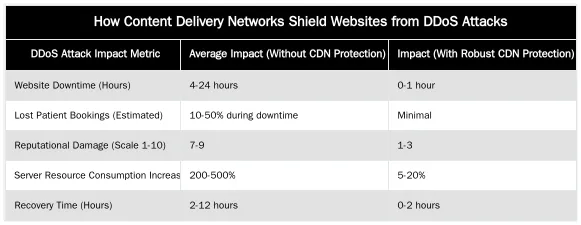
How Content Delivery Networks Shield Websites from DDoS Attacks
A Content Delivery Network (CDN) provides DDoS protection by acting as a distributed shield for your origin server. It absorbs and disperses malicious traffic from a DDoS attack across its global network, preventing the flood of requests from reaching and overwhelming your web server.
With a CDN, incoming traffic is routed through its edge servers. During a DDoS attack, these servers identify and filter malicious requests, allowing only legitimate traffic to reach the origin. This buffer prevents the attack from consuming the origin server’s resources and causing downtime. A CDN’s scale allows it to handle traffic volumes that would overwhelm a single origin server.
For London clinics, uninterrupted access to online booking systems and patient information is paramount. Implementing advanced caching and CDN strategies for London clinics builds a resilient digital infrastructure.
Beyond the Basics: How CDNs Architect DDoS Defense
A CDN’s architecture provides DDoS mitigation. Unlike a single origin server, a single point of failure, a CDN uses a globally distributed network. Attack traffic is spread across its points of presence (PoPs) instead of converging on one target. This dispersal dilutes the attack’s impact, making it difficult to overwhelm the network.
CDNs employ traffic scrubbing, analyzing incoming requests in real-time to distinguish legitimate traffic from malicious bot activity. Suspicious requests are filtered, blocked, or challenged, while valid requests pass through. Intelligent routing enhances this defense by directing traffic away from congested or attacked nodes, ensuring content availability from healthy servers. This protects against both network-layer attacks, which exhaust network bandwidth, and application-layer attacks, which target web application vulnerabilities.
Global Network Distribution and Traffic Scrubbing
A CDN’s global network distribution is its primary strength against DDoS attacks. With servers located worldwide, a CDN can absorb high volumes of malicious traffic close to its source, preventing it from reaching the origin server. During an attack, the CDN scales its resources across its network to distribute the load. Traffic scrubbing inspects each data packet for known attack signatures or anomalous behavior. Malicious packets are dropped, while clean traffic is forwarded to the origin. This filtering keeps the website accessible to legitimate users during an attack.
Key CDN Features for DDoS Mitigation
Effective DDoS protection relies on specialized features within a content delivery network that extend beyond basic traffic distribution to offer granular control and threat detection.
Web Application Firewalls (WAF) and IP Masking
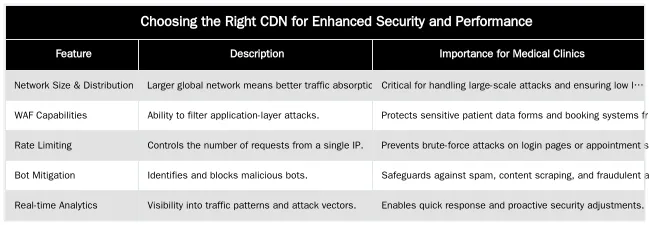
A Web Application Firewall (WAF) operates at the application layer (Layer 7 of the OSI model), inspecting HTTP/HTTPS traffic for malicious patterns indicating web vulnerabilities like SQL injection, cross-site scripting (XSS), and application-layer DDoS attacks. The WAF acts as a reverse proxy between the internet and the origin server, filtering threats before they exploit application weaknesses. IP masking is another security benefit of a CDN. By routing traffic through its network, the CDN hides the origin server’s IP address. This makes it harder for attackers to target the server directly, forcing them to contend with the CDN’s infrastructure. This combination of application-layer filtering and origin concealment provides protection.
Rate Limiting and Advanced Bot Mitigation
Rate limiting controls the number of requests a single client can make to a server in a specified timeframe. This prevents brute-force attacks, like attempts to guess login credentials or overwhelm endpoints with high request volumes. By setting thresholds, the CDN blocks or challenges clients exceeding normal request rates, preserving server resources. Advanced bot mitigation complements rate limiting. Malicious bots engage in activities like credential stuffing, content scraping, and DDoS attacks. CDNs use behavioral analysis, machine learning, IP reputation databases, and CAPTCHAs to identify and block these automated threats, ensuring only legitimate users interact with the website.
Why DDoS Protection is Crucial for Medical Website Uptime & Trust
For medical clinics, especially in YMYL (Your Money Your Life) niches like plastic surgery and aesthetic medicine in London, website uptime and security are critical. A DDoS attack impacts patient trust, operational continuity, and revenue. Abdurrahman Şimşek, with 10+ years of experience in semantic engineering and medical SEO, notes that DDoS mitigation is part of the infrastructure for a trustworthy online presence. This contributes to a clinic’s E-E-A-T (Experience, Expertise, Authoritativeness, Trustworthiness) signals, critical for ranking in medical search.
Protecting Patient Trust and Service Continuity
DDoS-induced downtime erodes patient trust. If patients in London cannot access a clinic’s website to book appointments or view information, it creates frustration and a perception of unreliability. For Harley Street clinics, this disruption can cause patient loss and damage the clinic’s reputation. A secure, consistently online website signals reliability, reinforcing patient trust. This continuity supports a successful Harley Street SEO strategy.
DDoS Mitigation and Cost of Retrieval Optimization
DDoS protection aligns with ‘Cost of Retrieval’ optimization. During an attack, an origin server expends resources on malicious requests, increasing server load, slowing response times, and raising operational costs. A CDN reduces the origin server’s burden by offloading and filtering this traffic. This allows efficient processing of legitimate requests, minimizing the resources Googlebot needs to crawl and index the site. Reducing the ‘Cost of Retrieval’ improves user performance and optimizes the crawl budget, important for large medical websites. Learn more about reducing Cost of Retrieval for efficient medical website performance.
Choosing the Right CDN for Enhanced Security and Performance
Selecting a CDN requires consideration, especially for DDoS protection. Not all CDNs offer the same level of security features or network capacity. For medical clinics, where data integrity and continuous service are paramount, prioritizing security over basic caching is essential. Evaluate a CDN provider’s global footprint, security offerings, and ability to handle various DDoS attacks.
Free CDNs often provide only basic protection and may lack the advanced features, security teams, and network infrastructure of premium solutions. For YMYL websites, relying on a free CDN for DDoS protection is not advisable. A solution should offer a layered defense against multi-vector attacks. This investment supports website health and a medical SEO services for surgeons strategy.
Evaluating CDN Providers for Medical Website Security
When evaluating CDN providers, medical clinics should prioritize those with a security track record. Look for providers with DDoS protection, including WAF, rate limiting, and bot mitigation. Inquire about their network capacity, ability to absorb large-scale attacks, and incident response times. Consider their compliance with healthcare data privacy regulations like GDPR. A CDN with detailed security analytics and reporting provides insights for proactive defense. The right CDN partner enhances performance and security.
Secure Your Digital Presence: Partner with an SEO Expert
DDoS protection via a CDN is a component of a web strategy that safeguards your online presence, ensures service continuity, and reinforces trust. Security is one aspect of a high-performing website; a complete approach includes technical SEO, semantic architecture, and audience understanding.
Abdurrahman Şimşek specializes in semantic content networks for medical clinics, skin clinics, and plastic surgeons in London. His expertise ensures your website is secure and optimized for search engines to drive patient acquisition. For a secure, performant, and optimized digital presence, contact us.
Conclusion
Content Delivery Networks provide a layer of defense against DDoS attacks. By distributing traffic, scrubbing malicious requests, and offering security features like WAFs and rate limiting, CDNs ensure website uptime and protect online assets. For medical clinics, this protection maintains patient trust, ensures service continuity, and upholds E-E-A-T signals necessary for success in the YMYL sector. DDoS mitigation is a strategic investment in digital reputation and operational resilience.
To improve your website’s security and search performance, Book a Semantic SEO Audit with Abdurrahman Şimşek to develop a strategy for your clinic. Direct WhatsApp Strategy Line: +90 506 206 86 86.
Frequently Asked Questions
How does cdn ddos protection work to safeguard websites?
A CDN provides cdn ddos protection by distributing incoming traffic across its global network, acting as a massive shield. It absorbs and filters malicious requests, preventing them from overwhelming your origin server and ensuring continuous website availability. This distributed approach effectively mitigates large-scale attacks.
What specific features contribute to effective cdn ddos protection?
Effective mitigation against distributed denial-of-service attacks relies on features like global traffic distribution, intelligent rate limiting, and advanced bot detection. These capabilities allow the network to identify and block malicious traffic before it reaches your server, maintaining site performance and security. Web Application Firewalls (WAFs) also play a crucial role in filtering application-layer threats.
Is the level of cdn ddos protection offered by free CDN plans sufficient for medical clinics?
For many small to medium-sized clinics, the unmetered DDoS mitigation included in free CDN plans from providers like Cloudflare is remarkably robust. It effectively protects against most common volumetric attacks, maintaining website availability. Paid plans typically offer more advanced features for sophisticated application-layer attacks and greater customization.
How does a CDN help hide my website’s origin server for enhanced security?
A key security benefit of using a CDN is IP masking. All website traffic is routed through the CDN’s IP addresses, effectively concealing the true IP address of your origin server. This makes it significantly harder for attackers to directly target your server, enhancing overall security and resilience against direct attacks.
Why is robust protection against DDoS attacks crucial for medical and plastic surgery websites?
For high-value services like plastic surgery, consistent website uptime is crucial for patient trust and revenue generation. If potential patients cannot access your site to research procedures or book consultations, they will quickly turn to competitors. Robust denial-of-service attack protection is therefore essential to prevent significant reputational and financial damage.
How can I learn more about securing my medical website with advanced SEO strategies?
To explore comprehensive strategies for securing and optimizing your medical website, including robust defenses against cyber threats, consider a Semantic SEO Audit. You can book a consultation directly through our website at abdurrahmansimsek.com/contact/ or reach out via WhatsApp at +90 506 206 86 86 for personalized guidance from Abdurrahman Şimşek.
Ruxi Data brings together multi-model AI, automated website crawling, live indexation checks, topical authority mapping, E-E-A-T enrichment, schema generation, and full pipeline automation — from crawl to WordPress publish to social posting — all in one platform built for agencies and freelancers who run on results.